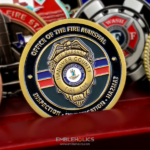
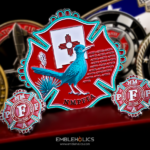
This coin carries a year on it. The front has the WSCFF insignia, IAFF Local 3219 and the 86th Annual Convention mark; the reverse has a firefighter cross with “Wash State 2025” and the date. For a coin made for one specific gathering, fixing it in time is the entire point, and that is a decision worth examining because for most coins it would be the wrong one.
When to Put a Date on a Coin
This comes up on nearly every order and the answer splits cleanly in two.
Date it when the coin is about an occasion. A convention, an anniversary, a deployment, a single ceremony. These coins exist to mark a moment, and without the date the object loses the thing it was made to record. Somebody finding it in a drawer in fifteen years should be able to tell which one it was.
Do not date it when the coin is about an identity. A unit coin, a department coin, a commander’s presentation coin. These are issued continuously, and a date either makes the coin look like old stock or forces a reorder every year. A standing organization’s coin should still be correct in five years.
Two practical consequences follow from choosing to date.
You are committing to the quantity. Leftovers from a dated coin cannot be carried into next year. That argues for ordering to the attendance figure rather than generously, which is the opposite of the advice for an undated coin.
And scarcity becomes a feature. A coin that exists only for one year is collectible in a way a standing coin is not. For an annual event, people who attend several end up with a run of them, and that series is worth more to them than any single piece. It is a good reason to keep the format consistent year to year and change only the date and the number.
For a coin marking a milestone rather than an annual event, see a fire department anniversary coin and a 100 year challenge coin.
Contemporary Shapes, Traditional Devices
The client asked for a conservative, typical coin: round and standard sized. The styling inside that outline is contemporary, built from straightforward lines and simple geometric shapes, with the logo and insignia as the exceptions.
That combination is more deliberate than it sounds. A round coin of ordinary size is the format everybody recognizes, so it carries no risk and no surprise. The modern treatment then sits safely inside it, because the overall object still reads as a coin rather than as a design exercise.
Leaving the insignia untouched is the other half of it. Official devices are the one element that should not be restyled to match a contemporary scheme, both because they are usually governed by the organization and because their familiarity is what makes them work. A coin where the geometry is modern and the emblems are exactly as they always are gets the benefit of both.
The reverse works the other way around: a firefighter cross, which is as traditional as the fire service gets, with the year beneath it. Classic, clean, and the element the whole convention will recognize.
Durable Paint on an Event Coin
The paint on this coin is specified for durability, which matters more on an event piece than people expect.
An event coin has an unusual life. It is handed out in a crowd, goes straight into a pocket alongside keys and a phone for three days, gets passed around tables, and then sits somewhere for years. That is a harder first week than most coins ever see.
Two things protect it. High quality enamel resists chipping at the edges of each color cell, which is where damage starts. And an epoxy coating over the painted areas adds a clear protective layer, which is worth specifying on any coin that will be carried loose rather than kept in a capsule.
It is also worth ordering a few spares beyond the headcount for exactly this reason. A dated coin cannot be reordered cheaply later, and a handful of replacements costs very little at the margin. See enamel and coating options.
About the Convention
The Washington State Council of Fire Fighters held its 86th Annual Convention from 24 to 26 June 2025 at the Tulalip Resort Casino in Marysville, Washington. It was hosted by IAFF Local 3219, which has around 155 members drawn from three departments across Snohomish County and San Juan County.
At the convention, delegates from affiliated local unions meet to discuss and set the council’s goals and to elect its officers. That structure, delegates from many locals convening once a year, is what makes an event coin work here: the people in the room come from different departments and will not all be together again until next year.
See more event challenge coins, a firefighters association coin and firefighter challenge coins.
Order a Coin for Your Event
Professional artwork is free with unlimited revisions, and nothing goes into production until you approve a digital proof. The challenge coin minimum is 50 pieces, standard production runs about 45 to 50 days after final artwork approval, rush production is available on many projects, and shipping within the continental United States is included. Embleholics is veteran-owned, SDVOSB and registered in SAM.gov.
Two things to plan for. Work back from the event date: allow about 45 to 50 days of production after final artwork approval, plus the artwork and proof rounds before that, and remember an event date does not move. And if this will be an annual coin, keep the layout fixed and change only the year and the number, so attendees who come back build a series rather than a collection of unrelated pieces. Request a free quote to begin.
Frequently Asked Questions
What is a dated challenge coin?
It is a coin carrying a specific year or date, made for one occasion rather than for continuous issue. Conventions, anniversaries and deployments are the usual cases, because the coin exists to record a particular moment.
Should a challenge coin have a date on it?
Only if the coin is about an occasion. Date a convention, anniversary or deployment coin, because the date is what it records. Leave it off a unit, department or presentation coin, which is issued continuously and should still be correct in five years.
What is the downside of dating a coin?
Leftovers cannot be carried forward. A dated coin is committed to one year, so you have to order close to the actual attendance rather than generously, and a reorder means a new die rather than a repeat run.
How many event coins should we order?
Close to your expected attendance, plus a small margin for replacements and late additions. A dated coin cannot be used next year, so over-ordering is waste, but spares cost very little at the margin and cannot be obtained later.
Can an annual event have a coin every year?
Yes, and keeping the layout fixed while changing only the year and the number is the better approach. Attendees who return build a series, and a consistent run is worth more to a collector than several unrelated designs.
Can a coin look modern and still feel traditional?
Yes. Keep the format conventional, round and standard sized, and let the styling inside it be contemporary. The familiar outline carries the object, and the modern treatment sits safely within it.
Should official insignia be restyled to match a modern design?
No. Official devices should be left exactly as they are, both because they are usually governed by the organization and because their familiarity is what makes them work. Modern geometry around unaltered emblems gets the benefit of both.
Does an event coin need a protective coating?
It is worth specifying. An event coin goes straight into a pocket with keys for several days and gets passed around, which is harder treatment than most coins ever see. An epoxy layer over the painted areas protects the enamel through that first week.
More Firefighters Projects