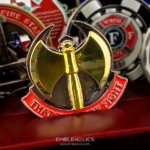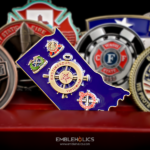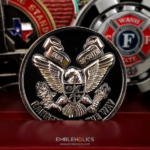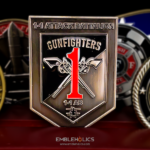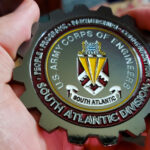
The coin is cut as a gear, with teeth running around the whole edge. Both faces carry the unit’s insignias and emblems, engraved. The finish is dark chrome plating with the remaining graphic elements painted in glossy colors. The emblems were digitized from the originals and the shape mocked up before anything was machined. This USACE South Atlantic Division coin was made for the Army Corps of Engineers South Atlantic Division.
Why a Gear Shape Works
A gear is among the most effective non-round outlines available, and it has one advantage no other custom shape has.
It is still a circle. The teeth modify the rim rather than changing the overall form, so the coin keeps everything a round blank gives you: full usable area on both faces, a symmetrical layout, and a piece that still stacks and sits flat. Most custom shapes cost you all of that.
The teeth are structurally sound. They are short, wide and evenly distributed, which means no long thin projections to bend or chip. Compared with an animal outline or a tool shape, a gear is a very safe custom die.
It means engineering without depicting anything. A gear is the universal shorthand for mechanical work and construction, and it communicates that without committing to a specific machine, project or discipline. For a division covering everything from dams to buildings, that generality is useful rather than vague.
And it reads at a glance. A toothed rim is identifiable in silhouette from across a desk, which is the test a shaped coin has to pass.
The one thing to specify is tooth count and depth. Too many shallow teeth look like a milled edge rather than a gear, and too few deep ones look like a star. The shape has to be unmistakably a gear, which is a proof stage judgment.
See also custom shaped challenge coins and an Army Corps of Engineers challenge coin.
The South Atlantic Division
The South Atlantic Division is one of eight regional divisions of the United States Army Corps of Engineers. It oversees military and water resources design, construction and operation across eight southeastern states, the Caribbean, and Central and South America. The division designs major military facilities for the Army and the Air Force and works with private sector contractors on dams, waterways, buildings and recreational facilities.
That range is the reason a general symbol beats a specific one here. A division responsible for dams, harbors, military construction and recreational facilities across three continents cannot put its work on a coin, because the work has no single image. A gear covers it; a dam or a building would not.
The Corps is also an unusual organization in that most of its workforce is civilian and much of its output is public infrastructure that carries no military association at all. A coin from a USACE division ends up with contractors, engineers, local officials and partner agencies, which is a wider and less military circle than most Army coins reach.
See also an army engineer challenge coin.
Dark Chrome With Glossy Accents
Dark chrome is an underused plating and it does something neither bright chrome nor antique finishes manage.
It is reflective but not bright. Dark chrome keeps the mirror quality while dropping the value, so the coin has depth and shine without the glare that makes a polished piece hard to read.
Engraving gains contrast automatically. Recessed lines in a dark plating read almost black against a reflective field, which is more separation than bright chrome gives and more drama than an antique finish.
And it is a modern register. Where antique bronze says heritage and gold says award, dark chrome says contemporary and technical, which suits an engineering organization.
Pairing it with glossy paint is consistent rather than contrasting. Both surfaces are reflective, so the colors sit in the same visual world as the plating instead of looking applied on top of it. A matte paint on dark chrome would read as two unrelated treatments.
The practical caution is fingerprints. Any reflective plating shows handling, and a dark one shows it more than a bright one. For a presentation piece that is fine, and for something carried daily it is worth knowing in advance.
See antique vs polished finishes.
Digitizing Existing Emblems
The emblems on this coin were digitized from the originals before machining, and that step is worth explaining because it is where accuracy is won or lost.
Official insignia exist as defined artwork, but what an organization can usually supply is a photograph, a web image or a printed document. None of those can drive a cutting machine. Converting them means redrawing the mark as clean vector geometry, and every proportion in that redraw is a decision.
That is why supplying source artwork matters more than any other thing a customer can do. An emblem redrawn from a low resolution image will be subtly wrong in ways that are hard to name and immediately visible to the people who wear it. Official insignia have precise specifications, and the closer the starting material is to those, the better the result.
The related point is that digitizing is also where simplification happens. A mark with detail too fine to strike has to be adapted, and it is better for that decision to be made deliberately with the organization’s input than discovered when the first sample arrives.
Order an Engineering or Division Coin
Professional artwork is free with unlimited revisions, and nothing goes into production until you approve a digital proof. The challenge coin minimum is 50 pieces, standard production runs about 45 to 50 days after final artwork approval, rush production is available on many projects, and shipping within the continental United States is included. Embleholics is veteran-owned, SDVOSB and registered in SAM.gov.
Two suggestions. Send original artwork files for any official emblem rather than a photograph or a web image, since redrawing from low resolution material introduces proportion errors that the people who wear the insignia will spot. And if a custom shape is involved, review the silhouette on the proof as a shape in its own right, because tooth depth and count are the difference between a gear and a decorative edge. Request a free quote to begin.
Frequently Asked Questions
Why is a gear a good shape for a challenge coin?
Because it is still a circle. The teeth modify the rim without changing the overall form, so the coin keeps full usable area, a symmetrical layout, and the ability to stack and sit flat.
Is a gear shaped coin fragile?
No. The teeth are short, wide and evenly spaced, so there are no long thin projections to bend or chip. It is one of the safest custom dies available.
What should be checked on a gear outline?
Tooth count and depth. Too many shallow teeth look like a milled edge and too few deep ones look like a star, so the shape has to read unmistakably as a gear on the proof.
Why use a gear rather than show the actual work?
Because a division covering dams, harbors, military construction and recreation has no single image. A gear communicates engineering without committing to one project or discipline.
What is dark chrome plating?
A reflective finish at a lower value than bright chrome. It keeps the mirror quality without the glare, and recessed engraving reads almost black against it, giving strong contrast.
Why pair glossy paint with dark chrome?
Because both surfaces are reflective, so the colors sit in the same visual world as the plating. Matte paint on a reflective plating reads as two unrelated treatments.
What is the drawback of a reflective plating?
It shows fingerprints and handling, and a dark plating shows them more than a bright one. That suits a presentation piece better than something carried every day.
Why does source artwork matter for official insignia?
Because a cutting machine needs clean vector geometry, and redrawing from a photograph or web image introduces proportion errors. The people who wear the insignia notice them even when they cannot name what is wrong.
More Army Projects