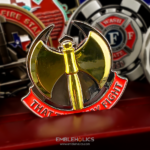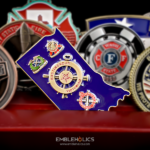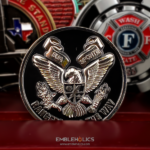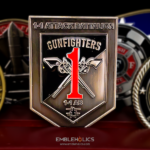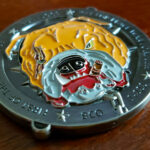
A unit mascot challenge coin carries the informal character a unit identifies with, such as a bulldog, a wolfhound or a gator, usually drawn rather than heraldic. It is often the design people actually want to carry, as distinct from the official crest.
Can a Cartoon Work on a Challenge Coin?
Yes, but not by shrinking the drawing. Illustration and metal are different problems, and artwork that works on a T-shirt frequently fails on a coin for reasons nobody anticipates until they see the first proof.
A drawing relies on line weight and flat color. The outline does the work of separating one element from another, and the colors sit inside those outlines because the artist put them there. A coin has neither of those things. Color on a coin sits in recessed wells, and the walls of those wells are raised metal. Every line in the artwork has to become a physical ridge with enough width to hold its shape and enough height to contain paint on either side of it.
That is where cartoons run into trouble. A fine stroke that reads beautifully at print resolution becomes a ridge too thin to survive striking, or too shallow to keep two colors from bleeding into each other. Cross-hatching, feathered shading and thin tapering lines all disappear.
So the artwork gets rebuilt for the medium. Strokes are thickened to a weight the die can hold. Detail that carried tone in the drawing is simplified or removed, and the tone is recovered another way, usually through finish contrast rather than line. Color areas are given walls to sit inside. The character stays the same; the construction underneath it changes entirely.
This work is included in the free artwork rather than charged as a change. Send the drawing you have and you will get back a proof showing what it becomes in metal.
Why Units Put Mascots on Coins
The crest is the identity a unit is issued. The mascot is usually the identity it feels.
Official heraldry is designed by committee and approved through a process, and it goes on the letterhead, the guidon and the plaque on the wall. The mascot arrives some other way, often decades ago and often from something that happened rather than something that was decided, and it is what people call themselves. That difference is why the mascot belongs on the object people carry in a pocket, and the crest belongs on the wall.
The range is wide. Animals dominate, because a unit nickname usually resolves into one: bulldogs, wolfhounds, gators, tigers, rams, mustangs. Some units carry characters instead, or a nickname rendered as a figure, or an object with a story behind it that only makes sense inside the unit.
The occasions are informal by nature. End of tour, informal awards given personally, morale coins, and orders placed at company or platoon level inside a larger formation. That last pattern matters commercially: a battalion may have one official coin, while the companies inside it each have their own mascot coin, which is several orders rather than one. You can see comparable work on our battalion challenge coins and across custom Army challenge coins.
What Is the Triple Deuce?
The Triple Deuce is the 2nd Battalion, 22nd Infantry Regiment, written as 2-22 Infantry. The nickname comes from the numbers rather than from anything more elaborate.
The distinction between battalion and regiment matters here. The 22nd Infantry is a parent regiment whose 1st, 3rd and 4th Battalions have been inactivated. The 2nd Battalion is the active one, and the regimental colors sit with it at Fort Drum, New York, where it serves as light infantry with the 1st Brigade Combat Team, 10th Mountain Division.
The battalion’s lineage begins on 3 May 1861, when it was constituted in the Regular Army as Companies B and K, 2nd Battalion, 13th Infantry. It was organized in May 1865 at Camp Dennison, Ohio, and redesignated as the 22nd Infantry in September 1866. The regiment’s campaign service since then covers the Indian Wars, the Civil War, the Spanish-American War, the Philippine-American War, the Second World War, Vietnam, Somalia, Iraq, Afghanistan and Operation Inherent Resolve.
The battalion’s best-known service is Vietnam, and it went as a mechanized unit. It trained at Fort Lewis, Washington with the 3rd Brigade, 4th Infantry Division during 1966 and deployed that September, operating M113 armored personnel carriers, before being reassigned to the 25th Infantry Division in August 1967. In March 1967 it fought at Suoi Tre, one of the largest single-day engagements of the war, and holds the Presidential Unit Citation with the streamer embroidered SUOI TRE.
The motto is “Deeds, Not Words.”
About This Triple Deuce Coin
The brief was for something lighter than a formal unit coin. Not an award, not a commemorative, but a coin worth carrying and worth handing to someone.
The front carries a cigar-smoking bulldog, drawn in cartoon style rather than rendered as heraldry. The reverse carries the flag with the battalion and regiment lettering.
The construction is where the design earns itself. The base is a brushed steel effect, and the bulldog and the flag colors are carried in glossy paint over it. That contrast is doing the work an outline would do on paper. Matte and gloss reflect light differently, so the painted areas separate from the field by finish rather than by a drawn border, which is exactly what a cartoon needs and exactly what a flat engraved treatment would have failed to provide.
Both faces carry wide rims, which frames the artwork and gives the eye somewhere to stop. Small protruding details are chiseled into the edge itself, which is unusual, since most coins treat the edge as a plain band or a decorative cut and leave it at that.
The bulldog was the customer’s chosen mascot for the coin.
Morale Coins and Informal Awards
This coin belongs to a category that sits between the formal award and the commemorative, and it is probably the largest of the three.
A morale coin is not given for anything that would survive a citation. It is given because someone handled a bad week well, or fixed something nobody else could, or did the job when the job was miserable. There is no paperwork, no ceremony and no record, which is the point of it.
These are usually the coins that get carried. A formal award coin goes in a display case with the certificate. A coin someone was handed in a motor pool at the end of a long day goes in a pocket and stays there.
Units order them in advance and in quantity, because the whole value is being able to give one at the moment it is deserved rather than three weeks later. That also explains why they tend to be the most distinctive coins a unit orders, and why coins as informal awards and mascot designs so often turn out to be the same thing.
Design a Coin for Your Unit or Mascot
Artwork is free and revisions are unlimited, and that includes redrawing a mascot for metal. Rebuilding a cartoon so it works as relief and enamel is part of the artwork process, not an extra line on the quote.
You receive a digital proof before anything is struck, which matters more on mascot work than on heraldry, since a character has to still look like itself after the construction underneath it has changed. If you have a drawing, a patch, a stencil or a decal, send whatever exists. Related work sits in the gallery on our infantry unit coins and battalion coin designs.
Orders start at 50 coins, shipping within the continental United States is included, and most orders are complete in 45 to 50 days after artwork approval. Rush production is available.
Embleholics is veteran-owned, based in Port Orchard, Washington, and registered in SAM as a Service-Disabled Veteran-Owned Small Business under UEI F3AGRUW5RT53. Request a quote and you will hear back within 24 hours.
Frequently Asked Questions
What is a unit mascot challenge coin?
A unit mascot challenge coin carries the informal character a unit identifies with rather than its official crest. Mascots are usually animals or figures drawn in an illustrative style, and they are often the design members most want to carry.
Can a cartoon or illustration be put on a challenge coin?
Yes, but the artwork has to be rebuilt for metal. Illustration relies on line weight and flat color, while a coin relies on raised ridges and recessed wells, so strokes are thickened and fine detail is simplified before production.
Does artwork need to be redrawn for a coin?
Usually. Fine strokes, cross-hatching and feathered shading do not survive striking, so they are rebuilt as relief the die can hold. This is included in the free artwork rather than charged separately.
What is the Triple Deuce?
The Triple Deuce is the 2nd Battalion, 22nd Infantry Regiment, or 2-22 Infantry. It is light infantry based at Fort Drum, New York with the 1st Brigade Combat Team, 10th Mountain Division, and the regimental colors sit with it.
What does “Deeds, Not Words” mean?
“Deeds, Not Words” is the motto of the 22nd Infantry Regiment. It states that the unit is measured by what it does rather than what it says, and it appears on the regiment’s heraldry.
What is a morale coin?
A morale coin is given informally for work that does not warrant a formal award. There is no citation or ceremony attached, which is why these coins tend to be the ones people actually carry rather than display.
Can we order coins for a company or platoon rather than a whole battalion?
Yes. Company and platoon-level orders are common, often with each element carrying its own mascot while the battalion keeps a separate official coin. The minimum order is 50 coins.
What is the minimum order?
The minimum order on coins is 50. Most orders are complete in 45 to 50 days after artwork approval, and rush production is available if you are working to a date.
More Army Projects