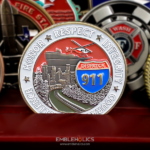
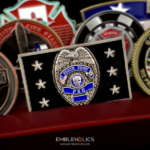
A police badge challenge coin is a coin whose outline is cut to the shape of the department’s badge instead of being struck as a circle. This one was made for the Roswell Police Department in Roswell, Georgia. The silhouette is a sculpted civic crown with the department’s star-shaped badge at the center, so the coin reads as the badge itself from across a desk rather than as a round coin with a badge printed on it.
Get permission in writing before any artwork starts
A police badge is controlled property, and most departments require authorization to reproduce it. This is the first step, not a formality to clear later. Badges are protected under department policy and, in many states, under statute, because a convincing reproduction can be used to impersonate an officer. That protection does not stop at a full-size metal badge: it generally covers the badge design itself, which is exactly what a badge-shaped coin reproduces.
In practice the approval comes from the chief’s office, a designee, or the department’s legal counsel. Get it in writing, keep it on file, and have it before art goes into production. We walk through who signs and what the request should say in our guide on permission to use a police badge on a coin. If you are an officer ordering privately rather than through the department, this is the step that most often needs sorting out first.
Where permission is not available, the usual substitute is the department patch or seal, or a badge-inspired outline that does not copy the issued design. Both still produce a coin that is unmistakably from that department.
How a badge becomes the coin’s outline
There are two ways to break out of a circle, and they are not the same thing. A custom shaped coin is struck from a die cut to the badge’s outer profile, so the whole coin is badge-shaped. A cutout coin keeps a round or framed body and removes metal from inside it, so the badge shows through negative space. The Roswell coin takes the first approach: the die follows the crown and the points of the star, and nothing is left over.
- Custom shape gives the strongest read, because the silhouette alone identifies the department. It needs a new die cut to that profile, which is why shape work is quoted separately from a standard round coin.
- Cutout keeps a conventional rim and uses the open space as part of the design. It is useful when the badge outline is too irregular to hold up as a whole coin, or when the department wants a rim for lettering.
We compare the two in more detail on custom shaped coins versus cutout coins, and you can see the range of profiles we have cut on our custom shaped challenge coins page.
What survives at coin size, and what does not
A badge is designed to be read at chest height; a coin is read in the palm. Shrinking the design is where most badge coins either work or fail, and three things decide it.
- Star points and crown tips are fragile. Thin points on an outline are the part most likely to catch, bend, or feel sharp in the hand. The usual fix is to thicken them slightly or soften the tip radius, which is invisible at coin size and makes the coin far more durable in a pocket.
- Badge numbers and small lettering are the first casualties. A department name will hold. A motto in a curved banner, a city charter date, and a badge number all compete for the same few millimeters. Decide which one matters and let the others go rather than shrinking all three.
- Layered relief needs depth to read. A badge’s seal, eagle, or crown is sculpted in several planes. On a coin, that depth comes from 3D relief rather than from flat engraving, and it is what makes the center of the badge look like metalwork instead of a stamp.
Finishes that make a badge look like a badge
Badges are two-tone far more often than coins are. Many departments issue gold for one rank and silver for another, or combine the two in a single badge. That translates directly: a dual-plated coin can carry an antique silver field with polished gold on the crown and the center seal, which matches how the real badge is finished rather than flattening it to one metal.
Enamel does the color work. Department blues, the state seal’s colors, and a red or green banner all come from enamel sunk into recessed areas. Hard enamel is polished flat with the metal and wears best for something that will live on a keyring or in a duty bag. Soft enamel leaves the color slightly recessed, which gives more visible depth and costs less.
Ordering a badge coin for a department
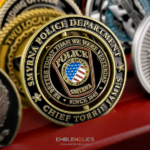
Send the badge artwork, the approval, and the rank or unit the coin is for. If you only have a photograph of the badge, that is usually enough to start from, and our art team redraws it to the resolution a die needs. We will come back with a profile drawing showing exactly where the outline falls before anything is cut, which is the point at which point thickness and lettering decisions get made. You can see other department projects we have produced, including the first Roswell Police Department coin and the Smyrna Police Department coin, or browse our police challenge coins. Send your artwork through the free quote form and we will come back within a day.
Frequently Asked Questions
Do I need permission to put a police badge on a challenge coin?
Yes, in almost every case. Police badge designs are controlled by the department and are protected in many states by statute, because reproductions can be used to impersonate an officer. Authorization normally comes from the chief’s office, a designee, or department legal counsel, and you should have it in writing before artwork goes into production. If permission is not available, a department patch, seal, or badge-inspired outline that does not copy the issued design is the usual alternative.
What is a police badge challenge coin?
A police badge challenge coin is a coin cut to the outline of a department’s badge rather than struck as a circle. The silhouette itself identifies the department, so the coin reads as the badge from a distance. The Roswell Police Department coin is an example: the die follows a civic crown with a star-shaped badge sculpted at the center.
What is the difference between a custom shaped coin and a cutout coin?
A custom shaped coin is struck from a die cut to the badge’s full outer profile, so the entire coin is badge-shaped. A cutout coin keeps a round or framed body and removes metal from inside it, so the design shows through open space. Custom shapes give the strongest identification; cutouts are useful when the outline is too irregular to work as a whole coin or when you want a rim for lettering.
Will the points of a star-shaped coin be sharp?
Not if the profile is drawn for metal rather than traced from the badge. Thin points are the most fragile part of any shaped outline and the most likely to feel sharp in a pocket, so we thicken them slightly and soften the tip radius. The change is not visible at coin size and makes the coin considerably more durable in daily carry.
Can a coin be two different metals like our badges?
Yes. Dual plating lets one coin carry two finishes, such as an antique silver field with polished gold on the crown and center seal. Because many departments issue gold for one rank and silver for another, or combine both in a single badge, two-tone plating usually matches the real badge more closely than any single metal would.
Can you work from a photo of our badge?
Yes. A clear photograph is normally enough to begin, and our art team redraws it at the resolution a die requires. You will see a profile drawing showing exactly where the coin’s outline falls before any die is cut, which is when decisions about point thickness and which lettering to keep get settled.
How much lettering fits on a badge-shaped coin?
Less than most badges carry. A department name will hold at coin size, but a motto, a charter date, and a badge number all compete for the same few millimeters and will not all survive. The best results come from choosing the one piece of text that matters most and giving it room, rather than shrinking everything to fit.
More Police Projects