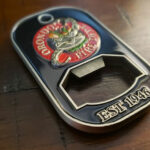
The coin is cut to the shape of the shield on a firefighter’s helmet, with a bottle opener built in near the center and a sculpted element at the top. The front identifies the crew and its founding date. The reverse carries a swarm of bees, with the lead bee hauling two buckets labeled A and C. It was made for a fire department’s B shift.
A Shift Is Its Own Crew
Departments order coins. Shifts order coins too, and the shift coin is usually the better object.
A shift is who you actually work with. A department can be hundreds of people across many stations. A shift is the crew you run calls with, eat with and sit through nights with, on a rotation that repeats for years. That is a far tighter group, and a coin means more inside a tight group.
Shifts have real rivalries. A, B and C shift compare themselves constantly, and that is the engine behind most shift coins. Nobody makes a coin about being one third of a staffing schedule; people make coins about their crew being the one that carries the load.
The quantity fits. A shift at a station or across a small department sits comfortably inside a 50 piece order, with spares for people who transfer in.
And nobody has to agree. A department coin needs sign-off from people with competing views about what belongs on it. A shift coin needs the shift to agree, which is a much shorter conversation and is why shift coins tend to be more interesting.
The same applies to any rotating crew: police watches, EMS shifts, dispatch, plant operations, anywhere the schedule creates a permanent in-group.
Designing Around an Inside Joke
The bees on the reverse are the whole coin. B shift, bees, and the lead bee carrying two buckets labeled A and C: B shift does the work for the other two.
That is exactly what a shift coin should be, and it is worth being explicit about why.
A joke makes the coin unrepeatable. Every fire department in the country could order a coin with a Maltese cross and a helmet on it. Only one crew has this particular bee on it, and that is what makes a coin something people keep rather than put in a drawer.
Visual puns reproduce better than verbal ones. A pun that has to be read takes lettering, and lettering takes space and legibility budget. A pun you can see, like a bee for B shift, costs nothing to read and works at any size.
Layers reward a second look. The swarm reads immediately. The buckets labeled A and C take a moment longer. A coin with a detail people discover later is a better object than one that gives everything up at a glance.
And it needs no explanation to the people who matter. An outsider sees bees. The crew sees the whole argument. That asymmetry is the point.
The one thing to watch is durability of the humor. A joke about the crew’s character lasts; a joke about a specific individual or a current incident will age badly on an object that outlives both.
Where the Opener Goes
The opener on this piece sits near the center rather than at the edge, which was a deliberate change from the first approach. It is the main decision on any opener design.
An edge opener keeps the faces clear. The cutout sits at the rim, so both faces stay almost entirely available for artwork. The trade-off is that it interrupts the outline, which matters on a shaped piece where the silhouette is part of the design.
A center opener preserves the outline. The shape stays intact, which is why it suits a helmet shield: the shield profile is doing identifying work and a bite taken out of it would weaken that. The trade-off is that the cutout now sits in the middle of the face, so the artwork has to be composed around a hole rather than across a clear field.
In practice a center opener works best when the design has a natural middle to give up, or when it can be arranged in a ring. A single large central device and a center opener cannot both occupy the same space.
Two other points on openers. Minimum quantities for bottle openers differ from the challenge coin minimum, so ask when you request a quote. And an opener has to be thicker than a standard coin to work as a tool, which affects both the feel and the price. See custom bottle openers and whether a challenge coin can be a bottle opener.
The Helmet Shield Outline
Cutting the piece to a helmet shield is the right shape for the fire service and a sound one structurally.
The shield is instantly recognizable in a fire context, it has no narrow points or thin projections to bend, and its broad upper half tapering to a point gives a layout a natural reading order: the crew name across the top, the main artwork in the middle, the date in the taper.
The sculpted element at the top adds relief where the shield is widest, which stops the upper half reading as a flat panel. See custom shaped challenge coins.
Order a Coin for Your Shift
Professional artwork is free with unlimited revisions, and nothing goes into production until you approve a digital proof. Standard production runs about 45 to 50 days after final artwork approval, rush production is available on many projects, and shipping within the continental United States is included. Minimum quantities for bottle openers differ from challenge coins, so ask when you request a quote. Embleholics is veteran-owned, SDVOSB and registered in SAM.gov.
One suggestion worth more than any design advice. Send us the joke. Whatever your crew calls itself, whatever the running argument with the other shifts is, whatever the nickname is that nobody outside the station would understand. That material is what makes a shift coin worth having, and it is the thing customers most often leave out because they assume we need something official. Request a free quote to begin.
Frequently Asked Questions
What is a shift challenge coin?
It is a coin made for one rotating crew rather than a whole department, such as a fire department’s A, B or C shift. The shift is the group people actually work with, which is why a shift coin usually means more than a department coin.
Can a single shift order its own coins?
Yes, and it is common. A shift sits comfortably inside a 50 piece order with spares for transfers, and it only needs the shift to agree on the design rather than the whole department, which is a much shorter conversation.
Should a crew coin include an inside joke?
If you have one, yes. A joke makes the coin unrepeatable, where a generic cross and helmet could belong to any department. It is the single thing most likely to make people keep the coin rather than shelve it.
Do visual puns work better than written ones?
Yes. A written pun needs lettering, which costs space and legibility. A visual pun, like a bee for B shift, reads instantly at any size and costs nothing in layout.
Can a joke date badly on a coin?
It can. A joke about the crew’s character lasts, but one about a specific individual or a current incident will age badly on an object that outlives both. Aim for the kind that will still land in five years.
Where should the bottle opener go on a coin?
At the edge if you want both faces clear for artwork, or near the center if you want to keep the outline intact. A shaped piece whose silhouette is part of the design usually calls for a center opener.
What is the drawback of a center opener?
The cutout sits in the middle of the face, so the artwork has to be composed around a hole rather than across a clear field. It works best when the design has a natural middle to give up or can be arranged in a ring.
Is the minimum order the same for bottle openers?
No. Minimum quantities for bottle openers differ from the challenge coin minimum, and an opener also has to be thicker than a standard coin to work as a tool, which affects both feel and price. Ask when you request a quote.
More Firefighters Projects