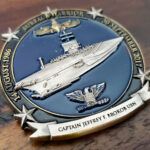
This coin was commissioned for presentation to a Naval Surface Force commander. It carries a modern warship on one face and an older one on the other, which turns the two sides of the coin into two points in the same history.
Two Eras on Two Faces
The design decision here is the one worth the page. Rather than putting one ship on the front and something unrelated on the back, this coin puts the same subject in two periods.
That is an underused structure and it solves a real problem. Most organizations with a long history want to acknowledge it and have nowhere to put it. A heritage element crammed into a corner of a modern design looks like an afterthought; a whole face given to it looks deliberate.
Why it works as well as it does:
The viewer does the comparing. Turning the coin over is an action, and the design uses it. The two faces are not two separate pictures, they are a before and an after that the recipient assembles themselves.
It says continuity without any words. A motto about tradition and heritage takes a line of text and still has to be believed. Two ships separated by a century make the same point and cannot be argued with.
And the eagle on both faces ties them together. This is the detail that makes the structure work rather than reading as two unrelated coins. One device repeated across both sides is what tells the eye that the two images belong to each other.
If you want to use the same approach, the rule is that the two eras have to be clearly distinguishable at coin size. A ship from 1900 beside one from 1940 will read as one ship twice. The further apart the periods, the better the structure works.
Engraving Both Ships
Both ships are engraved into the surface rather than sculpted out of it, and that consistency is deliberate.
Engraving cuts into the metal and produces a flat tonal image. Sculpting raises the subject and gives it curvature and shadow. Using engraving on both faces means neither ship dominates, which is exactly right when the point is a comparison. Sculpt one and engrave the other and the sculpted one wins, which would undermine the whole structure.
Engraving also suits ships better than people expect. A hull is a long horizontal shape with fine superstructure detail above it, and that detail is mostly thin vertical lines: masts, funnels, directors, antennas. Cut into the surface those lines hold crisply. Raised in relief at the same scale they would need thickening and would lose their character. For how the two techniques compare, see 2D and 3D coins compared.
Brushed Brass, Black and Blue
The base is brushed brass, with black and blue paint and nothing else.
Brushed brass is the natural choice for a coin about history, for the same reason it appears on so many commemorative pieces: a warm metal tone with a scattered-light finish reads as older than polished nickel does, without imitating anything specific.
The two-color palette does something more interesting. Black and blue over brass gives you depth on a maritime subject without resorting to a literal blue sea. Black fills the recesses and makes the engraved lines read; blue sits where the design needs the water and the sky to register. Two colors is enough because the metal is carrying everything else.
The general lesson: on an engraved design, color belongs in the cuts rather than across the surface. Filling the recesses makes the engraving legible. Painting the raised areas flattens it. Our page on plating and enamel options covers the detail.
Surface Warfare and the Surface Warrior
Naval Surface Force is the type command responsible for manning, training and equipping the Navy’s surface fleet, organized into Pacific and Atlantic commands. It sets surface warfare policy and standards and develops the expertise the surface fleet runs on.
Surface Warrior is the term used for its commander, who also leads the Surface Warfare Enterprise. A coin presented to that officer is a presentation piece rather than a unit coin, which is why the brief called for something symbolic and respectful rather than something a crew would carry in a pocket.
That distinction is worth noting if you are ordering. A presentation coin goes to a small number of senior people and is likely to be mounted or displayed. A unit coin goes to everyone and lives in a drawer. They want different designs, different finishes and very different quantities. See more Navy challenge coins.
Order a Presentation Coin
Professional artwork is free with unlimited revisions, and nothing goes into production until you approve a digital proof. The challenge coin minimum is 50 pieces, standard production runs about 45 to 50 days after final artwork approval, rush production is available on many projects, and shipping within the continental United States is included. Embleholics is veteran-owned, SDVOSB and registered in SAM.gov.
Two things to tell us. Whether the coin is for presentation to a few people or for issue to a whole command, because that changes the finish as much as the quantity. And if you want to show history alongside the present, say so early, since giving a heritage element its own face is a structural decision rather than an addition. Request a free quote to start.
Frequently Asked Questions
What is a surface warfare challenge coin?
It is a coin made for the Navy’s surface fleet community, covering the ships and the people who crew them. This one was commissioned for presentation to a Naval Surface Force commander and carries warships from two different eras, one on each face.
Can a coin show two different time periods?
Yes, and giving each era its own face is a strong structure. The viewer turns the coin over and makes the comparison themselves, which says more about continuity than a motto would. The periods need to be far enough apart to be distinguishable at coin size.
How do you tie two faces of a coin together?
Repeat one device across both. On this coin an eagle appears on each face, which tells the eye that the two images belong to the same object rather than reading as two unrelated designs. A shared border or background pattern does the same job.
Should ships be engraved or sculpted on a coin?
Engraving suits ships well, because the fine superstructure detail is mostly thin vertical lines that hold crisply when cut into the surface. Raised in relief at the same scale, masts and antennas would need thickening and would lose their character.
Why use the same technique on both faces?
Because mixing them creates a hierarchy. A sculpted face will always dominate an engraved one, which is useful when you want a clear front and counterproductive when the point of the design is a comparison between two equal subjects.
Where should color go on an engraved coin?
In the cuts rather than across the surface. Filling the recesses makes engraved lines read more clearly, while painting the raised areas flattens the design and wastes the engraving. Two colors in the recesses will usually do more than five spread over the face.
What is the difference between a presentation coin and a unit coin?
A presentation coin goes to a small number of senior recipients and is often displayed rather than carried, so it justifies a more considered finish. A unit coin is issued broadly and lives in pockets and drawers. They need different designs and very different quantities.
Why does brushed brass look older than polished metal?
Because a warm metal tone and a scattered-light finish together read as age, where bright reflective surfaces read as new. It is also a neutral choice: it suggests age without imitating any specific historical coin or period finish.
More Space Force Projects