A game warden challenge coin is a custom coin made for state conservation law enforcement. This Washington example shows the agency badge sculpted in raised relief on one face and an engraved eagle, stag and fish on the other, so the badge and the wildlife being protected each get a side.
Badge on One Side, Wildlife on the Other
A conservation officer is both a sworn law enforcement officer and a wildlife professional. A game warden challenge coin has to show both roles without one overshadowing the other. This coin gives each role its own face. The badge shows authority, and the animals show purpose.
Here’s what the coin includes:
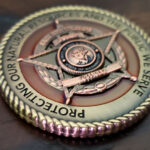
- Front. A star-shaped agency badge sculpted in relief (raised above the metal surface). A round state seal sits at the center of the star. Banners read Fish and Wildlife Police and Officer, and laurel leaves sit at the sides.
- Outer ring. The words Protecting Our Natural Resources and the Public We Serve run around the face.
- Rope edge. A twisted, cord-like pattern runs around the rim.
- Back. An engraved eagle, stag and fish (engraved means the design is etched into the metal as fine lines).
- Material and finish. Brass-colored base metal with a monochrome look, meaning the design relies on metal tones. A copper-toned band sits behind the badge.
Putting the badge and all three animals on one face can crowd the coin and make each harder to read. Giving each role its own face can work for other groups with two roles too, such as park rangers, harbor patrols and search and rescue teams.
A state badge and seal are official marks, and agencies usually set their own rules for reproducing them. If you’re ordering for an agency or unit, get written approval from the agency before artwork begins. We work from artwork you’re authorized to supply, and we can design a coin around your team’s identity without the official badge or seal. For more on seals, see our page on state seals on challenge coins.
Choosing Which Animals Go On
This coin uses an eagle, a stag and a fish. An eagle can read as authority and as protected wildlife at once. A stag can stand for the game animals an agency manages, and a fish for its waters. Together the three can cover air, land and water. Our gallery also features an animal on a coin, made for a different kind of organization.
Four habits help when you plan a wildlife enforcement coin for another agency:
- Pick species that belong to your state. Signature animals can make the coin easy to recognize as yours.
- Cover the territory you patrol. Choose animals that stand for the air, land and water in your area.
- Keep the count low. Three animals can already fill a face.
- Leave space around each animal. An animal shown from the side needs generous room to keep its outline clear.
Before you settle on an animal challenge coin design, check whether any species is contested in your state or tied to a hunting debate. Choosing one can signal a position, so it helps to decide on purpose.
Sculpting Animals in Monochrome
A sculpted wildlife coin puts every proportion on display, and anyone who has seen the real animal can spot an error. Antlers are often the hardest detail, because fine, branching shapes are among the most difficult to stamp into metal at coin size.
Engraving the animals (etching fine lines into the metal) is one way to keep that detail readable, and the eagle, stag and fish on this coin were etched beautifully.
With a monochrome look, light and shadow shape what the eye sees. That can suit natural subjects, because fur, feather and scale read through texture.
The rope edge gives the coin a traditional frame. Our manufacturing page covers sculpting, engraving and edge options.
What These Officers Do
Fish and wildlife officers give the public hunting and fishing information. They also protect the state’s wildlife from poaching (illegal hunting and fishing) and overuse. They’re armed, they usually work alone, and many work nights, weekends and holidays. They patrol on foot, on horseback, by plane, by boat and by vehicle.
The job centers on animals, water and land, so a conservation officer challenge coin often uses natural symbols. Police challenge coins for city departments usually draw on municipal imagery.
An officer who works alone across a large area may keep a coin as one of the few tangible things the job produces.
Order a Coin for Your Agency
Want a coin like this Washington Fish and Wildlife coin for your own agency? Request a free quote and our artists will draft professional artwork at no charge. You can ask for as many revisions as you need before production.
Tell us which species matter in your state, and we’ll build the back of the coin around them. If you’d like a historic version of your insignia instead of the current one, send a clear image. Old agency artwork is often hard to find as a file.
You’ll approve a digital proof (a preview of the finished design) before anything is made. Shipping within the continental US is free, rush production is available, and orders start at 50 coins. We’re veteran-owned, and our SAM.gov registration lists us as a service-disabled veteran-owned small business (SDVOSB).
Frequently Asked Questions
What is a game warden challenge coin?
A game warden challenge coin is made for a conservation or fish and wildlife law enforcement officer or agency. It often shows the agency badge on one face and the wildlife being protected on the other. This one was made for the Fish and Wildlife Police of Washington state.
Do conservation officers and game wardens use challenge coins?
Many do. Conservation officers and game wardens are sworn law enforcement officers, and challenge coins are a common way to recognize service and mark membership in a unit or agency.
What should go on a fish and wildlife officer coin?
It works well to give the badge one face and the wildlife the other. Choose species that belong to your state and stand for the air, land and water you patrol.
How many animals can go on one coin?
Three is often the practical limit for one face. Animals shown from the side need space around them, so a fourth can crowd the design. Fewer animals can be drawn larger and with more detail.
Can animals be sculpted in detail at coin size?
Often, yes. Fine shapes such as antlers are among the hardest details to stamp into metal at coin size. Engraving (etching fine lines into the metal) can build fur and feather texture, and it’s how the animals on this coin were made.
Does a wildlife coin need color?
No. Many wildlife subjects read well in metal tones alone, because engraved lines and shadow give the animals their shape. This coin pairs brass-colored base metal with a monochrome look (a look that relies on metal tones).
Can you reproduce a historic agency insignia?
Usually, yes. A sharp photo or scan of the original gives our artists the detail to work from. Check with the agency before ordering, because official marks often have reproduction rules.
What is a rope edge on a challenge coin?
A rope edge is a twisted, cord-like pattern around a coin’s rim. It gives the face a traditional frame, and the Washington coin has one around its rim.
More Law Enforcement Challenge Coins Projects