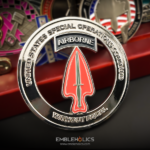
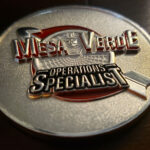
The concept was a helmet combined with crossed assault rifles and arrows. Both faces are sculpted, carrying patterns, lettering and embossed graphics. It was ordered for the ATFP 5717 program.
Crossed Weapons Behind a Central Device
This arrangement, a device in the middle with weapons crossed behind it, is one of the oldest in military heraldry and it survives because it solves a real compositional problem.
It fills the corners. On a round coin the diagonals are the areas most designs leave empty, because the eye puts the main device in the middle and the lettering around the rim. Two crossed elements running corner to corner occupy exactly that space.
It creates symmetry without repetition. An X is symmetrical on both axes, so the composition is balanced automatically. That is why the arrangement looks resolved even when the central device is irregular.
And it frames without enclosing. A full border ring closes a design off. Crossed weapons point outward at four corners, which gives the face energy while still directing attention to the center.
Mixing rifles and arrows, as this coin does, is also deliberate. Two weapon types from different eras in the same device says something about continuity that either alone would not, and it is a common approach in special operations and expeditionary units whose lineage matters to them.
A Helmet as the Central Device
A helmet is among the strongest central devices available, for the same reasons it works as an outline: the silhouette is unmistakable at small size, the form has natural depth for a sculptor to work with, and it carries meaning without text.
Used as a device rather than as the coin’s shape, it gains one advantage and loses another.
It gains context. As a device the helmet sits on a face with other elements around it, so it can be combined with weapons, lettering and a background pattern. Cut as the outline, it has to stand alone.
It loses immediacy. A coin shaped like a helmet is recognizable before anything is read. A helmet printed on a round coin is one element among several.
Which is the right call depends on whether the helmet is the whole idea or part of one. Here it is part of one, so a device is correct. For the other approach, see a helmet shaped challenge coin.
Sculpting Both Faces
Both sides of this coin are sculpted rather than one sculpted and one flat, which is less common than it sounds and worth considering.
The usual pattern is one sculptural face and one graphic face: a figure or object on the front, a crest or inscription on the back. Sculpting both means every surface has relief, which gives the coin a consistent weight and feel in the hand and makes it read as a medal rather than as a token.
The costs are real. A sculpted coin needs a three dimensional model and a deeper die, and doing it twice is more work than doing it once. The relief on each face also has to be planned against the other, because a coin has a finite thickness and deep recesses on both sides at the same point leave little metal between them.
Patterns and lettering embossed into a sculpted face need particular care. Raised type on a surface that is already rising and falling can get lost in the surrounding relief, so the usual approach is to give the lettering a flatter band of its own to sit on. See 2D vs 3D challenge coins.
About the Program
Antiterrorism Force Protection is a multi-faceted security program intended to identify, assess and counter terrorist threats to United States military personnel, family members, civilians and assets. It draws on security, intelligence and law enforcement functions alongside diplomatic, military and economic measures, and it operates on five threat conditions running from Delta, the most severe, down to Normal.
A program rather than a unit is an interesting coin client. There is no crest and no lineage to draw on, which is why these coins tend to be built from symbolic elements, a helmet, weapons, a shield, rather than from official insignia. That gives the designer more freedom and gives the recipients something that represents the function they perform rather than the organization they happen to sit in.
See also a Marine CI/HUMINT challenge coin and more military challenge coins.
Order an Expeditionary or Security Coin
Professional artwork is free with unlimited revisions, and nothing goes into production until you approve a digital proof. The challenge coin minimum is 50 pieces, standard production runs about 45 to 50 days after final artwork approval, rush production is available on many projects, and shipping within the continental United States is included. Embleholics is veteran-owned, SDVOSB and registered in SAM.gov.
Two things worth raising. If your program has no official insignia to work from, say so, because a design built from symbolic elements is a different conversation than one built around a crest and it is often the more interesting brief. And if you want both faces sculpted, mention it at the quote stage; it affects the die and the price and it is not something to add later. Request a free quote to begin.
Finished Coin (Front)

Finished Coin (Back)

Frequently Asked Questions
What is an expeditionary warfare challenge coin?
It is a coin for a unit or program concerned with deployed operations and force protection. These are often built from symbolic elements such as a helmet, weapons or a shield rather than from an official crest, since a program may not have one.
Why are crossed weapons so common on coins?
Because they solve a compositional problem. On a round coin the diagonals are the areas most designs leave empty, and two crossed elements running corner to corner fill exactly that space while creating symmetry on both axes.
Can weapons from different eras be combined?
Yes, and it is a deliberate device. Rifles and arrows together say something about continuity that either alone would not, which is why the combination appears often in special operations and expeditionary units.
Should a helmet be the coin’s shape or a device on it?
It depends whether the helmet is the whole idea or part of one. As the outline it is recognizable before anything is read; as a device it can be combined with weapons, lettering and a background, which a cut outline cannot.
Can both faces of a coin be sculpted?
Yes. It gives the piece a consistent weight and feel and makes it read as a medal rather than a token. It costs more, since a three dimensional model and a deeper die are needed for each face.
What has to be planned when sculpting both sides?
The relief on each face against the other. A coin has a finite thickness, so deep recesses on both sides at the same point leave very little metal between them. The two faces have to be designed together.
How do you keep lettering readable on a sculpted face?
Give it a flatter band of its own to sit on. Raised type placed directly onto a surface that is already rising and falling gets lost in the surrounding relief.
Can a program order coins if it has no official insignia?
Yes, and it is often a better brief. Without a crest to reproduce, the design is built from symbolic elements, which gives more freedom and produces something representing the function people perform rather than the organization they sit in.
More Special Operations Projects