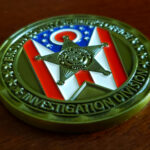
A sheriff’s office challenge coin belongs to a county law enforcement agency led by an elected sheriff. It is usually ordered by one division inside that office, such as criminal investigations, patrol, the jail or court services, rather than by the agency as a whole.
What Divisions Does a Sheriff’s Office Have?
A sheriff’s office is one of the broadest organisations in American law enforcement. Under a single badge and a single elected sheriff, a county agency typically runs:
- Patrol, covering unincorporated county roads and any township that contracts for service
- Criminal investigations, the detective bureau, sometimes with its own narcotics, property crime and juvenile sections
- The county jail, which in most counties is the largest single division by headcount
- Court security and civil process, serving papers, transporting prisoners and manning the courthouse
- K9, often a handful of handlers who identify strongly as a group
- Search and rescue, dive and marine units, frequently staffed by reserve deputies and volunteers
- A drug task force, sometimes county-run and sometimes shared with neighbouring agencies
- Reserve and auxiliary deputies, corrections officers and dispatchers
That is close to a dozen distinct groups inside an agency that may only employ a few hundred people, and each of them has its own patch, its own culture and its own reasons to want something of its own.
This is why sheriff’s offices rarely order one coin. A detective bureau coin and a jail division coin are different objects for different groups who happen to work in the same building. The K9 handlers want their dogs on it. Court services want the courthouse. A single agency coin serves nobody in particular, which is why the division coin is the far more common order.
Why Sheriff’s Offices Order Coins
- Division identity. The most common reason. A detective bureau, a jail division or a K9 unit wants something that says which part of the office they belong to, not just which county.
- Promotions and retirements. A deputy who spends twenty-five years in one county leaves with a wall of coins, and the office that sends them off is expected to add to it.
- Academy graduation and field training. New deputies finishing the academy or completing field training receive a coin from the office, and corrections officers finishing jail school get the same.
- A new sheriff taking office. This is the one that separates sheriff’s offices from every other law enforcement agency. The sheriff is elected, which means the top of the organisation changes on a ballot rather than on a promotion board. A new administration usually brings a new sheriff’s coin, and it is one of the few genuinely predictable reorder cycles in this business. It also means the old coin becomes dated the moment the election is certified, which is why the smart version carries the office and the division rather than the individual’s name.
- County anniversaries and agency milestones. A county founding date or a hundred years of the office is a strong reason to produce something, and those designs tend to be the most elaborate of the lot.
- Recognition and challenge use. Sheriffs hand coins to deputies, to visiting agencies and to members of the public who help on a case.
What Goes on a Sheriff’s Coin?
The star. The sheriff’s star is the single most recognisable object in county law enforcement, and it is the centre of most of these designs. Point counts vary by state and by office, five, six and seven point stars all being common, and getting the count right matters more than almost anything else on the coin. A deputy will notice a six point star on a five point office immediately.
The county. Municipal police coins lean on city imagery, a skyline, a city seal, a landmark bridge. County agencies do not have that, so they lean on the county itself: the county outline, the county seal where it is authorised, the founding date, the courthouse. See how county and state seals on coins are usually handled before committing to one.
Division names and mottos. Criminal Investigations, Corrections, Court Services, Special Operations. These are frequently set in a ring around the star or banded across the reverse.
Antique finishes. Sheriff’s office coins skew heavily toward antique silver, antique brass and antique copper rather than bright plating. The look is deliberate. A county office is an old institution, often the oldest law enforcement body in its county, and an aged finish says that better than a polished one.
Deputies, not officers. A sheriff’s office is staffed by deputies. Getting the word wrong on the coin itself is the kind of error nobody in the building will let go.
About This Brown County Coin
The Brown County Sheriff’s Office in Ohio commissioned this coin for their drug task force, which sits inside the office’s criminal investigations unit.
The brief was classic, elegant, minimal and vintage. The execution matches it exactly: the office insignia and the unit emblem etched on both faces, with no shaping, no enamel colour and no novelty feature anywhere on the piece.
That restraint is the point, and it is worth defending. A sheriff’s star is already a finished piece of design. It has been refined over a century and a half of use, it is legible at any size, and it carries the authority of the office on its own. Adding colour fill, a cut-out silhouette or a 3D scene to it does not make it stronger. It makes it busier. The right job on a design like this is reproduction rather than invention: strike the insignia cleanly, keep the relief shallow and even so the star reads as a single object, and let the finish do the ageing.
Etching both faces rather than colouring either one is a deliberate answer to that problem, not an absence of one. It is also the version that will still look right in fifteen years, which is what a vintage brief is really asking for.
For a different approach to the same institution, see another county sheriff coin. Task forces of this kind have their own design conventions, covered on our page about county drug task force coins, and the handler groups inside a sheriff’s office are covered on our page about K9 unit coins.
Can We Use Our Office’s Insignia on a Coin?
Most offices can, but the authorisation has to come from the agency, not from us. Office insignia, county seals, star designs and division emblems are controlled by the organisations that own them, and county seals in particular are often restricted by state law or county ordinance.
The practical version is straightforward. Clear the artwork through your own chain of command before you order, and send us artwork your agency is authorised to supply. We produce from what the customer provides and we do not grant permission on anyone’s behalf. If you are unsure who signs off, your office’s administrative division or the county clerk is usually the right place to ask.
Design a Coin for Your Office or Division
You do not need to know what you want before contacting us, and you do not need artwork. Send a photograph of your patch, a description of your division, or a coin you liked from someone else’s office, and a designer will draw something up at no cost with unlimited revisions. Nothing goes into production until you approve a digital proof.
The minimum order is 50 coins, which suits a division rather than a whole agency. Standard production runs about 45 to 50 days after final artwork approval, rush production is available on many projects, and shipping within the continental United States is included. Embleholics is veteran-owned, SDVOSB, and registered in SAM.gov. Browse more custom law enforcement challenge coins or request a quote to get started.
Frequently Asked Questions
What is a sheriff’s office challenge coin?
A sheriff’s office challenge coin is a custom coin made for a county law enforcement agency led by an elected sheriff. It usually carries the office’s star, the county name and a division name, and it is given for service, presented at retirements and promotions, or carried by deputies as a mark of the unit they belong to.
How is a sheriff’s office different from a police department?
A sheriff’s office is a county agency headed by an elected sheriff, while a police department serves a city and is headed by an appointed chief. Sheriff’s offices also run the county jail, court security and civil process, which municipal departments generally do not, and they are staffed by deputies rather than officers.
Can a single division order its own coins?
Yes, and most sheriff’s office coins are ordered this way. A detective bureau, a jail division, a K9 unit, a court services section or a task force can each order its own design. The 50-coin minimum is set at a level that suits a single division rather than an entire agency.
What goes on a county sheriff coin?
A county sheriff coin usually carries the office’s star with the correct point count for that state, the county name and outline, the founding date of the county or the office, and the name of the division the coin belongs to. Antique silver, brass and copper finishes are the most common choices.
Why do sheriff’s offices reorder coins when a new sheriff takes office?
Sheriff’s offices reorder because the sheriff is an elected official, so the head of the agency changes at the ballot box rather than through internal promotion. A new administration usually commissions a new coin. Designs that carry the office and the division rather than an individual’s name last longer across those changes.
Can we use our county seal on a challenge coin?
County seals are often restricted by state law or county ordinance, so permission has to come from the county rather than from a manufacturer. Clear the use through your agency’s chain of command and send us artwork your office is authorised to supply. Many offices use their star and division emblem instead.
Do I need to know what I want before asking for a quote?
No. Most projects start from a rough idea, a photograph of a patch or another agency’s coin, and the design is developed from there. Professional artwork is included at no cost with unlimited revisions, so working out what you want is part of the process rather than something to finish beforehand.
What is the minimum order for sheriff’s office coins?
The minimum order for custom challenge coins is 50 coins. That figure is set so a single division, shift or unit can order without the whole agency having to participate, and larger quantities bring down the cost per coin.
More Law Enforcement Challenge Coins Projects