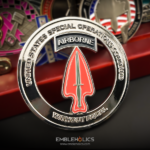
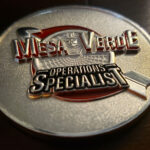
This coin was made for a single federal field office rather than for the agency as a whole. It is a round coin with engraved insignia on both faces and nothing else, which is a harder brief to execute well than it looks.
A Field Office Is Its Own Thing
Federal agencies are organized into field offices, and a field office has an identity that the national organization does not supply.
It has its own territory and its own people. Agents and staff in one office work the same geography for years, know each other, and share a set of cases nobody outside the office does. That is a unit in every meaningful sense.
It is the level where a coin actually means something. A coin carrying only the national seal represents an employer. A coin tied to a specific office represents the people you worked alongside, and that is the one people keep.
And the quantity suits a coin order. A field office is tens to a few hundred people, which sits comfortably above the minimum without running into the volumes a national issue would require.
The same pattern applies across federal law enforcement and well beyond the FBI. District offices, resident agencies, regional commands and area offices in any agency have the same shape of identity, and most of them have no coin. For the agency-wide material, see FBI challenge coins, and for a professional association covering officers across agencies, a law enforcement association coin.
Why a Plain Coin Is the Hard One
The client’s brief was simple: a round coin with engraved insignia on both sides. No custom shape, no sculpted figure, no color scheme to hide behind.
That is the most exposing brief we get. A coin with a striking shape or a bold palette has something to carry it. Strip those away and the entire result depends on things nobody notices when they are right and everybody notices when they are wrong.
What a plain coin actually depends on:
Spacing. With one device and some lettering, the relationship between them is the design. A device sitting slightly too high, or lettering slightly too close to the rim, is immediately visible because there is nothing else to look at.
Engraving depth. Cut too shallow and the detail vanishes under plating. Cut too deep and fine lines widen and lose their crispness. On a coin with color, a little variation is absorbed. On a bare engraved coin it is the whole surface.
Lettering weight. Type that is correct on screen frequently reads too light once struck, because the metal softens every edge slightly. A plain coin has nowhere to hide thin lettering.
And centering. A circle is unforgiving. Any element even slightly off center on a round coin with a plain field looks like a mistake rather than a choice.
None of that is difficult to get right, and all of it has to be got right, which is the honest reason a simple coin takes as much attention as an elaborate one. We cover the same on our Spring Hill Fire Department Coin. Our page on engraving and finish options covers the processes.
Official Insignia and What It Rules Out
A coin built around an official federal seal works under a constraint that most designs do not: the central element cannot be altered.
A crest designed for a unit can be simplified, restyled or adapted to suit the metal. An official agency seal cannot. It is a fixed device, and the only decisions available are how large it sits, where it sits and what surrounds it.
That is why the design work on a coin like this goes entirely into layout. It also means the artwork has to come from the agency rather than be redrawn from a photograph. A seal reproduced by eye will be subtly wrong in its proportions, and the people receiving the coin look at that device every working day.
Authorization sits with the agency too. We produce from the artwork a customer supplies and we do not grant permission on any agency’s behalf. See more government challenge coins.
About the Bureau
The FBI is the principal federal law enforcement agency in the United States and its domestic intelligence and security service, organized into functional branches under the Office of the Director, with field offices across the country.
This coin was made for the office covering Charleston, South Carolina.
Order a Coin for Your Office
Professional artwork is free with unlimited revisions, and nothing goes into production until you approve a digital proof. The challenge coin minimum is 50 pieces, standard production runs about 45 to 50 days after final artwork approval, rush production is available on many projects, and shipping within the continental United States is included. Embleholics is veteran-owned, SDVOSB and registered in SAM.gov.
Two things that help. Send the approved artwork files for any official insignia rather than an image pulled from elsewhere, because a seal has to be exact. And if the design is deliberately plain, expect us to spend the artwork stage on spacing and lettering weight rather than on adding anything. Request a free quote to begin.
Finished Coin (Front)

Finished Coin (Back)

Frequently Asked Questions
What is a field office challenge coin?
It is a coin made for one office of a federal agency rather than for the agency nationally. A field office has its own territory, its own staff and its own shared history, which is the level at which a coin represents the people you worked with rather than your employer.
Why order a coin for one office rather than the whole agency?
Because that is where the identity is. A coin carrying only a national seal represents an organization; one tied to a specific office represents a group of colleagues. The quantity also suits a coin order, since an office is tens to a few hundred people.
Is a simple coin design easier to produce?
No, it is harder to get right. A plain coin has nothing to carry it, so the result depends entirely on spacing, engraving depth, lettering weight and centering. Those are invisible when correct and obvious when not, which is why a simple brief takes as much attention as an elaborate one.
Why does a round coin need such careful centering?
Because a circle gives the eye a perfect reference. Any element slightly off center on a plain round face reads as an error rather than as a design choice, where the same offset on a shaped coin with a busy field would go unnoticed.
Can an official agency seal be simplified for a coin?
No. An official seal is a fixed device and cannot be altered, restyled or simplified the way a unit crest can. The design decisions available are its size, its position and what surrounds it, which is why layout is where all the work goes.
Why send artwork files rather than a photograph?
Because a seal reproduced by eye will be subtly wrong in its proportions, and the recipients look at that device every working day. Approved artwork files preserve the exact geometry; a redrawn version almost never does.
Why does engraved lettering sometimes look too light?
Because striking softens every edge slightly, so type that looked correct on screen can read thin in metal. On a plain coin there is nothing to compensate for it, which is why lettering weight is usually adjusted upward during the artwork stage.
Do federal agencies need permission for coins?
The agency confirms what it is authorized to reproduce and supplies the approved artwork. We produce from what the customer provides and do not grant permission on any agency’s behalf, which is the same position we take on all controlled insignia.
More Special Operations Projects