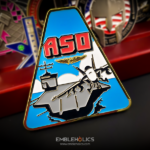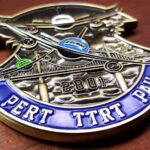
Getting a coin for less is a question about which costs to cut, not about buying a worse coin. Some savings are invisible in the finished piece and some are obvious the moment it lands in someone’s hand. The coin on this page is the example worth looking at: a badge-shaped design with a 3D eagle gripping a bridge, sculpted waves, aircraft over cloud texture, and small hidden details worked into both faces. It is not a stripped-back coin, and understanding what drove its cost is the fastest way to see where your own budget should go.
Quantity moves the price more than any design choice
This is the lever almost everyone underuses. A coin order carries a fixed setup cost, chiefly the die, and that cost is spread across however many coins you order. At fifty coins it is spread thinly. At five hundred it is barely visible in the unit price. Nothing you do to the artwork comes close to that effect.
The practical consequence is counterintuitive: if you are debating between a plain coin at a small quantity and a better coin at a larger one, the larger order is often the better value per coin even though the total is higher. Before cutting design features, check whether the quantity is right. Our minimum is fifty coins, and the challenge coin minimum order page explains how that works.
Order for the whole year, not the next event. Two orders of a hundred cost more than one order of two hundred, because the setup is paid twice. If the design has no dates or names on it, there is no reason to split the run.
What actually drives the cost of a coin
In rough order of impact, after quantity:
- Size. The single biggest design-side cost, because you are buying metal. Going up in diameter costs more than almost any feature you could add at the smaller size.
- Thickness. Less visible than diameter but it is still metal, and it is what gives a coin its weight in the hand.
- Shape. A custom outline needs a die cut to that profile. Simple departures from a circle, such as an oval or a shield, cost less than irregular profiles with points and cutouts.
- Enamel coverage. Priced by the number of color areas, not by how much you like the result. A design with four colors costs less than one with twelve.
- Dual plating. Two metal finishes on one coin is a second plating operation.
- Edge treatment. A plain or reeded edge is standard. Decorative edges cost extra and are the first thing to deform if dropped.
- Packaging. Capsules, pouches, velvet boxes and acrylic cases are all separate line items, and this is where budgets quietly disappear.
Savings that do not show, and savings that do
Cut these first. Nobody will notice:
- Packaging. A presentation box roughly doubles what you are paying per unit on a modest coin, and for a coin that goes straight into a pocket it adds nothing. Keep boxes for the small number of coins that will actually be presented formally.
- A few millimeters of diameter. The difference between the two most common sizes is obvious on a spec sheet and almost invisible in the hand.
- Color count. Consolidating twelve colors down to five usually improves the design as well as the price, because scattered color is what makes a coin look busy.
- 3D on one face only. Full sculpted relief on the front and a flatter, simpler reverse costs noticeably less than two sculpted faces, and most people only ever look closely at one side.
Do not cut these. They are what makes a coin feel cheap:
- Thickness. A thin coin is the most recognizable false economy there is. Weight is most of what people register when a coin is handed to them.
- Printed artwork instead of struck relief. Printing onto a flat blank is the cheapest way to get a design onto metal and it looks like exactly that. It also wears off.
- Soft enamel on a carry coin. Soft enamel is cheaper than hard enamel and fine for display, but its raised ridges chip in a pocket. If the coin will be carried, this saving costs you the coin’s appearance within a year.
- The design time. Our artwork is free and includes revisions, so there is nothing to save here anyway, but rushing the proof stage to save a few days is how avoidable mistakes get struck into a die.
The coin on this page, and why it was not expensive
It spends its budget on relief, not on extras. The eagle, the bridge, the waves and the cloud texture are all sculpted into the die, which means the detail costs design time rather than materials. The color is limited and the finish is a single plating. There is no decorative edge and no elaborate packaging. What makes it look like a premium coin is depth and composition, both of which are among the cheapest things on the list.
That is the general lesson. Sculpted relief is where coins get their presence, and relief is paid for once in the die and then reproduced across the whole run for nothing. Color areas, plating operations and packaging are paid for on every single coin. Spend on the first and economize on the second.
Getting a realistic quote
Tell us your budget and your quantity in the same message, and say which one is fixed. If the budget is fixed we will tell you what it buys and where we would spend it. If the quantity is fixed we will tell you what it costs and which features we would drop first. Artwork is free either way, as is shipping within the US. You can see the range of work on our law enforcement challenge coins and send your details through the free quote form.
Frequently Asked Questions
How can I get challenge coins for less?
Increase the quantity before cutting design features. A coin order carries a fixed setup cost, mainly the die, spread across the number of coins ordered, so the unit price falls sharply as the run grows. After quantity, the biggest savings come from reducing size, consolidating the number of enamel colors, using sculpted relief on one face only, and dropping presentation packaging.
What makes one challenge coin cost more than another?
After quantity, the main drivers are size and thickness, because you are buying metal; the shape, since a custom outline needs its own die profile; the number of enamel color areas; whether the coin uses two metal finishes; the edge treatment; and packaging. Packaging is the cost people most often overlook and the easiest to remove.
Is it cheaper to order coins twice or all at once?
All at once, clearly. The setup cost is paid on each order, so two runs of a hundred cost more than one run of two hundred. Unless the design carries dates or names that will change, there is no reason to split a run. Ordering for the year rather than for the next event is the simplest saving available.
What should I never cut to save money on a coin?
Thickness, struck relief, and hard enamel if the coin will be carried. A thin coin is the most recognizable false economy, because weight is most of what people register when a coin is handed to them. Printed artwork instead of struck relief looks cheap immediately and wears off. Soft enamel is fine for display but chips in a pocket.
Does a detailed 3D coin cost a lot more than a plain one?
Less than most people expect. Sculpted relief is paid for once, in the die, and then reproduced across the entire run at no additional cost per coin. Enamel colors, extra plating operations and packaging are paid for on every coin. That makes relief one of the most cost-effective ways to give a coin presence.
Do you charge for artwork or revisions?
No. Artwork and revisions are included, so the design stage is not somewhere you need to economize. The only thing worth avoiding is rushing the proof approval, since a mistake approved quickly becomes a mistake struck into a die.
How many coins do I need to order?
Fifty is the minimum. Beyond that, the right number is usually driven by how long you want the batch to last rather than by budget, because the unit price improves as the quantity rises. If the design has no dates or names on it, ordering for a full year rather than a single event is almost always better value.
More Law Enforcement Challenge Coins Projects