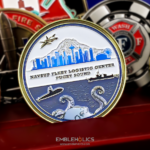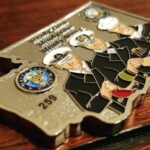
Every service has a birthday, and most of them mark it with a ball, which makes service birthdays one of the most reliable reasons a command orders coins. This one was made for the 240th Navy Birthday Ball at Naval Base Kitsap Bremerton, Washington. It is cut to the outline of Washington state, carries Navy rank insignia from the junior enlisted ranks through chief and officer on the front, shows the Bremerton skyline, a submarine and a carrier returning to port on the back, and each coin is individually serial numbered.
The dates, and when to order against them
The six service birthdays:
- Army — 14 June 1775
- Navy — 13 October 1775
- Marine Corps — 10 November 1775
- Coast Guard — 4 August 1790
- Air Force — 18 September 1947
- Space Force — 20 December 2019
These dates do not move, which is the useful part. Unlike a deployment or a change of command, a birthday ball is on the calendar years in advance, so there is no excuse for a rush order and no reason to be designing in the final month. Work back from the ball date: allow time for artwork and revisions, approval by whoever is signing off, production, and shipping, and start earlier than feels necessary.
The committee is usually the bottleneck, not the manufacturing. Ball committees are volunteers doing this alongside their actual jobs, and the approval chain is often longer than for a unit coin because the coin represents the whole command. Begin the conversation as soon as the committee forms rather than once the design is agreed.
Serial numbering, and why it changes the coin
Each coin in this run carries a unique number, and that single feature changes what the coin is. An unnumbered ball coin is a souvenir. A numbered one is a limited edition with a place in a sequence, and people treat the two differently: numbered coins get kept, traded and asked after years later.
What to know before specifying it:
- It is applied after striking, not struck into the die. The number is added to each individual coin, which means it is a per-coin operation rather than a one-time tooling cost. Price it that way.
- It needs a designated flat area. Leave a clear space in the design for the number, ideally on the reverse or the edge. Numbers crammed into a gap between artwork look like an afterthought because they are one.
- Decide what the run size means. Numbering to the exact attendance makes each coin a record of who was there. Numbering to a round figure above attendance leaves room for guests, late additions and the command’s own stock.
- Think about who gets low numbers. Someone will care. Agree the convention in advance rather than discovering it at the ball.
Designing around a place rather than a branch
A birthday ball coin has a problem a unit coin does not: the subject is an entire service. The Navy’s birthday belongs to every sailor, so a coin that simply shows an anchor and a date could have come from anywhere. What makes a ball coin memorable is anchoring it to the specific command and the specific place.
This one solves it geographically. Cutting the coin to the outline of Washington state locates it immediately, and the reverse fills in the detail: the mountains behind Bremerton, the Space Needle, a submarine, a carrier coming home. Anyone who served in the Pacific Northwest recognizes it without reading a word. A sailor who was at that ball has a coin that says where as clearly as it says when.
The rank progression on the front does similar work for a different reason. Showing the ranks from junior enlisted through chief and officer makes the coin belong to the whole command rather than to one part of it, which matters at an event where everyone from seaman to captain is in the room.
This one is close to home for us. Embleholics is a veteran-owned shop in Port Orchard, across the water from Naval Base Kitsap, so a coin shaped like Washington state for a Bremerton ball is about as local as our work gets.
Other formats for a ball
A coin is not the only option, and some commands order more than one piece. Bottle openers in coin form are popular as the general giveaway, with a numbered coin reserved for a smaller presentation group. Belt buckles and larger display pieces work for award recipients and guests of honor. If the budget has to stretch across a few hundred attendees and a handful of honorees, splitting the order into a volume piece and a presentation piece usually produces a better result than one compromise coin for everybody.
Ordering a birthday ball coin
Tell us the ball date, the expected attendance and whether you want numbering. Those three answers set the schedule, the quantity and the per-coin cost, which is most of what a committee needs to take back to its budget. We will show you the design at actual size before anything is struck. You can see more Navy challenge coins and military challenge coins we have produced, or send your details through the free quote form.
Frequently Asked Questions
When are the US military service birthdays?
The Army’s birthday is 14 June 1775, the Navy’s is 13 October 1775, the Marine Corps’ is 10 November 1775, the Coast Guard’s is 4 August 1790, the Air Force’s is 18 September 1947, and the Space Force’s is 20 December 2019. Each is marked with a birthday ball, which is why these dates drive a predictable annual cycle of commemorative coin orders.
How far ahead should we order coins for a birthday ball?
Earlier than feels necessary, and earlier than the design is settled. The ball date is fixed years in advance, so the schedule should be worked backwards from it with time for artwork, revisions, committee approval, production and shipping. The approval chain is usually the bottleneck rather than manufacturing, because a ball coin represents the whole command and more people sign off on it.
Can each challenge coin have its own serial number?
Yes. Numbering is applied to each coin after striking rather than being cut into the die, so it is a per-coin operation and priced as one. The design needs a designated flat area for the number, ideally on the reverse or the edge, because a number squeezed between artwork looks like an afterthought.
Should we number to attendance or to a round figure?
Numbering to the exact attendance makes every coin a record of who was in the room, which is the stronger idea. Numbering to a round figure above attendance leaves margin for guests, late additions and the command’s own stock. Either works, but agree in advance who receives the low numbers, because someone will care.
What should go on a birthday ball coin?
Something that locates it. A service birthday belongs to everyone in that branch, so an anchor and a date could have come from any command in the world. Tying the design to the specific base, region or command, as this coin does by taking the shape of Washington state, is what makes the coin mean something to the people who were actually there.
Can we order bottle openers instead of coins for a ball?
Yes, and many commands order both. A bottle opener in coin form works well as the general giveaway for a large attendance, with a numbered coin kept for a smaller presentation group. Splitting a fixed budget into a volume piece and a presentation piece usually produces a better result than one compromise piece for several hundred people.
Who usually organizes the coin order for a ball?
A ball committee, generally volunteers doing it alongside their regular duties. That is worth knowing because it shapes the timeline: decisions take longer than they would for a unit coin, and the committee often needs to show a cost per coin to a budget holder before anything can be approved. Getting a quote early, even before the design is agreed, helps that along.
More Navy Projects