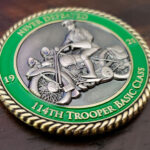
One face carries a classic state trooper on a vintage motorcycle, engraved. The other carries the newest patrol car in the fleet. It was made for the graduates of the 114th Trooper Basic Class, who asked for something classy and elegant with a strong idea behind it.
Putting the Past on One Side and the Present on the Other
A coin has two faces and most designs waste one of them, putting a crest on the front and a motto on the back. Pairing an old image with a current one uses both, and it is among the strongest two-sided ideas available.
It needs no caption. A motorcycle from the early days of the patrol next to this year’s cruiser explains itself in a second. Nobody has to be told what the pairing means.
It says something about the organization and about the holder at once. The agency has a long history, and the person holding the coin has just joined it. For an academy graduate that is precisely the right message, and it is far better than a date and a class number.
It gives each face a reason to exist. Neither side is the back. You have to turn the coin over to get the whole idea, which is more than most two-sided designs achieve.
The execution detail that makes it work: the two faces should be drawn in the same style and at the same level of detail, so the difference reads as time passing rather than as two unrelated pieces of art. Make the old side look like an old illustration and the new side look like a photograph and the coin falls apart.
Trooper School
Trooper school is the state patrol academy, the training a cadet completes after selection before being commissioned as a trooper. Basic training runs roughly 10 to 30 weeks depending on the state, and the selection process in front of it is rigorous enough that a class finishing together is a meaningful achievement rather than a formality.
That is why academy classes order coins. A class is a fixed group of people who went through something demanding at the same time, and they scatter to posts across the state the week after graduation. The coin is the thing that marks the group, and for most graduates it is the first coin of a career.
A class coin is also numbered by nature. The 114th class is the 114th class and no other, so the number on the coin dates it deliberately rather than by accident. That is the opposite of most coin advice, and it is correct here.
See also academy graduation challenge coins and state police challenge coins.
Motorcycles and the History of State Patrols
The motorcycle is the right historical image for a highway patrol, and not only because it looks good engraved. Early state traffic enforcement was done on motorcycles before patrol cars were standard, which makes the machine a genuine marker of the organization’s beginnings rather than a decorative choice. Many state agencies still run motorcycle units today, so the image is also not purely historical.
For a design, that history gives the old side something specific to be accurate about: the shape of the machine, the uniform of the period, the style of the equipment. Getting those details right is what separates a heritage image from a generic old-timey one, and it is worth checking against the agency’s own historical photographs rather than against stock imagery.
Classy and Elegant in Practice
The brief asked for classy and elegant, which is a real design direction with specific consequences.
Restraint over coverage. An elegant coin leaves metal visible. Filling every surface with color or text is the single most common way a coin stops looking refined.
Engraving over enamel. Line work and relief read as considered; large areas of bright color read as energetic, which is a different and perfectly good register but not this one.
A consistent, quiet palette. If color appears at all it should be limited and muted, and ideally confined to one element rather than spread across the face.
And room around the subject. Negative space is what makes a design feel composed rather than crowded. It is also the first thing sacrificed when someone adds one more sponsor line or one more inscription.
See antique vs polished finishes and a police academy challenge coin.
Order a Class or Academy Coin
Professional artwork is free with unlimited revisions, and nothing goes into production until you approve a digital proof. The challenge coin minimum is 50 pieces, standard production runs about 45 to 50 days after final artwork approval, rush production is available on many projects, and shipping within the continental United States is included. Embleholics is veteran-owned, SDVOSB and registered in SAM.gov.
Two practical notes for an academy class. Count graduates, instructors, staff and family before setting the quantity, because classes almost always want more than the headcount and a reorder of the same class coin is an unusual thing to need. And if the design includes a historical image, send reference photographs from the agency’s own archive with the artwork request, since accuracy in the period details is what makes a heritage design land. Request a free quote to begin.
Frequently Asked Questions
What is a then and now challenge coin?
It is a two-sided design that pairs a historical image with a current one, such as an early motorcycle on the front and this year’s patrol car on the back. The contrast explains itself without a caption.
Why does the pairing work so well on a coin?
Because a coin has two faces and most designs waste one. A then and now layout gives each side a reason to exist, so the holder has to turn the coin over to get the whole idea.
How do you keep the two sides from clashing?
Draw them in the same style and at the same level of detail. If the historical side looks like an old illustration and the current side looks like a photograph, the coin reads as two unrelated pieces of art rather than one idea.
What is trooper school?
It is the state patrol academy, the basic training a cadet completes after a rigorous selection process before becoming a trooper. It typically runs about 10 to 30 weeks depending on the state.
Should an academy class coin carry the class number?
Yes. A class is a fixed group, the number identifies it permanently, and graduates scatter to posts across the state afterward. Dating this coin is deliberate rather than a mistake.
Why a motorcycle for a highway patrol heritage image?
Early state traffic enforcement was carried out on motorcycles before patrol cars became standard, so the machine marks the organization’s beginnings. Many agencies still run motorcycle units, so it is not purely historical either.
What makes a coin design look elegant?
Visible metal, engraving rather than large areas of enamel, a limited and muted palette, and space around the subject. Covering every surface is the most common way a coin stops looking refined.
How many coins should an academy class order?
Count graduates, instructors, staff and family rather than graduates alone. Classes consistently want more than the headcount, and reordering a specific class coin later is an awkward thing to need.
More Police Projects