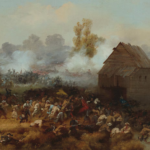
For thousands of years, the Strait of Hormuz has connected the Persian Gulf to the wider Indian Ocean, shaping trade, navigation, and cultural exchange across continents. Before modern shipping routes transformed the region, these narrow waters served as a meeting place for merchants, sailors, kingdoms, and empires whose influence can still be traced today.
Why the Strait of Hormuz Became One of History’s Most Important Waterways
The Strait of Hormuz became important because of its geography.
Stretching between the Persian Gulf and the Gulf of Oman, the Strait forms a narrow passage that has guided maritime traffic for thousands of years. Any vessel seeking to move between the Gulf and the open waters of the Indian Ocean eventually had to pass through this corridor. Over time, that geographic reality transformed the Strait into one of the world’s most significant maritime crossroads.
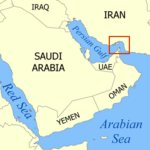
The history of the Strait of Hormuz is a story about movement. About how sailors, merchants, and travelers from distant regions repeatedly converged in the same place, bringing with them new ideas, technologies, beliefs, and traditions. Across centuries, the Strait became a bridge between cultures.
The Birth of a Maritime Crossroads
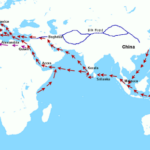
Before the rise of modern nations, the waters surrounding the Strait of Hormuz were already part of a vast maritime network.
Archaeological and historical evidence suggests that trade across the Persian Gulf dates back thousands of years. Coastal communities exchanged goods with neighboring civilizations, while merchants gradually expanded routes linking Mesopotamia, Persia, Arabia, India, and East Africa.
As maritime navigation improved, the sea became the most efficient highway for long-distance commerce.
Ports throughout the region became places where practical knowledge traveled alongside goods. Navigators shared routes and weather patterns. Shipbuilders adopted techniques from neighboring cultures. Merchants carried customs, languages, and religious traditions from one shore to another.
What emerged was a connected maritime world shaped by continuous exchange.
The Strait of Hormuz sat at the center of that process.
The Kingdom of Hormuz
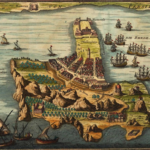
Koa-public. Persia Kingdom Ormus Strait Hormuz Old plan Bellin 1756, (2019). https://commons.wikimedia.org/wiki/File:Persia_Kingdom_Ormus_Strait_Hormuz_Old_plan_Bellin_1756.jpg
By the medieval period, the Strait’s strategic position had given rise to one of the most remarkable trading states in the Indian Ocean world.
The Kingdom of Hormuz began on the mainland before relocating to Hormuz Island, where its rulers sought greater security and stronger control over regional commerce.
The kingdom built influence through trade.
The rulers of Hormuz recognized an opportunity that geography had created. Merchants crossing between the Persian Gulf and the Indian Ocean needed safe harbors, reliable markets, and access to regional trade networks. Hormuz provided all three.
As ships arrived from distant ports, the kingdom grew wealthy from facilitating commerce.
Contemporary travelers described Hormuz as one of the most prosperous ports of its era.
Its harbors welcomed merchants from across the Indian Ocean, creating a city where different cultures interacted daily through commerce and seafaring life. Markets offered goods from distant regions, while the docks reflected the constant movement of people and ideas across the sea.
What made Hormuz remarkable was its ability to bring together communities that might otherwise never have met: its greatest value came from connection.
Portuguese Expansion and the Struggle for Control
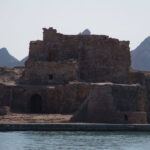
By سید محمود جوادی, CC BY 3.0, https://commons.wikimedia.org/w/index.php?curid=56170534
By the early sixteenth century, the importance of the Strait was evident to outside powers.
When Portuguese fleets entered the Indian Ocean, they encountered an established maritime system that had been developing for centuries. The region already possessed thriving trade routes, experienced navigators, and commercially connected port cities.
In 1507, Afonso de Albuquerque captured the island as part of Portugal’s effort to secure influence over major sea routes linking Europe and Asia. Fortifications soon rose above the harbor, including the imposing Fort of Our Lady of the Conception, whose remains can still be seen today.
whose remains can still be seen today.
Portuguese control marked a new chapter in the Strait’s history. However, merchants continued to move through the region, local communities remained tied to maritime commerce, and the Strait retained its role as a gateway between the Gulf and the Indian Ocean.
The Maritime Traditions That Defined Life in the Gulf
While kingdoms and empires competed for influence, everyday life throughout the region remained tied to the sea.
Generations of maritime communities built their livelihoods around the waters of the Gulf, developing traditions that lasted for centuries.
Pearl Diving

Before the twentieth century, pearl diving stood among the region’s most important industries.
Seasonal fleets departed coastal settlements each year, carrying divers into Gulf waters in search of one of the world’s most valuable natural resources. The work demanded extraordinary endurance and skill. Divers descended repeatedly with minimal equipment, relying on experience, teamwork, and intimate knowledge of local waters.
The diving season could last for months. Crews lived aboard their vessels, returning repeatedly to the same waters in search of pearls that would eventually be sold in markets across the region and beyond. The work was physically demanding and often dangerous, but it became one of the defining traditions of Gulf maritime culture.
The pearl trade connected Gulf communities to markets beyond the region, helping sustain maritime economies.
The Legacy of the Dhow

The dhow was closely associated with Gulf maritime culture.
Designed for long-distance travel, these ships connected ports throughout the Indian Ocean for centuries. Their captains relied on accumulated knowledge passed from one generation to the next, including celestial navigation, seasonal wind patterns, and the ability to read changing sea conditions.
In many ways, the dhow became a symbol of the maritime traditions that shaped life around the Strait of Hormuz for generations.
Oil Changed the Strait of Hormuz in the Twentieth Century
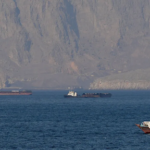
The twentieth century introduced a new chapter in the history of the Strait.
Industrialization transformed global commerce, while the development of oil production throughout the Gulf reshaped international shipping patterns. Increasing numbers of tankers began moving through the passage, carrying energy resources to markets around the world.
The spice traders, pearl fleets, and merchant convoys that once defined the region gradually gave way to industrial shipping on an unprecedented scale.
Yet the reason ships continued to pass through Hormuz remained remarkably similar to centuries before.
There was still no substitute for the passage itself.
The same geography that once attracted merchants, sailors, and empires now placed the Strait at the center of the modern global economy.
The Legacy of the Strait of Hormuz
The history of the Strait of Hormuz is ultimately a history of movement.
Across centuries, different peoples arrived with their own ambitions, traditions, and knowledge, yet all were shaped by the same narrow passage between the Gulf and the open ocean. Ancient merchants, medieval kingdoms, naval empires, pearl divers, and modern shipping companies each found their own reasons to value these waters.
The Strait remained what it had always been: a meeting place between worlds.
Recent Posts