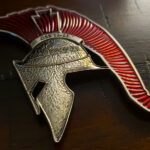
This coin is not a disc with a helmet printed on it. The coin is the helmet: cut to the outline of a Spartan warrior helmet and sculpted in relief so the form reads as an object rather than a picture. It was made for the 28th Infantry Division.
Building a Helmet in Metal
A helmet is one of the more demanding shapes to produce, and the reason has nothing to do with the outline.
A helmet is a three dimensional object that everyone has seen from the side. Cut it flat and the eye immediately notices it is flat. The shape alone does not do the job, which is why this coin was sculpted rather than struck from a flat layout.
The production route is worth understanding before you specify one:
A 2D layout comes first. The design is drawn flat and approved flat, because that is where the outline, the proportions and the placement of any lettering get settled.
Then the flat drawing is turned into a sculpture. The approved artwork is translated into a three dimensional model, with the crest, the cheek guards, the nasal and the eye openings each given their own depth. That model is what the die is cut from.
Depth is the whole decision. A sculpted coin has a limited range of relief available, so the sculptor is choosing what stands proud and what recedes. On a helmet, the crest needs the most height, the brow and nasal need the next tier, and the surface of the dome needs to curve rather than sit flat. Get the hierarchy wrong and a sculpted coin looks mushy instead of carved.
And the openings matter. The eye slots and the gap beneath the nasal are where a helmet reads as a helmet. Those are either cut through the metal or recessed deeply enough to read as shadow. Cutting through is more dramatic and more fragile; recessing is sturdier. It is a decision to make at the artwork stage rather than later.
The crest is also the weak point in use, because it is the part that projects furthest. The same consideration applies to any shape with a raised extension. See custom shaped challenge coins and, for the difference between flat and sculpted work, 2D vs 3D challenge coins.
Why a Spartan Helmet
The Spartan helmet has become one of the most used devices in military coin design, and it is worth being honest about both sides of that.
It works because it reads instantly at small size. The silhouette is unmistakable even when it is an inch across, which is more than can be said for most historical imagery. It also carries a clear meaning without needing any text to explain it.
It is common enough that execution is what separates one from another. A great many units have used it. What makes this version its own is the sculpting: the depth of the crest, the curve of the dome, the shadow in the eye slots. A flat helmet outline is generic. A properly sculpted one is a specific object.
If your unit wants a shape that is instantly readable but less used, the same sculpting approach works on anything with a strong profile. A tool, an animal, a piece of equipment tied to the unit’s mission, a local landmark. The requirement is a silhouette that holds up small, not a particular subject.
About the 28th Infantry Division
The 28th Infantry Division is a unit of the Army National Guard and the oldest division-sized unit in the Department of Defense.
It was first known as the Keystone Division, having been formed from Pennsylvania National Guard units, and it took the name Iron Division from General Pershing during the First World War. It is the oldest continuously serving division in the Army and among the most decorated. Its deployments have included Bosnia, Kosovo, the Sinai, Kuwait, Iraq and Afghanistan.
A unit with that record has a particular problem when it comes to coin design: a century of history is too much to put on one face. A single strong device is the better answer, and that is what this coin does. See more National Guard challenge coins.
Order a Shaped and Sculpted Coin
Professional artwork is free with unlimited revisions, and nothing goes into production until you approve a digital proof. The challenge coin minimum is 50 pieces, standard production runs about 45 to 50 days after final artwork approval, rush production is available on many projects, and shipping within the continental United States is included. Embleholics is veteran-owned, SDVOSB and registered in SAM.gov.
Two things to raise early. Sculpted coins cost more than flat ones because a three dimensional model and a deeper die are involved, so say at the quote stage whether you want relief or a flat design. And a shaped coin does not fit standard capsules or display racks, so packaging needs specifying separately. Request a free quote to begin.
Frequently Asked Questions
What is a helmet shaped challenge coin?
It is a coin cut to the outline of a helmet rather than struck as a disc, usually sculpted in relief so the form reads as a three dimensional object. The Spartan helmet is the most common version because its silhouette stays recognizable at coin size.
Can a challenge coin be made in any shape?
Almost any, provided the silhouette holds together at coin size and has no extremely narrow projections. The practical limits are fragility at thin points and the fact that a custom outline will not fit standard packaging.
Does a helmet coin need to be sculpted?
In practice, yes. A helmet is an object everyone has seen in three dimensions, so a flat version looks flat. Sculpting gives the crest, brow and dome their own depth, which is what makes the shape read as a helmet rather than a cutout.
How is a 3D coin design made?
The design is drawn and approved as a flat 2D layout first, since that is where proportions and lettering get settled. The approved artwork is then translated into a three dimensional model, and the die is cut from that model.
What makes sculpted relief look good or bad?
The depth hierarchy. A coin has a limited range of relief available, so the sculptor decides what stands proud and what recedes. A clear hierarchy reads as carved; an even one reads as mushy, which is the usual failure in sculpted work.
Can the eye openings be cut through the coin?
Yes, and it is more dramatic, but cut-through openings make the piece more fragile. Recessing them deeply enough to read as shadow is sturdier and often looks just as good. Decide at the artwork stage rather than after the die is cut.
Is a 3D challenge coin more expensive?
Yes, because a three dimensional model has to be produced and the die is deeper and more complex to cut. The difference is worth raising at the quote stage so you can compare a sculpted and a flat version of the same design.
Are Spartan helmet coins overused?
The device is common, which means execution is what distinguishes one from another. A flat helmet outline looks generic; a properly sculpted one with real depth in the crest and shadow in the eye slots is a specific object. If you want something less used, any subject with a strong profile works the same way.
More Navy Projects