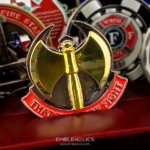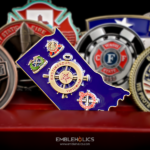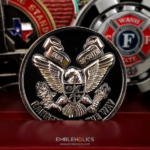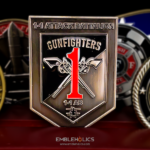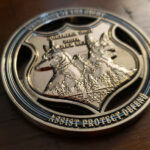
The coin keeps the outline of an ordinary round coin, but parts of it are hollowed out so that a badge shape sits within the surface. The base is machined and carved, with images and lettering applied during detailing. It was made for the military working dog unit at Fort Wainwright, Alaska.
A Badge Shape Inside a Round Coin
This construction is the most interesting thing about the coin, and it is a genuine third option alongside a round coin and a cut-to-shape one.
The badge is defined by what is removed, not by the outline. Rather than cutting the coin to a badge shape, the round outline is kept and material around the badge is taken out. The badge then reads as the solid form standing within a ring.
It keeps the structural advantages of a disc. A coin cut to a badge shape has points and edges that bend. A round coin with internal removals keeps its full rim, which is the strongest part of any coin, so the piece stays rigid in a way a cut badge would not.
And it keeps standard packaging usable. The outline is still a circle, so capsules, sleeves and display cases fit, which a shaped coin rules out.
The cost is usable area. Everything removed is surface you no longer have, so a coin with substantial hollowing has less room for artwork than the same disc intact. It also means the remaining connections between the badge and the rim have to be wide enough to hold the whole thing together.
The shape of the removed areas is doing as much work as the shape of the badge, because what the eye reads is the contrast between solid and open. That means the negative spaces have to be deliberate forms rather than whatever is left over. See whether cutouts make a coin weaker and custom shaped coin vs cutout coin.
Coins for a Military Working Dog Unit
An MWD unit is one of the best coin candidates on any installation, and the reasons stack up.
It is a small specialized team. A handful of handlers with their own training pipeline, their own kennels and a specialty nobody else on the post has. That is the level at which a coin carries weight.
The dogs are part of the unit. A coin is one of very few forms of recognition that can include working animals alongside the people, which gives these coins a subject that is genuinely their own rather than a variation on a unit crest.
Handlers meet other handlers constantly. MWD teams train with units from other services and agencies, attend certifications and work alongside civilian police K-9 units. Those are exactly the occasions where coins get exchanged, so the coin has a real use rather than a theoretical one.
And the unit nickname is usually its own. Guardians of the Night is the unit’s name for itself, and a name a team has chosen is better coin material than anything a designer could supply.
See also a military police K9 coin, a police dog challenge coin and a shield shaped challenge coin.
About Military Working Dogs
Using dogs for hunting is ancient, but formal military working dog training programs became common only after the First World War. In the United States and the United Kingdom these animals are variously called police dogs, military working dogs or K-9, and their roles are varied, though they are less often employed in front-line units.
Fort Wainwright is a United States Army installation at Fairbanks, Alaska, managed by US Army Garrison Alaska, with the 11th Airborne Division as its senior command.
The Alaska posting is worth noting as a design opportunity that many units overlook. A unit in an unusual environment has something specific to draw on, and climate, terrain or latitude are all stronger coin material than a generic device would be.
Designing Around a Unit Nickname
A name like Guardians of the Night gives a designer a clear direction, and the question is how literally to take it.
The reliable approach is to let the name set the palette and the tone rather than illustrating it directly. Dark fills, deep recesses and a restrained metal read as night without needing a moon or stars on the face. An illustrated night sky, by contrast, spends the whole surface on a background.
Two other points. A nickname belongs on the coin as lettering, because it is the part outsiders will not know and the part the unit will want to see. And if the name has a story behind it, that story is worth sending along with the artwork, because it frequently suggests a better device than the obvious one.
One note on text. If your unit uses a particular prayer, creed or passage associated with working dogs, check its authorship before putting it on a coin. Several in circulation have named authors and may still be protected, and that is a question better answered before a die is cut. We produce from the text a customer supplies and do not verify permissions on a customer’s behalf.
Order a Coin for Your Unit
Professional artwork is free with unlimited revisions, and nothing goes into production until you approve a digital proof. The challenge coin minimum is 50 pieces, standard production runs about 45 to 50 days after final artwork approval, rush production is available on many projects, and shipping within the continental United States is included. Embleholics is veteran-owned, SDVOSB and registered in SAM.gov.
Two suggestions. If you want a shaped element without a shaped coin, ask about internal removals rather than a custom outline; you keep the strength of a full rim and standard packaging, and the open areas become part of the design. And send your unit nickname and where it came from, because a name the team chose for itself is the element most likely to make people keep the coin. Request a free quote to begin.
Frequently Asked Questions
What is a military working dog challenge coin?
It is a coin made for an MWD unit, the handlers and dogs on a military installation. These are small specialized teams with their own training pipeline, and a coin is one of the few forms of recognition that can include the animals.
Can a badge shape sit inside a round coin?
Yes. Rather than cutting the coin to a badge outline, the round shape is kept and material around the badge is removed, so the badge reads as a solid form standing within a ring.
Why not just cut the coin to the badge shape?
Because a cut badge has points and edges that bend, where a round coin with internal removals keeps its full rim, which is the strongest part of any coin. It also still fits standard capsules and display cases.
What is the drawback of hollowing out a coin?
Lost surface. Everything removed is area no longer available for artwork, and the remaining connections between the inner form and the rim have to stay wide enough to hold the piece together.
Do the removed areas need designing?
Yes, as much as the solid parts. What the eye reads is the contrast between solid and open, so the negative spaces have to be deliberate shapes rather than whatever happens to be left over.
Why do K-9 and MWD units order coins?
Because they are small specialized teams with a specialty nobody else on the post has, the dogs can be recognized in no other way, and handlers constantly train alongside other services and civilian police units, which is where coins get exchanged.
How should a unit nickname shape the design?
Let it set the palette and tone rather than illustrating it literally. Dark fills and deep recesses read as night without spending the whole face on a night sky. The nickname itself belongs on the coin as lettering.
Can we put a working dog prayer or creed on the coin?
Check the authorship first. Several passages in circulation have named authors and may still be protected, with stricter rules on selling an item that carries them than on giving one away. Settle that before a die is cut.
More Army Projects