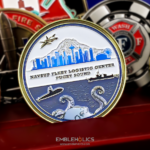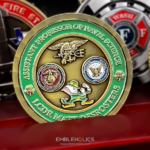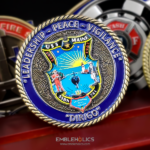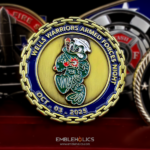
A presentation challenge coin is given by a commander or senior official in an official capacity, usually to someone outside the organisation. Because the recipient may know nothing about the command, the design has to be legible and formal in a way a unit coin never has to be.
What Is a Presentation Coin?
Almost every other coin on this site belongs to the people who receive it. A unit coin, a division coin, an association coin, all of them go to members, and the design can assume the recipient already knows the organisation from the inside.
A presentation coin does the opposite. It is given by someone acting for the command rather than by a member sharing something with peers, and it is given outward. The recipient is a visiting officer, an allied counterpart, a civilian official, a contractor, a partner organisation, or a family member at a ceremony.
That single difference drives everything else. The design cannot rely on shared knowledge, because the person holding it may have walked into the building an hour ago. It has to identify the command clearly, look correct to someone who deals with a dozen organisations a month, and survive being examined closely, because presentation coins are handed over one at a time, usually with a handshake, and usually looked at immediately.
There is also a status element that is easy to miss. A unit coin says you are one of us. A presentation coin says you were received by us. Those are different messages, and the second one is why these coins end up on desks and in display cases rather than in pockets.
Who Gives Presentation Coins, and to Whom?
Who gives them. Commanding officers and flag officers, programme and project office heads, agency directors and deputy directors, civilian executives and senior government officials, and the protocol staff who manage official visits on their behalf. The coin is usually described as belonging to the office rather than to the individual: the commander’s coin, the director’s coin.
Who receives them. Visiting officers from other commands. Allied and foreign counterparts, which is common enough at fleet and joint command level that it shapes the design conventions. Civilian officials and elected representatives on official visits. Contractors and industry partners at programme milestones. Individuals being recognised for a specific contribution. Families at change of command, retirement and commissioning ceremonies.
How that changes quantity. These coins are given deliberately, one at a time, for a specific reason. A unit coin might be distributed to two hundred people in an afternoon. A commander’s coin might last a whole tour at a few dozen a year, which means the order is smaller and the design has to stay current for longer. It also means the stock is held by an office rather than handed out, so reorders are planned rather than urgent.
Programme offices work the same way at a different level, as our page on program office coins covers, and joint commands add another layer again, described on our page about coins for joint and coalition commands.
Why Presentation Coins Are Formal
The formality is not conservatism. It follows from who is holding the coin.
No in-jokes or unit shorthand. An outsider will not get them, and a design that excludes its recipient is a failure of hospitality rather than a piece of character. This is the exact opposite of the advice we give for unit coins, and the reasoning behind that is on our page about when a coin should not be formal.
Conventional round formats. Custom shapes read as informal, and at this level a round coin is the expected object. Meeting the expectation is the point.
Restrained colour or none at all. Relief, engraving and two-tone metal carry these designs. Bright enamel tends to read as a souvenir, and souvenirs are not what is being exchanged.
Heraldry that is correct. Command insignia, service seals and national devices have rules, and a foreign counterpart handed a coin with an error on it will notice. This is the one category where getting a device slightly wrong has diplomatic rather than aesthetic consequences.
And then the consequence of all that restraint: with no colour, no shape and no humour to carry the object, the execution is the entire product. There is nothing to distract from a shallow relief, uneven spacing, a crowded field or a border that does not meet itself. A presentation coin is a harder thing to make well than a colourful one, because every decision is visible.
Presentation and Packaging
A coin handed over individually is usually presented in something. A coin distributed from a box is not.
Packaging is quoted as part of the project rather than sold from a fixed list, because what suits a commander’s coin is different from what suits a two-hundred-piece unit run. If the coins are for official presentation, say so when you request a quote and the options that fit will be included in it.
Two practical points worth raising early. Packaging affects both cost and lead time, so it belongs in the first conversation rather than added at the end. And if coins will be presented to foreign counterparts or carried to official visits, mention that too, because it changes what makes sense.
About This Seventh Fleet Coin
The United States Seventh Fleet is a numbered fleet of the U.S. Navy, headquartered at Fleet Activities Yokosuka in Japan. This coin was produced for the Seventh Fleet Commander’s office.
The coin is a conventional round format. Insignia and emblems are struck in relief on both faces, and a rope pattern is machined around the rim and edge. There is no colour, no custom shaping and no novelty feature of any kind.
The detail worth looking at is the rope border. A rope rim is a repeating pattern that has to travel the full circumference and arrive back where it started, and the join is the hardest part of the piece. A rope that does not meet itself cleanly leaves a visible seam, a doubled twist or a flattened section at the closure point, and on a coin that is going to be examined at arm’s length by someone who handles a lot of them, that is the first thing seen. Getting the repeat to divide evenly into the circumference is a decision made in the die rather than a matter of care at the strike.
This is also why the rest of the coin looks the way it does. Relief on both faces and nothing else means the depth of the strike and the spacing around each device are doing all the work. There is no enamel to define an edge and no shape to make the object interesting, so the design succeeds or fails on proportion. Rim treatments in general are covered on our page about rim and edge options.
Can We Use Our Command Insignia on a Coin?
Most commands can, but the authorisation has to come from the command, not from us. Command insignia, service seals, flag devices and agency emblems are controlled by the organisations that own them, and the rules differ between branches, between commands and between governments.
The practical version is straightforward. Clear the artwork through your own chain of command before you order, and send us artwork your organisation is authorised to supply. We produce from what the customer provides and we do not grant permission on anyone’s behalf. If you are unsure who signs off, your command’s public affairs or protocol office is usually the right place to ask.
Design a Presentation Coin
Professional artwork is free, with unlimited revisions, and nothing goes into production until you approve a digital proof. If the coin is for official presentation, say so at the start, because it affects the format, the finish and the packaging.
The minimum order is 50 coins. Standard production runs about 45 to 50 days after final artwork approval, rush production is available on many projects, and shipping within the continental United States is included. Embleholics is veteran-owned, SDVOSB and registered in SAM.gov. Browse more custom Navy challenge coins or request a quote to get started.
Frequently Asked Questions
What is a presentation challenge coin?
A presentation challenge coin is given by a commander or senior official in an official capacity, usually to someone outside the organisation. It is handed over individually rather than distributed, and it is designed to be understood by a recipient who may know nothing about the command.
How is a commander’s coin different from a unit coin?
A commander’s coin is given outward to visitors, counterparts and officials, while a unit coin is shared among members. That changes the design: a commander’s coin avoids in-jokes and novelty, uses a conventional round format, and has to identify the command clearly to someone unfamiliar with it.
Who receives presentation coins?
Presentation coins go to visiting officers, allied and foreign counterparts, civilian officials and elected representatives, contractors and industry partners, families at ceremonies, and individuals being recognised for a specific contribution. They are given deliberately and one at a time rather than distributed in bulk.
Why are presentation coins usually plain?
Presentation coins are plain because their audience is external. In-jokes, novelty shapes and bright enamel read as informal or souvenir-like to a recipient who is not a member of the organisation. Relief, engraving and two-tone metal carry the design instead, which also sets a higher standard for execution.
Can presentation coins be supplied in cases?
Packaging is quoted as part of each project rather than sold from a fixed list, because what suits an individually presented commander’s coin differs from a bulk unit run. Mention at the quote stage that the coins are for official presentation and the suitable options will be included.
Does a commander’s coin change when the commander changes?
Often, but not always. Many offices treat the coin as belonging to the post rather than the person and keep the same design across changes of command, while others issue a new coin for each commander. Designs built around the command insignia rather than an individual’s name last across both approaches.
Can we use our command insignia on a coin?
Command insignia, service seals and flag devices are controlled by the organisations that own them, so permission has to come from your command rather than from a manufacturer. Clear the artwork through your chain of command and send us artwork your organisation is authorised to supply.
What is the minimum order for presentation coins?
The minimum order for custom challenge coins is 50 coins. Presentation coins are given out more slowly than unit coins, often a few dozen a year, so a minimum order typically covers a full tour rather than a single event.
More Navy Projects