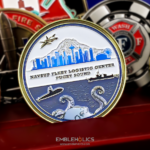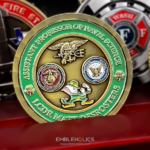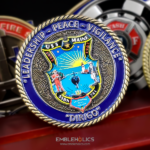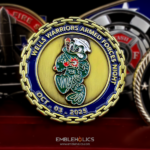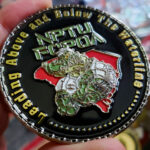
Challenge coin rim designs fall into six common types: plain, rope, chain, beaded, reeded and diamond cut. The edge does two jobs at once. It frames the artwork on both faces, and it takes the wear first, protecting the design as the coin is carried, handled and set down on hard surfaces.
What Are the Rim Options on a Challenge Coin?
- Rope. A twisted cable running the full circumference, and the most common edge on military coins by a wide margin. The convention is maritime, since rope is the oldest naval material there is, which is why it turns up on so many Navy and Coast Guard pieces. It is also the most forgiving edge, because the repeating twist reads clearly at any size and hides small irregularities in the strike.
- Chain. Interlocking links in relief, as on this coin. Heavier and more mechanical than rope, and better suited to units whose work is industrial rather than seafaring: engineering, maintenance, propulsion and ordnance. Chain also carries an obvious secondary meaning for command groups. Linked, individually replaceable, stronger as a run than as a single piece.
- Beaded. A ring of raised dots. Borrowed directly from circulating currency, where the beaded border was originally a security feature, and it makes a coin feel like money in the hand. It is quiet, so it works well under a busy face.
- Reeded. The fine vertical ridges you feel on the edge of a quarter, cut into the side rather than the face. Reeding does not use up any of the design area, which makes it useful on coins where every millimetre of the face is already spoken for.
- Diamond cut. A machined bevel that catches the light along the rim, usually left unplated or plated a second color so the cut line reads as a bright ring. It looks best on polished finishes and gets lost under antique plating.
- Plain. A flat rim with no treatment, which is a decision rather than an omission. When a design has a dense crest, a long motto and a ring of text, a plain edge gives it room to breathe.
Custom rims are also possible on the right project: a repeating unit device, a rank chevron, or a rope swapped for an anchor chain. That is a die-cutting question, so raise it early while the artwork is still being drawn.
What Does a Rim Actually Do?
A coin lives in a pocket, a desk drawer or a challenge coin rack, and it spends its life touching other things. The rim is the part that touches them. A raised edge holds the faces off whatever surface the coin is resting on, so scuffing lands on the border instead of on the unit crest. On a coin that will be carried daily for a twenty-year career, that is the difference between a design that stays readable and one that goes soft at the high points.
The rim also does the framing. Without a boundary, artwork that runs close to the edge looks like it has been cropped, and text set in a ring around the face has nothing to sit against. A raised border closes the composition and stops a busy centre spilling.
That leads to the one rule worth remembering. A decorated rim and a detailed face compete. A rope or chain edge is itself a pattern, and it borrows attention from whatever is inside it. A coin with a fine-line crest, a dense seal or a lot of small text almost always looks better with a plain or beaded edge. A coin built around a single bold device, such as a mascot, a silhouette or a number, can carry a heavy rope or chain rim and be better for it.
Coins for Training Commands and Staff
The people at a Navy schoolhouse are mostly not students. They are instructors, watch supervisors and support staff assigned to the command on a fixed tour, and the student population turns over around them several times a year.
That churn is exactly why staff at training commands form associations. A First Class Petty Officer Association, a chief’s mess or a wardroom gives a rotating staff something continuous to belong to, and it is usually the body that organises professional development, community events and fundraising at the command.
Their coins reflect that. A training command staff coin marks a tour and a role, the people who ran the place for two or three years, rather than a qualification earned or a course passed. It is a different object from a graduating class coin, which marks a specific cohort and a specific date, and the two rarely look alike. Staff coins lean on the command’s identity, its mascot and its in-jokes. Class coins lean on the class number and the graduation year.
Because these associations are funded by their own members rather than by the command’s budget, quantity matters more than it does on an official coin. A First Class association at a mid-sized command might have sixty to a hundred members, which sits just above the 50-coin minimum, and coins are often sold on to members at cost rather than issued.
About This NPTU FCPOA Coin
The NPTU FCPOA is the First Class Petty Officer Association at a Navy Nuclear Power Training Unit. First Class Petty Officers are senior enlisted sailors at the E-6 paygrade, and the association is made up of the First Class Petty Officers assigned to the command.
They asked for something with a sense of humour. The front carries their mascot, an alligator drawn as a cartoon, engraved into the face. The reverse puts the command logo embossed at the centre, with symbols and insignia etched in a ring around it. Both faces are painted in glossy color, and chain relief runs the full rim on both sides.
The chain is the choice that makes the coin work. A cartoon alligator on its own would read as light, almost novelty. Ringing it in heavy mechanical chain sets a hard industrial border against a soft drawing, and the contrast is what stops the coin looking like a joke. It also suits a nuclear propulsion command better than rope would, because this is a plant rather than a ship.
This is the second project for the same command. We also made a belt buckle for the same command using related artwork, which is worth seeing alongside this coin if you are deciding between the two formats. For a contrasting edge treatment on the same service, compare a rope-edged Navy coin, and for more on the alligator side of it, see how unit mascots on coins are usually handled. Associations aboard a seagoing command work the same way. See coins for associations aboard a command for an example.
Can We Use Our Command Insignia on a Coin?
Most units can, but the authorisation has to come from the unit, not from us. Command logos, unit insignia, service seals and agency emblems are all controlled by the organisations that own them, and the rules differ from one to the next.
The practical version is straightforward. Clear the artwork through your own chain of command before you order, and send us artwork your organisation is authorised to supply. We produce from what the customer provides and we do not grant permission on anyone’s behalf. If you are unsure who signs off, your command’s public affairs office or your association’s parent organisation is usually the right place to ask.
Design a Coin for Your Command
Professional artwork is free, with unlimited revisions, and nothing goes into production until you approve a digital proof. The minimum order is 50 coins. Standard production runs about 45 to 50 days after final artwork approval, with rush production available on many projects, and shipping within the continental United States is included. Embleholics is veteran-owned, SDVOSB, and registered in SAM.gov. Browse more custom Navy challenge coins or request a quote to get started.
Frequently Asked Questions
What rim options are available on a challenge coin?
Standard challenge coin rim designs include plain, rope, chain, beaded, reeded and diamond-cut edges. Rope is the most common border on military coins, chain suits engineering and industrial commands, and beaded and reeded borders are borrowed from circulating currency. Custom rim patterns are possible on some projects when the artwork calls for them.
What is a rope edge coin?
A rope edge coin has a twisted cable pattern raised around the full circumference of the rim. It is the most common border on military challenge coins, particularly Navy and Coast Guard pieces, because rope is the defining maritime material and the pattern reads clearly at any coin size.
What is chain relief on a coin rim?
Chain relief is a border of interlocking links raised around the edge of a coin. It is heavier and more mechanical than a rope edge, which makes it a natural fit for engineering, maintenance and propulsion commands, and it frames bold central artwork without competing with fine detail.
Does a decorated rim cost more than a plain one?
A decorated rim is cut into the die rather than added afterwards, so it is part of the overall project quote rather than a separate line item. Quantity, coin size, plating and the complexity of the two faces usually move a quote far more than the choice of edge does.
Why do so many Navy coins have rope edges?
Navy coins use rope edges because rope is the defining material of seafaring, and the twisted cable border has been shorthand for maritime service on medals, badges and plaques for well over a century. It also echoes the rope borders that frame ship’s crests and command seals.
Should a detailed design have a plain rim?
Usually yes. A rope or chain border is a pattern in its own right and competes with fine detail, so coins carrying a dense crest, a long motto or a ring of small text generally look sharper with a plain or beaded edge. Bold single-device designs can take a heavy rim.
What is a First Class Petty Officer Association?
A First Class Petty Officer Association, or FCPOA, is a professional organisation made up of the E-6 First Class Petty Officers assigned to a Navy command. First Class Petty Officers are senior enlisted sailors, and their associations handle professional development, community service and command events.
What is the minimum order for challenge coins?
The minimum order for custom challenge coins is 50 coins. Association and mess orders often sit just above that figure, and larger quantities reduce the cost per coin. Minimum quantities for other products, such as belt buckles, may differ by item.
More Navy Projects