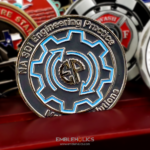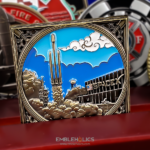
A Native American challenge coin is a government coin. A tribal nation is a sovereign government with its own territory, its own law and its own treaty relationship with the United States, so its coin sits alongside a city, state or federal agency coin rather than alongside a club or company one. That changes who can authorize the artwork, how faithfully it has to be reproduced, and what the coin is used for. This one was made for the Muckleshoot Indian Tribe, whose reservation lies on Muckleshoot Prairie southeast of Auburn, Washington.
A Tribal Nation Coin Is a Government Coin
The practical differences show up immediately once you treat a nation’s coin as a government coin.
- It is presented, not sold. Government coins are given by officials to visitors, partner agencies, employees and guests, which means the quantity is driven by how often the nation hosts people rather than by membership.
- It has to be correct. A seal reproduced loosely on a company coin is a design decision. On a government coin it is an error, and the people who notice are the ones the coin is handed to.
- It outlasts an administration. Elected tribal councils change. A coin built around the nation’s emblem, values and land stays correct, where a coin built around a current council does not.
- Approval runs through the government. Not through whoever happens to be ordering.
Whose Emblem It Is, and Who Can Authorize Its Use
A tribal nation’s seal or emblem belongs to the nation, and the nation’s government controls its use. That is the whole of the rule, and it is worth being plain about because it catches people out.
An employee of a tribal department, a contractor working on tribal land, a vendor, a sports team or an event organizer does not acquire the right to put the nation’s emblem on merchandise by working with the nation. The authorization has to come from the nation itself, through whatever process its government uses, and some nations have a specific office or a written policy for it.
Our position is the same here as it is for military insignia, agency seals and corporate logos. We produce from the artwork a customer supplies, we rely on the customer to hold the right to supply it, and we do not grant permission on anyone’s behalf. If you are ordering on behalf of a tribal department or an outside organization, get the approval in writing before the artwork stage, not after you have a proof you like.
Reproduce the Artwork, Do Not Reinterpret It
When a nation supplies its own emblem or artwork, the correct approach is to reproduce it as closely as the process allows rather than to improve it.
This is not deference for its own sake. Indigenous design traditions in the Pacific Northwest and elsewhere use forms that carry specific meaning, and an outside designer adjusting a shape for balance or simplifying a figure to make it strike more cleanly can change what the artwork says. The usual instinct in coin design is to redraw and simplify. On tribal artwork that instinct is the thing to suppress.
What this means in practice is that the conversation at the artwork stage runs the other way from normal. Instead of proposing changes, we identify where the design will be difficult at coin size and ask the nation what may be altered and what may not. Some elements can be scaled or separated, and some cannot be touched at all. That answer comes from the nation, not from us.
If a design genuinely cannot hold its detail at coin size, the honest options are a larger diameter or a different layout, not a quietly simplified version of someone else’s artwork.
A Ring of Values Around the Emblem
The front of this coin carries the nation’s emblem in color on a black field, with the nation’s values set in a ring around it. That layout deserves more use than it gets.
A ring is the one place on a coin where a long piece of text works. Set across the face, a list of words needs several short lines, each one competing with the artwork for the middle of the coin. Set around the rim, the same words follow a continuous path at the outer edge where there is nothing else to collide with, and they frame the subject instead of crowding it.
Three things to settle before the artwork is approved:
- Where the ring starts and stops. Text around a circle has to begin somewhere, and the gap at the bottom or the separator between words is a design element, not an afterthought.
- Whether it reads in one direction. Running the top half one way and the bottom half the other is common on seals and makes a short ring easier to read, but it looks wrong with a long list.
- How many words the rim can hold. There is a hard limit. Past it the letters become too small to strike cleanly, and the right fix is fewer words rather than smaller type.
Putting a Landscape on a Coin
The reverse carries the nation’s landscape, which is one of the harder subjects in coin design and one of the most rewarding when it works.
A landscape is the only common coin subject built from depth. An emblem, a badge or a flag is flat artwork, so it only needs one plane. A landscape needs several, and it fails in a specific way: when the foreground, the middle distance and the sky all sit at the same relief height, the scene collapses into a pattern and the viewer stops reading it as a place.
Three things make a landscape read.
Give each plane its own height. Foreground highest, distance lowest. The eye reads depth from relief long before it reads it from drawing.
Keep the sky empty. An uninterrupted field behind a ridgeline gives the whole scene somewhere to sit. Filling it with text or clouds removes the one piece of visual breathing space the design has.
Limit the palette and let metal carry the rest. Color in two or three places, with the remaining surfaces in bare or antiqued metal, gives more apparent depth than coloring everything does. A fully painted landscape at coin size tends to read as flat, because paint hides the relief that was creating the depth.
The black painted field on the front works in the same way: it is there so the emblem has something to sit against, not as a color choice of its own.
The Muckleshoot Indian Tribe
The Muckleshoot Indian Tribe is a federally recognized tribal nation in Washington State. Its members are descendants of the peoples of the Duwamish and Upper Puyallup watersheds of central Puget Sound, who lived there for thousands of years before non-Indian settlement.
The name comes from a Lushootseed word for the prairie between the White and Green rivers. After the reservation was established there in 1857, the nation became known as Muckleshoot rather than by the names of its Duwamish and Upper Puyallup ancestors. The nation describes itself as uniquely holding rights under two of the Stevens treaties, the Treaty of Medicine Creek and the Treaty of Point Elliott, both negotiated in the mid 1850s, and it was formally organized in 1936 following the Indian Reorganization Act.
Fishing, hunting and gathering remain central. Ancestors fished the rivers for salmon, trout and steelhead, gathered shellfish on Puget Sound, hunted game, harvested huckleberries and wove baskets from cedar, and tribal members continue to fish and hunt today. Any of that is a legitimate subject for the reverse of a coin, and it is the kind of material a nation should choose from itself rather than have chosen for it.
Embleholics is based in Port Orchard, across Puget Sound, which makes the Muckleshoot Indian Tribe a neighbor as well as a customer. See more challenge coins in Washington State.
Design a Coin for Your Nation or Department
Send the emblem file or seal you are authorized to use, along with any wording for a ring and anything you want on the reverse. Tell us which elements of the artwork may be adjusted for coin size and which may not, because that answer shapes the whole layout.
Professional artwork is free with unlimited revisions, and nothing goes into production until you approve a digital proof. Standard production runs about 45 to 50 days after final artwork approval, rush production is available on many projects, and shipping within the continental United States is included. Embleholics is veteran-owned, SDVOSB and registered in SAM.gov.
Frequently Asked Questions
What is a Native American challenge coin?
A Native American challenge coin is a coin made for a tribal nation, a tribal government department, or a tribal enterprise or program. Because a tribal nation is a sovereign government, these coins work like government and agency coins: they are presented rather than sold, they carry the nation’s emblem and values, and their use has to be authorized by the nation itself.
Can a tribal seal or emblem be used on a challenge coin?
Yes, with the nation’s authorization. A tribal nation’s seal or emblem belongs to the nation and its government controls how it is used, so approval has to come from the nation through whatever process it has for the purpose. Working with a tribal department, as a contractor, vendor or event organizer, does not by itself grant that right.
Who can approve the use of a tribal nation’s artwork?
The nation’s government, not the person placing the order. Some nations have a specific office or a written policy covering emblem use. Get the approval in writing before the artwork stage, because a manufacturer produces from the artwork the customer supplies and relies on the customer to hold the right to supply it.
Should tribal artwork be redrawn or simplified for a coin?
Only where the nation says it may be. Indigenous design traditions use forms that carry specific meaning, so adjusting a shape for balance or simplifying a figure to strike more cleanly can change what the artwork says. The right process is to identify where the design will be difficult at coin size and ask the nation what may be altered, rather than proposing changes.
How do you fit a list of words or values on a coin?
Set them in a ring around the rim rather than across the face. The rim gives text a continuous path at the outer edge where nothing else competes with it, and it frames the central artwork instead of crowding it. There is a hard limit to how many words a rim will hold legibly, and the fix for exceeding it is fewer words rather than smaller type.
Can a landscape scene be put on a challenge coin?
Yes, and it works when the planes are given different relief heights, with the foreground highest and the distance lowest. A landscape fails when everything sits at the same height, because the scene reads as a pattern rather than as a place. Keeping the sky empty and limiting color to two or three areas, with the rest in bare or antiqued metal, gives more apparent depth than painting the whole scene.
Who are the Muckleshoot Indian Tribe?
The Muckleshoot Indian Tribe is a federally recognized tribal nation whose reservation lies on Muckleshoot Prairie between the White and Green rivers, southeast of Auburn, Washington. Its members descend from the peoples of the Duwamish and Upper Puyallup watersheds of central Puget Sound, and the nation’s name comes from a Lushootseed word for that prairie.
Does the Muckleshoot Indian Tribe hold rights under more than one treaty?
Yes. The nation describes itself as uniquely holding rights under two of the Stevens treaties, the Treaty of Medicine Creek and the Treaty of Point Elliott, both negotiated in the mid 1850s, because its members descend from peoples covered by each of them.
More Corporate Projects