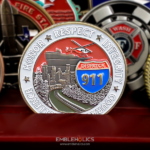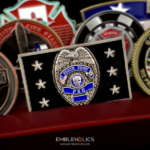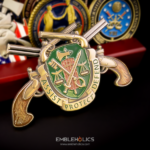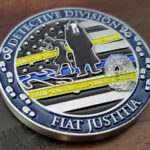
Detectives are the part of a police department least served by the usual coin vocabulary. There is no uniform, no patrol car, no badge worn on the chest, and the work is deliberately low profile. This coin was made for the Detective Division of the Bellingham Police Department in Whatcom County, Washington, and it solves the problem with character rather than equipment: the city’s mountains and river on one face, and detective figures silhouetted in a 1950s comic book style on the other.
Why detective units are hard to design for
Patrol has an obvious visual identity and investigations does not. A patrol coin can show a cruiser, a uniform, a badge, a K9. A detective division works in plain clothes, its tools are interviews and case files, and the parts of the job that would make good imagery are exactly the parts that should not go on a coin.
What is left, and what works:
- The archetype rather than the reality. The trench coat, the fedora, the silhouette in a doorway. It is a fictional detective rather than a real one, and that is the point: it is recognizable, affectionate and gives nothing away.
- The city. Investigations units are rooted in one jurisdiction in a way that specialist units are not. The place is a legitimate subject, and it ages well.
- Abstract tools of the trade. A magnifier, a fingerprint, a case file. These work, though they are used widely enough to look generic without something else carrying the design.
What to leave off is the shorter list but the more important one. No case references, no real names, no photographs of people, nothing that identifies a technique or a location. A coin outlives the case and circulates further than the unit.
Using an illustration style rather than an emblem
A period comic book treatment is an unusual choice on a police coin and a strong one. It signals that the unit has a sense of itself, it is instantly readable, and it separates the coin from the heraldic look of every other department piece.
Silhouette is the technical reason it works at coin size. A detailed illustration of a person loses its face, its hands and its clothing detail when shrunk to fit a coin. A silhouette has none of that to lose: it is defined entirely by outline, which strikes cleanly and reads at any size. If you want figures on a coin and you are not paying for full 3D sculpting, silhouette is the reliable way to get them.
Period styles carry a risk worth naming. A mid-century look is affectionate but it is also dated by design, and a unit should want that. If the coin is meant to be the division’s standing piece for the next decade, a period treatment is a commitment. If that gives anyone pause, the city imagery on the other face is the part that will not age.
Landscape on a coin
Mountains and a river are a good subject and a demanding one. Landscape needs depth to read: a range of peaks rendered at one relief height turns into a jagged line. The planes have to be separated, with the nearest ridge highest and each one behind it stepped down, so the eye reads distance rather than a single silhouette.
Glossy enamel suits a landscape better than most subjects. Water and sky are the two things on a coin that genuinely benefit from a flat, bright color area, because that is what they look like. Where we would normally push a working coin toward restraint, a landscape face is the case for letting the color do its job.
Keep the two faces in different registers. This coin pairs a colored landscape with a graphic silhouette, which works because neither is competing to be the detailed face. Two heavily illustrated sides on one coin is where these designs usually go wrong.
Who gets a division coin
A division coin is a small run, and that shapes the design. A detective division is a few dozen people at most, so the die is a significant share of the cost. Keep names and years off the artwork and the same design serves the division as people rotate in and out, which they will.
Allow for exchange. Investigators work with other agencies constantly, including county, state and federal units, and coin exchange is part of that. Add to the roster count for it, because a division coin that runs out stops doing the job it was made for.
Ordering a unit or division coin
Tell us which part of the department the coin is for and how the unit sees itself. A detective division, a patrol shift, a K9 unit and a traffic team all want different coins, and the difference is mostly in character rather than in specification. If the unit has an in-house joke or an image it already uses, send it. You can see more police challenge coins we have produced, including the Criminal Investigations Unit coin, or send your details through the free quote form.
Frequently Asked Questions
What goes on a detective challenge coin?
Character rather than equipment, because investigations has no uniform, vehicle or worn badge to draw on. The classic detective archetype in silhouette, the city or jurisdiction the unit works in, and abstract tools such as a magnifier or fingerprint are the three that work. Case references, real names and anything identifying a technique or location should stay off.
Why use a silhouette for figures on a coin?
Because a silhouette is defined entirely by outline, so it loses nothing when shrunk. A detailed illustration of a person loses the face, hands and clothing detail at coin size and turns muddy. If you want human figures without paying for full 3D sculpting, silhouette is the reliable approach.
Is a period or retro style a good idea?
It can be very effective, and it is a commitment. A mid-century comic book treatment is readable, affectionate and immediately distinguishes a coin from the heraldic look of most department pieces. It is also dated on purpose, so a unit should be comfortable with that before it becomes their standing design for the next decade.
How do you put a landscape on a challenge coin?
By separating the planes. A mountain range rendered at a single relief height collapses into a jagged line, so the nearest ridge needs to sit highest with each one behind it stepped down, which is what makes the eye read distance. Landscapes are also one of the few subjects where glossy enamel genuinely helps, because water and sky really are flat areas of color.
Can both faces of a coin be heavily illustrated?
It rarely works. Two detailed faces compete with each other and the coin ends up looking busy from both sides. Pairing one illustrated face with one graphic or restrained face, as this coin does with a colored landscape and a silhouette, gives each side its own job.
How many coins does a detective division need?
Usually a few dozen for the unit, plus a meaningful allowance for exchange. Investigators work alongside county, state and federal units routinely and coin exchange is part of that, so a run sized only to the roster tends to run out. Keeping names and years off the die means the same design serves as people rotate through.
Should different units in one department have different coins?
Often yes. A detective division, a patrol shift, a K9 unit and a traffic team see themselves differently, and a single department coin cannot carry all of that. The department coin handles official presentation; unit coins carry the character of the people in them, which is what makes them worth having.
More Police Projects