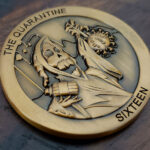
One face carries a grim reaper. The other carries a head in a firefighter helmet and a gas mask. The base is brushed brass, and the only paint on the coin is the white, red and blue of a flag background. It is a deliberately menacing object, and it was commissioned to remember the pandemic.
Dark Imagery Is a Tradition, Not a Novelty
Reapers, skulls, scythes and hooded figures appear across military and first responder coins constantly, and it is worth being clear about why, because it is easy to mistake for shock value.
It is how people in high-risk work talk about the risk. Gallows humor is not irreverence, it is a coping mechanism with a long history in professions that deal with death routinely. A coin made by and for those people reflects how they actually speak to each other, not how an outside organization would describe them.
It claims the thing rather than avoiding it. A reaper on a unit’s coin is usually the unit positioning itself in relation to death, not celebrating it. The imagery reads completely differently inside the profession than outside it.
And it is honest about the subject. A coin marking a pandemic with cheerful artwork would be a strange object. This one is not pretending the period was anything other than what it was.
The one judgment to make is audience. A coin that will go to bereaved families, to civilians or to a public ceremony is a different piece from one circulating inside a crew. Many organizations order both, and working two designs up in the same artwork session costs far less than two separate projects.
Executing a Reaper Properly
The figure is common enough that execution is what separates a good one from a cliché, and there are a few specific things that decide it.
The hood is the whole design. A reaper is recognized by the silhouette of a hooded head and shoulders, not by anything inside the hood. That outline has to be strong and unambiguous, because everything else is supporting it.
Leave the face dark. The strongest versions put nothing inside the hood and let a deep recess fill with shadow. Carving a detailed skull in there is the usual mistake: at coin size it becomes a pale blob and loses the menace that empty darkness provides for free.
Give the scythe room. A long diagonal line across a round face is one of the better compositional devices available, but it needs clear background on both sides. Crossing it behind the figure or over other elements turns it into an unreadable bar.
And drapery needs few folds, deeply cut. A robe is defined by its shadows. Many shallow folds turn to texture; a handful of deep ones read as cloth.
See 2D vs 3D challenge coins for how relief depth is handled.
Brushed Brass With One Flag of Color
Restricting the paint to a single flag against a brushed brass base is what keeps this coin from tipping into costume.
A fully painted reaper in greens and purples would read as Halloween. The same figure rendered in brushed metal, with the only color on the coin being the flag behind it, reads as serious. The restraint is doing the work that nothing else could.
Brushed brass also suits the subject for practical reasons. It scatters light rather than reflecting it, so the deep recesses the design depends on stay dark at any angle, where a polished surface would throw light into them and flatten the shadows. And a warm metal reads as commemorative rather than celebratory, which is the correct tone for the subject.
See finish and plating options and antique vs polished finishes.
The Second Face
The reverse carries a head in a firefighter helmet and a gas mask, which is the element that locates the coin.
A reaper on its own could belong to any unit in any era. A respirator and a fire helmet place it precisely: emergency services, during a respiratory pandemic. Together the two faces say something neither could say alone, which is the best argument for treating a coin’s two sides as a pair rather than as a front and a spare.
The gas mask is also a strong coin subject in its own right. Round filters, wide lenses and strap lines are all bold shapes with clear outlines, and the result reads instantly at small size.
About Quarantine
Quarantine describes someone who has been exposed to COVID-19 staying home and away from others, in case they are infected and contagious. It becomes isolation if the person later tests positive or develops symptoms.
This coin was commissioned to remember that period. See also a healthcare challenge coin for the same subject handled in a different register.
Order a Coin With Dark Imagery
Professional artwork is free with unlimited revisions, and nothing goes into production until you approve a digital proof. The challenge coin minimum is 50 pieces, standard production runs about 45 to 50 days after final artwork approval, rush production is available on many projects, and shipping within the continental United States is included. Embleholics is veteran-owned, SDVOSB and registered in SAM.gov.
Two things worth settling early. Decide who the coin is for, because a piece circulating inside a crew and a piece handed to families or the public are different designs, and it is cheaper to work both up at once than to come back later. And if the design depends on shadow, as a hooded figure does, specify a brushed or antiqued finish rather than a polish, since reflected light fills in the recesses the design relies on. Request a free quote to begin.
Frequently Asked Questions
What is a grim reaper challenge coin?
It is a coin built around a reaper or hooded figure, common across military and first responder units. The imagery is a long-standing part of how people in high-risk work refer to the risk, rather than shock value.
Is dark imagery appropriate on a challenge coin?
Within the profession, generally yes. Gallows humor is a recognized coping mechanism in work that involves death routinely, and a coin made by and for those people reflects how they actually speak. The judgment to make is audience, not taste.
Should we make a second, milder version?
If the coin will go to families, civilians or a public ceremony as well as circulating internally, yes. Working two designs up in the same artwork session costs far less than commissioning two separate projects later.
How do you draw a reaper so it works at coin size?
Build it on the hood. A reaper is recognized by the silhouette of a hooded head and shoulders, so that outline has to be strong and everything else supports it. The face, the hands and the robe are all secondary.
Should the face inside the hood be detailed?
No. Leave it as a deep recess that fills with shadow. A carved skull inside the hood becomes a pale blob at coin size and loses the menace that empty darkness gives you for nothing.
How should a scythe be placed on a round coin?
As a long diagonal with clear background on both sides. The diagonal is one of the better compositional devices available on a circular face, but crossing it behind the figure or over other elements turns it into an unreadable bar.
How do you keep a dark design from looking like a costume?
Restrict the color. A fully painted figure in bright shades reads as Halloween; the same figure in brushed metal with a single area of color reads as serious. The restraint is what carries the tone.
Why use a brushed finish on a shadow-heavy design?
Because a brushed surface scatters light instead of reflecting it, so deep recesses stay dark from any angle. A polished coin throws light into those recesses and flattens the shadows the design depends on.
More Firefighters Projects