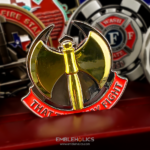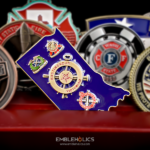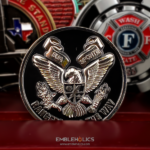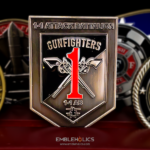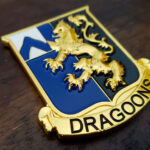
A 48th Infantry challenge coin has to choose between eras, because the regiment has served under two different armored divisions in two different periods. This one does not choose. The front carries the Dragoons insignia, and the reverse carries the 3rd Armored Division Spearhead insignia, crossed muskets and the names of the places the regiment was stationed, which is how a regiment with a broken lineage puts seventy years on a single object.
Which Era Should a Regiment’s Coin Represent?
Most unit coins represent a unit as it exists now. Regimental coins often cannot, because Army regiments are rarely continuous. They are constituted, demobilized, reconstituted, broken into battalions, consolidated, redesignated and reactivated, sometimes with decades of gaps and sometimes under a different parent formation each time.
That leaves whoever orders the coin with a decision nobody tells them they are making. There are three honest answers to it.
- Represent the regiment as it is today. Current insignia, current station, current mission. Clean, and it dates the coin to one assignment.
- Represent the regiment’s defining campaign. Usually the one the unit awards and foreign decorations came from. Powerful, and it excludes everyone who served in other periods.
- Represent the lineage itself. Carry more than one era on the coin and let the sides do different jobs. Harder to design, and it is the only option that suits a veterans’ association as well as a serving unit.
This coin takes the third route, which is why both an insignia and a list of station names appear on it.
Two Divisions, Two Periods
Anyone looking at the 48th Infantry’s history for the first time finds two armored divisions attached to it and assumes one of them is a mistake. Both are correct, and the dates are what separate them.
The 7th Armored Division, through the Second World War and up to 1957. The regiment was reconstituted in 1942 as the 48th Armored Infantry and assigned to the 7th Armored Division. In September 1943 it was broken up and its elements reorganized as the 48th, 38th and 23rd Armored Infantry Battalions, which fought through the European campaigns including the Ardennes and St. Vith. On 15 February 1957 those three battalions were relieved from the 7th Armored Division and consolidated to form the 48th Infantry as a parent regiment under the Combat Arms Regimental System.
The 3rd Armored Division, from 1957 to 1983. The 1st and 2nd Battalions then served with the 3rd Armored Division in West Germany, at Gelnhausen, on NATO border defense through the Cold War. That is the period most of the regiment’s living veterans served in, and it is why the Spearhead insignia rather than the 7th Armored Division’s appears on the reverse of this coin.
The regiment was withdrawn from the Combat Arms Regimental System on 16 June 1989, reorganized under the United States Army Regimental System and transferred to Training and Doctrine Command. It was reactivated at Fort Leonard Wood, Missouri in 2017, where its battalions conduct Basic Combat Training.
The practical lesson for anyone ordering a regimental coin is to put the period on the coin, not just the insignia. A division patch with no date is the single most common source of arguments about a unit coin, because the people who served under a different division read it as an error.
The Insignia a Unit Uses and the Heraldry It Was Granted
The customer supplied the Dragoons insignia, which is the device the regiment’s own people use. It is worth knowing that this is often not the same thing as a unit’s granted heraldry, and the 48th Infantry is a good example.
The regiment’s official distinctive unit insignia is built around a Belgian lion, taken from Belgium’s own arms in recognition of the regiment’s actions in the Ardennes and at St. Vith, with a wavy chevron for its descent from the 9th Infantry and Teutonic hunting horns for its German battle honors. The motto is By Force and Valor. The regiment also holds a Presidential Unit Citation for St. Vith and the Belgian Fourragère for the Ardennes campaign.
Either is legitimate on a coin, and they answer to different audiences. Granted heraldry is correct, formal and recognisable to the wider Army. The device a unit actually uses is the one its own members recognize instantly. Associations and veterans’ groups almost always want the second. Serving units with an official ceremony in mind usually want the first, or both, with the heraldry on the front and the working device on the reverse.
Send whichever one you want used and say which it is, because the two need different treatment at coin size. Granted heraldry has fine internal detail that needs reviewing on the proof. A working device is usually bolder and survives reduction better.
Crossed Muskets Are the Branch, Not the Regiment
The crossed muskets on the reverse are the Infantry branch insignia, which every infantry unit in the Army shares. That makes them the right device for a regimental coin and the wrong device for a regimental coin to lead with.
Used as a secondary element, as they are here, the muskets say Infantry to anyone in the Army at a glance and cost almost no space. Used as the main subject on the front, they would make the coin indistinguishable from any other infantry coin. The front is where the thing that is only yours goes.
Station Names Instead of Dates
The reverse carries the names of the places the regiment was assigned, which is a better choice than a date range and worth borrowing.
A date range raises a question the coin cannot answer, which is what happened in the gaps. A list of stations does not. It reads as a career rather than a timeline, each name means something specific to whoever served there, and it accommodates a broken lineage without having to explain it. It also ages well, because adding a station to a later run is a small artwork change, where changing a date range makes the earlier coins look superseded.
Practically, station names need flat or gently curved space and they need to be set at a size that survives striking. Lettering is the first thing that fails on a crowded reverse, so a list of names usually means the reverse carries the insignia smaller than the front does.
Engraving for History, Relief for Everything Else
The Dragoons insignia on this coin is engraved rather than built up in relief, and that suits a historical device for two reasons.
Engraving puts the line below the surface, so the design reads as cut into metal rather than stamped onto it, which is the right visual register for something old. And an antiqued finish settles into engraved lines and darkens them, which raises contrast without any paint at all. A polished finish does the opposite and tends to fill shallow engraving with reflection. If you are deciding between the two, see antique versus polished challenge coin finish.
Painted color still has a place on a coin like this one, and on this design it sits where it belongs, on the division insignia, which is a colored device in real life. The engraved historical artwork stays in bare metal.
Design a Coin for Your Regiment
Send your insignia, the station names or honors you want inscribed, and the period you want the coin to represent. If the regiment has served under more than one higher formation, say so, because that decides how the two sides are divided.
Professional artwork is free with unlimited revisions, and nothing goes into production until you approve a digital proof. Standard production runs about 45 to 50 days after final artwork approval, rush production is available on many projects, and shipping within the continental United States is included. Embleholics is veteran-owned, SDVOSB and registered in SAM.gov. See a 22nd Infantry Regiment coin, a 179th Infantry Regiment coin, or more Army challenge coins.
Frequently Asked Questions
What is the 48th Infantry Regiment known as?
The 48th Infantry Regiment is known as the Dragoons. It was constituted in the Regular Army on 15 May 1917 and organized that June at Syracuse, New York, and after a series of reorganizations it was reactivated at Fort Leonard Wood, Missouri in 2017, where its battalions conduct Basic Combat Training.
Was the 48th Infantry part of the 3rd Armored Division or the 7th Armored Division?
Both, in different periods. The regiment was assigned to the 7th Armored Division from 1942 until 15 February 1957, including the Second World War campaigns in Europe. Its 1st and 2nd Battalions then served with the 3rd Armored Division in West Germany from 1957 until 1983. Neither reference is an error, which is why a regimental coin should carry the period alongside the division insignia.
What does the 48th Infantry Regiment’s insignia mean?
The regiment’s distinctive unit insignia centers on a Belgian lion drawn from Belgium’s own arms, recognizing the regiment’s actions in the Ardennes and at St. Vith, with a wavy chevron for its descent from the 9th Infantry and Teutonic hunting horns for its German battle honors. The motto is By Force and Valor.
Which era should a regimental challenge coin represent?
Decide that before the artwork starts, because it changes everything else. A coin can represent the regiment as it exists now, the campaign the regiment is best known for, or the lineage as a whole. Coins for veterans’ associations usually need the third, because members served in different periods and a coin tied to one assignment excludes most of them.
What do crossed muskets on an Army coin mean?
Crossed muskets are the United States Army Infantry branch insignia, shared by every infantry unit. They are useful as a secondary device on a unit coin because they identify the branch instantly, but they do not distinguish one unit from another, so the front of the coin is normally given to something unique to that unit.
Should a unit coin use station names or dates?
Station names usually work better. A list of places the unit has served reads as a history without raising questions about gaps in a date range, each name means something specific to the people who served there, and a later run can add a station without making the earlier coins look out of date.
Is engraving or raised relief better for a historical insignia?
Engraving suits historical artwork, because the line sits below the surface and reads as cut into the metal rather than stamped onto it. An antiqued finish then settles into the engraved lines and darkens them, which gives contrast with no paint. Raised relief with a polished finish is the stronger choice for bold modern devices.
Can a veterans’ association order coins for a regiment?
Yes, and associations are among the most common customers for regimental coins. Because members served in different periods under different higher formations, association coins tend to be designed around lineage, insignia and station names rather than around a current unit’s organization.
More Army Projects