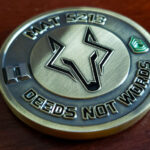
A unit motto challenge coin usually has its motto around the rim. The rim frames the insignia and holds one line of lettering at a readable size, which suits mottos longer than two or three words. On this coin, the 22nd Infantry’s motto, Deeds not words, runs along the lower rim.
Deeds Not Words, on a Coin Full of Words
The 22nd Infantry Regiment, a parent regiment of the Army, was first authorized on 26 June 1812. Congress added it with other infantry regiments to rebuild the Army quickly for the war with Britain. The regiment’s motto, Deeds not words, and its insignia were approved in 1923.
A founding date on a coin is often among the strongest text a unit can use. It’s short and unique to the unit, and it doesn’t go stale. For a different approach to a regiment’s history, see another infantry regiment coin.
Where a Motto Should Go
A motto can go in four common places:
- Around the rim, for mottos longer than about three words. The rim is one long, thin strip, so a motto engraved around a coin reads as a single line of text. On a regimental crest challenge coin, the rim frames the crest in the center and keeps it clear. This coin does exactly that.
- Across the face, for very short mottos. Two or three words can sit under a crest and still read. A full sentence across the middle can make the coin look like a sign.
- On a banner or scroll, if the insignia already includes one. Many approved unit insignia hold the motto on a scroll, so repeating it elsewhere usually adds clutter.
- On the reverse alone, when the motto matters more than a second image. This placement tends to be overlooked.
Rim space is limited, and a long official unit title plus a long motto often won’t both fit at a readable size. We sort out with you which text gets priority during artwork, and the digital proof (a preview of the finished coin) lets you check the lettering before production. Our manufacturing page lists lettering and finish options. Finish means the color and surface treatment of the metal.
Latin or English
Many Army unit mottos are approved in Latin, so a unit can choose between Latin and English. Latin looks formal and ties the coin to the unit’s official insignia. English is understood by the families and civilians who’ll also hold the coin.
Pick one language. Printing the same words twice uses rim space the unit designation could use. If you choose Latin, have someone who reads it check the spelling, since a mistake in a dead language is permanent and easy to spot. We set the text and send a proof, and you confirm the translation.
One Insignia, Two Faces
The regiment asked for a simple, elegant coin that still looks modern, with its insignia on both sides and the motto around it. Everything else stayed clean and straightforward.
Most coins use two different faces, and our page on whether both sides should differ covers that choice. This one repeats the insignia.
This matte brass challenge coin is fairly small, and our artists fit these details onto the front:
- Matte brass-colored base. Matte means flat and non-shiny.
- Sharply cut outlines around the graphics and lettering.
- Glossy paint on the lettering and drawings.
- Top rim. The text MAT 5213 arcs along it.
- Motto. Deeds not words runs along the lower rim in raised capital letters.
- Center emblem. A black-outlined emblem sits on a round brushed-metal panel.
- Rank insignia. Silver bars on the left and green chevrons on the right.
Against the flat metal, the glossy paint can keep a restrained design from looking plain.
Order a Coin for Your Unit
Artwork is free, and you can revise it as many times as you need before production. A digital proof arrives before anything is made.
For an Army regiment challenge coin, send your motto and full unit designation together. They share the same rim space, and we’d rather settle the layout during artwork. Also tell us if your approved insignia already includes the motto.
Insignia approval. Ordering a distinctive unit insignia coin usually calls for approval first. Official unit insignia are controlled by the Army Institute of Heraldry, so checking with your command early can save time. We work only from artwork you’re authorized to supply. If approval is pending, we can build the design around your motto, date and name.
We make Army challenge coins for units of many kinds. Orders start at 50 coins, and rush production is available when your date is close.
Embleholics is a veteran-owned business and an SDVOSB (service-disabled veteran-owned small business). Request a free quote to get started.
Frequently Asked Questions
Where should a unit motto go on a challenge coin?
On a unit motto challenge coin, the rim usually suits any motto over about three words. It gives the lettering one long line and leaves the center free. Very short mottos can sit under a crest, and some insignia already include a scroll.
How many words fit around the rim of a challenge coin?
There’s no fixed number, because it depends on the coin’s size and the letter height. A motto of a few words usually reads well. Longer mottos and long unit titles compete for the same space, so some text may need trimming at the artwork stage, before the proof.
Should a motto be in Latin or English?
Pick one, since printing both uses rim space. Latin suits a traditional look that matches official heraldry. English reads easily for everyone who sees the coin. If you choose Latin, have a Latin reader check the spelling.
Can both sides of a challenge coin have the same design?
Yes. This coin repeats the insignia on both sides, with the motto around it. Many coins use a different design on each face, and either approach can work. Tell us which you prefer when you request a quote.
What is a distinctive unit insignia?
A distinctive unit insignia (DUI) is a formally approved emblem for an Army unit. Because it’s an official design, its use is controlled, so confirm your rights before it goes on a coin. We work from artwork you’re authorized to supply.
Do we need permission to put our unit insignia on a coin?
Usually yes. Approval typically comes through your command, and we can’t grant it for you. Confirming it before artwork is final can help avoid delays.
Should a founding date go on a unit coin?
Often, yes. A founding date takes little space and shows how long the unit has served. It can sit on the rim or under the insignia. The 22nd Infantry Regiment’s history reaches back to 1812.
What does matte brass with glossy paint look like?
Matte brass gives a flat, warm background, and glossy paint adds bright color on top of it. On this coin, black outline paint and a green rank insignia read clearly against the brass.
More Army Projects