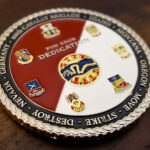
A cavalry brigade challenge coin is a custom coin made for a brigade-level unit with cavalry heritage. This one was made for the 116th Cavalry Brigade of the Idaho National Guard, an armored brigade combat team of about 3,000 citizen-soldiers. Its design represents an organization spread across four states.
A Brigade With No Single Home
The 116th Cavalry Brigade Combat Team is the largest unit in the Idaho National Guard. It’s one of a small number of armored brigade combat teams in the National Guard. Its soldiers live in more than 20 Idaho communities, and it has units in Montana, Nevada and Oregon. Often called the Snake River Brigade, it was formerly the 116th Armored Cavalry Regiment. Since 2001 it has deployed twice to Iraq and completed National Training Center rotations. For a smaller cavalry unit, see a cavalry squadron coin.
With about 3,000 citizen-soldiers spread this widely, there’s no single base to put on a coin. Members spend most of the year at civilian jobs, often in different towns. A cavalry brigade challenge coin for a unit like this needs a subject every member shares. Four approaches can work:
- Lead with the heraldry. The unit crests and insignia belong to everyone in the brigade, wherever they drill.
- Use a shared experience. Something every member went through can unify a unit that has no shared address.
- Pick a landmark that spans the territory. A river or mountain range can stand for every member’s region in one image.
- Use the nickname. On a Snake River Brigade coin, the name ties the unit to its region in three short words.
Skip the list of towns. More than 20 town names at coin size can turn into tiny, hard-to-read text, and some towns could still be left out. This Idaho National Guard coin names the four states on its rim, and the unit crests sit on the field.
The Castle on the Back
The reverse shows a picture of a German castle. Germany is also named on the front rim, along with the four states.
A major training rotation or deployment site may be the one location every member of a scattered unit has in common, which makes it a natural subject for one face of the coin. Here, the front holds the crests and lettering, and the reverse is given to the castle. Dividing the design this way can keep each face easy to read.
Coins That Go Home to Civilian Life
A Guard coin leaves the armory. It ends up in a desk drawer at a civilian workplace or in a pocket at a family event. People with no military background tend to see it more often than they’d see an active-duty unit coin.
A citizen soldier challenge coin tends to work best when someone outside the military can read it. A crest with no explanation, or a wall of acronyms, may say little to the person it’s shown to. A recognizable device, the unit nickname and a readable name can help. This coin’s field reads “For Your Dedication,” a line anyone can follow.
Citizen-soldiers hold a civilian job and a military role on the same calendar, so the coin needs to make sense in both settings. For a different Guard design, see another National Guard coin.
Polished Metal and a Rope Edge
The front has several layers of detail:
- Outer ring. Black, lettered with 116th Cavalry Brigade, Idaho, Montana, Oregon, Nevada and Germany, plus the words Move, Strike and Destroy.
- Rope edge. A silver-toned rope pattern circles the whole design.
- Field. Split between dark red and white, with “For Your Dedication” across it above the center emblem.
- Unit crests. Small embossed (raised) crests sit on both colors. Each is finely finished, with paint colors placed accurately.
- Center emblem. A gold-toned snake over blue water, ringed by red and gold rays.
- Polished surfaces. Unpainted metal areas are polished, so they’re smooth and shiny.
- Reverse. A picture of a German castle.
Small raised detail on a unit crest challenge coin tends to read well on polished metal, because the shine can highlight the edges of the raised areas. In photographs, shiny surfaces can glare, and the coin usually looks better in hand.
Plating is the metal coating on a coin, and relief is how far the design rises above its surface. Our manufacturing page covers plating, relief and edge options.
Unit insignia and authorization. Distinctive unit insignia are controlled by the Army’s Institute of Heraldry. If you’re ordering for a unit, please confirm with your chain of command which crests you may reproduce before artwork starts. We work from artwork you’re authorized to supply, and we can build a design around your unit’s identity, such as its nickname or colors, when a crest isn’t cleared.
Order a Coin for Your Unit
Whether it’s an armored brigade combat team coin or a design for another Guard unit, you can see more designs on our National Guard challenge coins page.
Our artists create the artwork at no charge, and you can revise it as often as you need before production. You’ll approve a digital proof (a preview image of the finished design) before anything is made.
If your unit is spread across several locations, tell us what its members have in common. The coin should show that shared thing. If you have a nickname, send it too, since it’s usually stronger than the formal designation. Orders start at 50 coins, and rush production is available when a date is tight.
Shipping is free within the continental US. Embleholics is veteran-owned and registered in SAM.gov as an SDVOSB (service-disabled veteran-owned small business). Request a free quote when you’re ready.
Frequently Asked Questions
What is a cavalry brigade challenge coin?
It’s a custom coin that represents a brigade-level unit with a cavalry background, usually through its crests, name and motto. This example was made for the 116th Cavalry Brigade of the Idaho National Guard.
How do you design a coin for a unit spread across several states?
Design the coin to represent the organization itself, using something every member shares. Lead with the unit crest and add the nickname. If place names are needed, use the states. A shared deployment or training site can fill the second face.
Should town or unit locations go on a coin?
No. A long list of towns shrinks to tiny text at coin size, and someone is likely to be left out. The states, or one place every member shares, usually read better, with the crests and nickname identifying the unit.
Can a deployment location go on a unit coin?
Yes. A deployment or training site is often the one place every member of a scattered unit shares, so it can make a strong subject. You can name the place on the rim or show a landmark from it.
Do National Guard units order challenge coins?
Yes. This coin for the 116th Cavalry Brigade is one example. Because a Guard coin often ends up in front of people outside the military, a design that’s easy to read without background knowledge helps.
How small can an embossed unit crest be?
Embossed means the design is raised above the surface. The crests on this coin are small and finely finished, with colors placed accurately. Check the digital proof to confirm each crest reads clearly at the size you plan.
What does a polished finish look like in person?
A polished finish looks smooth, bright and reflective. The shine can sharpen the edges of raised detail, which can help small crests read. In photographs it can glare, so a picture may not match what you see in hand.
Why do cavalry coins often use a rope edge?
A rope edge is a twisted-rope pattern around the rim, and it can suit formal designs. This brigade coin has a silver-toned one encircling the front design. Units outside cavalry can use it too, so the style isn’t tied to one branch.
More Army Projects