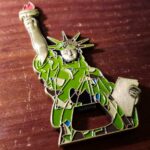
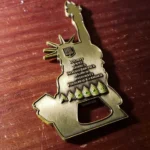
The coin is cut to the outline of the Statue of Liberty and painted in green camouflage to give it an Army look, with red on the torch as the only accent. The base is brushed brass. The reverse carries engraved rank insignia and the United States Army Core Values. It was commissioned by the Army National Guard.
Camouflage as a Coin Pattern
Camo is one of the most requested finishes in military coin work and one of the most frequently disappointing, because of a single scaling problem almost nobody anticipates.
Real camouflage is designed for a human-sized object. The pattern’s shapes are sized to break up a silhouette at tens of meters. Reproduce that pattern at its true relative scale on a coin and the blotches become specks, which read as mottled noise rather than as camouflage.
So the pattern has to be enlarged. A coin needs camo shapes several times larger, relative to the object, than the real pattern uses. Three or four visible blotches across a coin face reads as camouflage. Thirty reads as dirt.
Fewer colors, not more. Real camo patterns often use four to six tones. On a coin two or three is usually better, because each additional tone adds another boundary and the distinctions between similar greens are lost at this size anyway.
And digital patterns do not work. Pixelated camo depends on small square elements, which is precisely the detail a coin cannot hold. A soft-edged blotch pattern reproduces far better than a pixel-based one.
The payoff when it is done right is that camouflage reads as military instantly and without a single word of text, which few other treatments manage. See enamel and finish options.
A National Monument as the Outline
The coin is cut to the statue’s silhouette, which is one of the better landmark shapes available and worth examining for why.
The silhouette is globally recognizable. Very few outlines are identifiable from shape alone at coin size. The raised arm, the torch and the crown make this one of them.
It is vertical, which suits a tall coin. A standing figure needs height, and cutting to the outline gives it the full run of the piece rather than squeezing it into a circle with wasted arcs above and below.
The torch is the fragility point. A raised arm holding an object is the most exposed element on the whole shape, and it is where the piece will bend if it bends. The usual correction is thickening the arm slightly beyond true proportion, which is invisible to most viewers and prevents a great deal of trouble.
And the base anchors it. A tall narrow shape needs weight at the bottom or it reads as precarious. The pedestal does that naturally here, which is one reason this statue works better as a coin than a thinner monument would.
The red accent on the torch is a well judged piece of restraint: one color on an otherwise camouflaged coin, placed on the single element everybody looks for. See also an embassy challenge coin for a monument handled in relief rather than as an outline.
Camouflage Over Brushed Brass
The base metal is brushed brass, described as giving the coin a vintage feel, with the camouflage painted over it.
That combination is doing something specific. Camo on a bright chrome or polished nickel base would look like a toy, because the reflectivity fights the flatness of the pattern. Camo over a warm, softly textured metal reads as painted equipment, which is the correct association.
A brushed surface also means the unpainted areas have a finish of their own rather than looking like places where the paint ran out. On a coin where the camo covers part of the face and the metal shows elsewhere, that matters.
Core Values on the Reverse
The reverse carries engraved rank insignia and the Army Core Values lettering.
A values or creed list is a common request and has one hard constraint: it is a list, and lists take vertical space. Seven short words stacked down a face is manageable; seven phrases is not. The practical approach is to use the terms themselves rather than their definitions, set them at a comfortable letter height, and accept that the list will fill the face it is on.
Which is why it belongs on its own side. Text and artwork compete, and a list competes harder than a single inscription because it needs the eye to travel down it. Giving it the whole reverse means it can be read rather than merely present.
The rank insignia alongside it is the personal element. Rank devices are drawn to be recognized at a distance, so they are bold and simple and survive reduction well. For more on that, see a rank insignia challenge coin.
About the Monument
The statue, formally Liberty Enlightening the World, was a gift of friendship from France to the United States and has become a universal symbol of freedom and democracy. It was dedicated on 28 October 1886, designated a National Monument in 1924, and has been cared for by National Park Service employees since 1933.
See more National Guard challenge coins and Army challenge coins.
Order a Camouflage or Landmark Coin
Professional artwork is free with unlimited revisions, and nothing goes into production until you approve a digital proof. The challenge coin minimum is 50 pieces, standard production runs about 45 to 50 days after final artwork approval, rush production is available on many projects, and shipping within the continental United States is included. Embleholics is veteran-owned, SDVOSB and registered in SAM.gov.
Two things to expect. If you want camouflage, the pattern will be drawn larger than the real one, with fewer colors, and that is deliberate rather than a shortcut; a faithfully scaled pattern looks like dirt at coin size. And if the outline includes a raised or projecting element, expect it to be slightly thickened in artwork so it survives being carried. Request a free quote to begin.
Finished Coin (Front)
Finished Coin (Back)
Frequently Asked Questions
What is a camouflage challenge coin?
It is a coin finished with a camo pattern, usually painted over a metal base. It reads as military instantly without needing any text, which few other treatments manage, but the pattern has to be scaled up to work at coin size.
Why does camouflage need enlarging on a coin?
Because real camo is sized to break up a human silhouette at tens of meters. Reproduced at true relative scale on a coin the blotches become specks and read as mottled noise. Three or four visible blotches across a face reads as camouflage; thirty reads as dirt.
How many colors should a camo pattern use?
Two or three, fewer than the real pattern. Each additional tone adds another boundary, and the differences between similar greens are lost at coin size anyway, so extra colors cost money without adding anything visible.
Does digital camouflage work on a coin?
No. Pixelated patterns depend on small square elements, which is exactly the detail a coin cannot hold. A soft-edged blotch pattern reproduces far better.
What base metal suits camouflage?
A warm, softly textured one such as brushed brass. Camo over bright chrome or polished nickel looks like a toy, because the reflectivity fights the flatness of the pattern, while a brushed warm metal reads as painted equipment.
Can a coin be cut to the shape of a landmark?
Yes, if the silhouette is recognizable on its own. Very few outlines are identifiable from shape alone at coin size, so the test is whether somebody would know it with no color or detail at all.
What is the fragile part of a statue shaped coin?
Any raised or projecting element, such as an arm holding a torch. That is where the piece will bend, and the usual correction is thickening it slightly beyond true proportion, which is invisible to most viewers.
Can a creed or values list go on a coin?
Yes, on its own face. Use the terms themselves rather than their definitions, since a list needs the eye to travel down it and will fill whichever face it is on. Sharing a face with artwork makes both weaker.
More Corporate Projects