A fully sculpted coin, such as a dragon challenge coin, is modeled in three dimensions on both faces. Its limbs, wings and tail stand out as forms, with no plain background behind them. A shaped coin follows a profile with relief struck on a flat field.
Where Full Sculpting Sits on the Scale
A coin can depart from the round shape in four stages. Each stage adds modeling and tooling work, and each is quoted separately from a round coin.
- Partial shape. A tab or crest is added to a round base, and the disc is still the coin.
- Custom outline. The coin is cut to a profile, with relief struck on a flat field inside it.
- Cutout. Metal is removed from inside the coin, so the design frames open space.
- Full sculpting. The subject has volume on both sides, and no flat field remains.
Full sculpting sits at the top of the shape-work range. Our page on custom shaped challenge coins covers the first three steps.
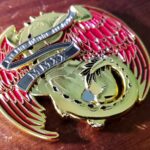
This dragon challenge coin sits at that top step, with its limbs showing on both faces.
When Full Sculpting Makes Sense
Full sculpting makes sense when the subject has volume that matters. A creature, a figure, a vehicle or an animal head all qualify. Modeling lets light and shadow describe their shape. A flat crest, a logo or a geometric device is drawn in two dimensions and gains nothing from being modeled.
A sculpted coin also rewards close attention. The recipient turns it over, and every angle shows something.
Here is a simple test. Ask what the extra dimension is doing for the design. If you cannot name it, a relief coin on a textured field is the better fit.
Choosing between a profile and open space is a separate decision, covered in our guide on shaped coin versus cutout coin.
Limbs, Wings and Tails Are Where Coins Break
Thin parts such as limbs, wings and tails are the most fragile areas of a figurative coin, and a sculpted creature has many of them. Our art team adjusts the design in four ways to protect them:
- Extremities are thickened slightly.
- Tip radii are softened.
- Limbs are folded against the body where the pose allows.
- Rows of small points, such as scales or spines, are simplified into a continuous edge.
Artwork drawn for a screen has never had to survive a pocket, so the struck version is always a slightly adapted drawing. We show you both versions to compare. Our page on how challenge coins are made explains the process behind these adjustments.
Small diameters shrink thin parts along with the coin. For a creature with long limbs or a long tail, we recommend a larger size to give the detail room.
Color on a Sculpted Coin
Red on the wing scales is the only bold color on this coin, and that is deliberate. On a sculpted piece, light and shadow already describe the form, so broad color can flatten it.
The gold is polished, so it reflects light across the raised surfaces. Against it, the red wing scales become the focal point.
Paint also sits in recesses, shielded by the raised metal around it. On a heavily sculpted coin, that protection can help it hold up.
About This Custom Dragon Coin
The coin is the dragon’s shape. No disc sits behind the creature, so its outline, limbs and wings form the coin’s edge.
- Shape. A dragon-shaped coin with sculpted limbs and details visible on both sides.
- Wings. Sculpted wing scales, painted red.
- Eagle side. An embossed and painted American Eagle, encircled by the gold dragon.
- Banner side. Silver banners cross the other face, and one reads MMXX.
- Finish. Polished gold across the raised surfaces.
- Lettering. Built into the sculpture as banners.
Commission a Sculpted Coin
Send us the creature or figure, even as a rough sketch. The modeling is our work. Professional artwork is free, you can revise it as often as you like, and a digital proof comes before production.
Sculpted detail needs room, and small diameters limit how much fits. If you already have a size in mind, share it early. Rush production is available if your date is tight. Orders start at 50 coins. Shipping within the continental U.S. is free.
Embleholics is veteran-owned and SDVOSB registered in SAM.gov. Browse our specialty challenge coins for more ideas, or request a free quote to start your own design.
Frequently Asked Questions
What is a sculpted challenge coin?
A sculpted challenge coin, sometimes called a 3D sculpted coin, is modeled in three dimensions with the subject’s form visible on both faces. No flat background sits behind the design, so the coin reads as a small sculpture.
How is a sculpted coin different from a custom shaped coin?
A custom shaped coin follows a profile and has relief struck on a flat field. A sculpted coin has no flat field. The subject’s limbs and details are modeled on both faces.
Can a challenge coin be shaped like an animal or a creature?
Yes. A coin can follow an animal or mythical creature in full relief, as our dragon coin does. Thin parts such as wings and tails are adapted during design.
When should you pay for full sculpting?
Pay for full sculpting when the shape of the subject is the point. A creature, a figure, a vehicle or an animal head all qualify. Flat crests, logos and geometric devices gain nothing from it.
Will the legs, wings and tail break off?
They are the most delicate parts of the coin, so the design is adapted to protect them. Extremities are thickened, tips are softened, and limbs are folded against the body where the pose allows.
Do you redraw our artwork before striking it?
Yes. The struck version is always a slightly adapted drawing. We show you the original and the adapted version so you can see what changed before production.
How much color should a sculpted coin use?
A sculpted coin usually needs only a little color. Light and shadow already describe the form, so paint on one feature draws the eye to that feature. Broad color can flatten the sculpting.
Can a sculpted coin still have lettering?
Yes, usually on a banner or ribbon built into the sculpture. Our dragon coin uses silver banners, and one reads MMXX.
More Corporate Projects