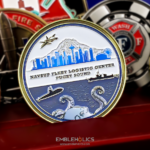
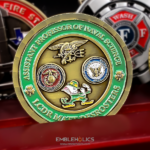
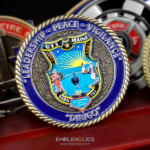
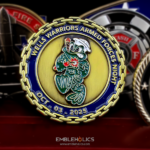
The front carries the ship rendered in three dimensions, gold plated chief’s anchors, and the silhouette of the fighter flown from her deck, with stars and symbolism tied to the mess and the ship. This USS George Bush challenge coin was commissioned by the carrier’s chief’s mess to build camaraderie and cohesion.
A Ship in Three Dimensions
An aircraft carrier is one of the more demanding subjects to sculpt onto a coin, and the difficulties are instructive for any ship design.
The proportions fight the format. A carrier is long and low. A coin is round. A profile view at true proportion becomes a thin strip across the middle with wasted space above and below, which is why most ship coins use a three quarter angle instead.
The flight deck is the recognizable feature. From a side profile a carrier is a gray slab. Angled slightly, the deck becomes visible and the ship is instantly identifiable. That one decision matters more than any amount of detail.
Detail has to be chosen, not reproduced. The island, the deck edge, the angle of the bow. Attempting catwalks, radar arrays and deck markings produces mush at coin scale.
And relief depth does the separating. A ship sculpted at uniform depth reads as an outline. Varying the height between hull, deck and island is what makes it look like a vessel rather than a shape.
See also Navy challenge coins and a ship anniversary challenge coin.
The Chief’s Mess
A chief’s mess coin is a specific thing within Navy coin culture, and it is not the same as a ship’s coin.
The chief petty officers aboard a ship form the mess, the senior enlisted leadership who run the day to day work and develop junior sailors. It is a deliberately distinct body with its own traditions, its own space aboard and a strong internal identity. Chiefs are also the people most associated with the coin tradition in the first place, which means a coin made for chiefs is held to a higher standard than most.
The stated purpose here, building camaraderie and cohesion, is worth taking at face value. A coin for a defined leadership group is an internal object: it circulates among people who already know each other and marks belonging to the mess rather than service aboard the ship. That makes it a smaller run than a ship’s coin and a stronger case for spending more per piece.
The anchors on the front are the specific marker. The fouled anchor is the chief petty officer’s insignia, and plating those anchors in gold while the rest of the coin stays in a different finish is the clearest way to say whose coin this is.
See also a chiefs mess challenge coin and Navy chief traditions and the coins that mark them.
Selective Gold Plating
Plating one element in gold while the rest of the coin takes a different finish is the most precise tool available for directing attention.
It is metal, not paint. A gold plated element cannot chip or fade because it is the surface of the coin rather than something applied over it. On a piece meant to last a career, that matters.
It creates hierarchy without color. The anchors become the most important thing on the face purely through finish, which keeps the coin entirely metallic and formal.
And it matches the insignia itself. Chief’s anchors are gold in reality. Rendering them gold on the coin is accuracy rather than emphasis, which is the best reason to use the technique.
The execution point is the boundary. Selective plating requires masking, and the line between the two metals has to be clean and follow the artwork exactly. A soft or wandering boundary is the main failure mode and it is a proof stage check.
See antique vs polished finishes.
Including the Air Wing
Putting the aircraft on a carrier’s coin raises a question worth thinking through, because the ship and her aircraft are not the same organization.
A carrier air wing is a separate command that embarks aboard the ship for a deployment and then detaches. Including a jet silhouette on a ship’s coin acknowledges what the carrier exists to do, since a carrier without aircraft is a very large ship with no purpose. It is a fair inclusion and a common one.
The caution is specificity. Air wings rotate, and the squadrons aboard today may not be aboard next deployment. A recognizable type silhouette ages well. More on rendering aircraft in Aircraft Challenge Coins. Specific squadron markings or tail codes date the coin to one cruise, which is correct for a deployment commemorative and a problem for a standing mess coin that will be issued for years.
Order a Ship or Chief’s Mess Coin
Professional artwork is free with unlimited revisions, and nothing goes into production until you approve a digital proof. The challenge coin minimum is 50 pieces, standard production runs about 45 to 50 days after final artwork approval, rush production is available on many projects, and shipping within the continental United States is included. Embleholics is veteran-owned, SDVOSB and registered in SAM.gov.
Two suggestions. If a ship appears on the coin, ask for a three quarter view rather than a side profile, because the flight deck or the superstructure is what makes a vessel recognizable. And if selective plating is used, inspect the boundary between the two metals on the proof, since a wandering edge is the one thing that makes the technique look accidental. Request a free quote to begin.
Frequently Asked Questions
What is a chief’s mess coin?
A coin made for the chief petty officers aboard a ship rather than the whole crew. The mess is the senior enlisted leadership, with its own traditions and identity, so the coin marks belonging to that group.
How is it different from a ship’s coin?
A ship’s coin goes to the whole crew and to visitors. A mess coin circulates among a defined leadership group, which means a smaller run and a stronger case for spending more per piece.
Why are the anchors gold?
The fouled anchor is the chief petty officer’s insignia and it is gold in reality. Plating it gold on the coin is accuracy rather than decoration, which is the strongest reason to use selective plating.
What is selective plating?
Applying one metal finish to part of a coin and a different finish to the rest. It creates hierarchy without any paint, and because it is metal rather than coating, it cannot chip or fade.
What goes wrong with selective plating?
The boundary. It requires masking, and the line between the two metals has to follow the artwork exactly. A soft or wandering edge makes the effect look accidental rather than designed.
How should a ship be shown on a coin?
From a three quarter angle rather than a side profile. A carrier seen from the side is a gray slab, while a slight angle reveals the flight deck and makes the ship instantly identifiable.
How much detail should a ship carry?
Only the defining features: the island, the deck edge, the bow. Catwalks, radar arrays and deck markings turn to mush at coin scale and cost legibility rather than adding realism.
Should aircraft appear on a carrier’s coin?
Often yes, since a carrier exists to operate them. Use a recognizable type silhouette rather than squadron markings, because air wings rotate and specific markings date the coin to one deployment.
More Navy Projects