For decades, American sailors saw the Pacific as U.S. Navy water. That assumption no longer holds. China is not only building more ships, it is producing them at a pace unseen since World War II. For those who have worn the uniform, the message is clear: in war, it is not just about who has the best ship, but who can build, deploy, and sustain them when it counts.
Today, China’s aircraft carrier fleet is still young compared to America’s eleven nuclear-powered carriers. But the trajectory is unmistakable. The People’s Liberation Army Navy is moving from regional defense to global ambition, and it is doing so with speed and determination.
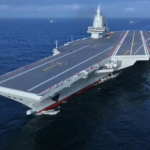
Fujian (CV-18) China’s bold leap into supercarrier class—built for global power projection.
China’s Growing Carrier Force
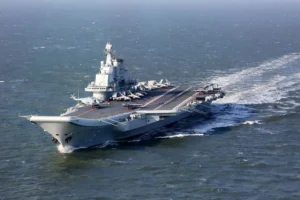
In 2012, China commissioned its first carrier, the Liaoning, a refurbished Soviet vessel. Seven years later, the domestically built Shandong proved Beijing could design and build its own flat-tops. In 2022, the launch of the Fujian marked a dramatic leap forward.
The Fujian is not just another carrier. At over 80,000 tons, it rivals American supercarriers in size and capability. It is fitted with electromagnetic catapults (EMALS), a technology previously exclusive to the U.S. Navy’s USS Gerald R. Ford. With room for up to 60 aircraft, it is designed for high-intensity operations, not symbolic gestures. The ship is now undergoing sea trials and expected to be fully operational by the end of 2025.
Earlier this year, for the first time, China operated two carrier strike groups simultaneously beyond the First Island Chain. Fighter jets launched from the decks of the Liaoning and Shandong, tracked by Japanese radar and closely monitored by U.S. Pacific Command. This was no training cruise, it was power projection in waters once dominated by America and its allies.
Industrial Power as a Weapon
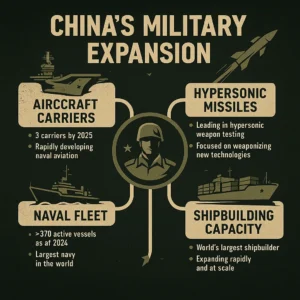
The most dangerous element of China’s rise is not Fujian itself. It is the shipyards behind it. China possesses the largest shipbuilding capacity in the world, dwarfing that of the United States by orders of magnitude.
Defense entrepreneur Palmer Luckey, founder of Anduril and once the visionary behind Oculus, has sounded the alarm repeatedly. In interviews and testimony, he has noted that China does not distinguish between civilian and military shipbuilding. Even ferries and container ships are constructed to military standards, meaning they can be quickly repurposed in wartime. “In China,” Luckey explains, “the line between civilian and military industry is deliberately erased.”
This integration means that in the event of conflict, China could surge ship production or mobilize its commercial fleet for military use almost overnight. By contrast, the United States relies on a fragmented industrial base, long procurement timelines, and political fights over budgets. American shipyards produce some of the most advanced vessels in the world, but not nearly enough of them.
For those who served, the takeaway is simple: in combat, you fight with what you have, and you replace what you lose. China can replace it faster.
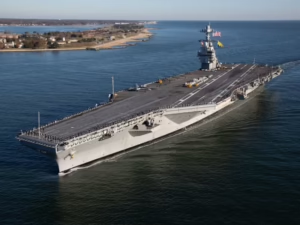
USS Gerald R. Ford (CVN-78)
The world’s most advanced supercarrier—unmatched technology, unmatched reach.
Shipbuilding Capacity
Naval Fleet Size
Why China’s Aircraft Carrier Fleet Expansion Matters
Sailors know that ships break down, take damage, and need repair. In a prolonged conflict, the question is not who wins the first battle, but who can keep fighting into the second, third, and fourth. Here, China’s industry might change the calculus.
The PLAN already commands more than 370 vessels, according to the U.S. Department of Defense. The U.S. Navy maintains around 290. On paper, America retains the qualitative edge, nuclear propulsion, combat experience, and global logistics. But quantity has its own quality. If China can sustain losses and still surge new ships into the fight, it forces American planners to reconsider force posture and supply lines across the Pacific.
In practical terms, this means that American carriers, submarines, and strike groups may one day face not only advanced Chinese platforms, but an enemy capable of replenishing them faster than we can. That is not a hypothetical problem. It is a readiness issue that affects training cycles, maintenance schedules, and the way the Navy prepares for attrition warfare.
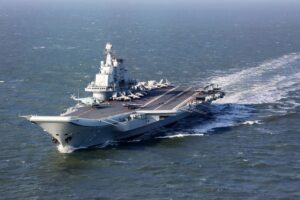
Liaoning (CV-16) The vessel that marked China’s arrival as a true carrier power.
Lessons from History
History offers sobering reminders.
In the early 20th century, Britain and Germany engaged in a dreadnought race that reshaped European politics and set the stage for World War I. The winner was not simply the nation with the most ships, but the one with the industrial base to keep building them as war loomed.
During World War II, American shipyards produced Liberty Ships and Victory Ships by the hundreds, outpacing Axis powers and turning industrial muscle into strategic dominance. U.S. sailors did not just outfight the enemy, they outbuilt them.
The Cold War carried the lesson forward. The U.S. and the Soviet Union matched each other in nuclear submarines, carriers, and missile technology. What ultimately mattered was not only capability, but sustainability. America’s combination of technology, alliances, and a thriving industrial base gave it the edge.
China has studied this history carefully. Its current expansion is not a mirror of American naval tradition, it is an industrial bet that mass and speed can erode U.S. dominance at sea.
The Fighter’s Will
And yet, for all the talk of carriers and shipyards, every veteran knows this: wars are not decided by machines alone.
As one combat veteran put it, “At the end of the day it comes down to man against man, not the technology you’ve got.” This truth runs through every generation of conflict. Technology can give you an edge, but it is the will of the fighter that decides who holds the ground, or the sea, when the dust clears.
China’s navy is growing, but it has not been tested in combat. The U.S. Navy has decades of hard-earned experience, from carrier operations in the Persian Gulf to humanitarian missions across the globe. American sailors and Marines have learned the hard lessons of sustaining operations far from home, under fire, and with allies depending on them. That cannot be mass-produced.
For U.S. military readers, this is the takeaway: respect China’s growth, study its industrial power, but never forget the decisive factor has always been training, readiness, and will.
Looking Ahead
China’s next carrier, rumored as the Type 004, is expected to feature nuclear propulsion. If true, it would mark another leap forward, placing the PLAN in the elite company of navies able to operate globally without tethered supply lines. A fleet of three or four modern carriers could alter the balance of power in the Indo-Pacific by the 2030s.
America’s response cannot be panic. It must be a strategy. That means revitalizing U.S. shipbuilding capacity, investing in next-generation submarines and carriers, and strengthening alliances with partners across the Pacific. It also means remembering what history teaches: naval supremacy is never permanent. It is earned, sustained, and tested, again and again.
Strength, Will, and Legacy
China’s aircraft carrier fleet is more than steel and decks. It is a statement of ambition. For the United States, it is both a warning and a reminder.
The warning is clear: China is building fast, erasing the line between civilian and military industry, and betting that mass production can change the Pacific balance.
The reminder is older: America has faced industrial rivals before. We prevailed not only with technology, but with shipyards, alliances, and the will of those who served.
For today’s leaders, the commander’s guidance is straightforward:
- Rebuild the industrial base. Naval supremacy is not just about the ships afloat, but about the ability to replace and repair them in wartime.
- Train for attrition warfare. Expect losses. Prepare forces, logistics, and industry to fight and keep fighting into the next round.
- Leverage alliances. America’s strength is multiplied by Japan, Australia, South Korea, and NATO partners who share the burden at sea.
- Preserve readiness and will. Ships are machines; sailors are the deciding factor. The culture of readiness, discipline, and endurance will always tip the scales.
At Embleholics, we honor that will, the courage of sailors, marines, soldiers, and airmen who carried America’s strength across oceans. The seas may host rival fleets, but they also carry the legacy of those who fought, endured, and protected peace.
Supremacy at sea is not a given. It is a duty. And as every veteran knows, the true measure of power is not just the ships you sail, but the people who sail them.
Recent Posts