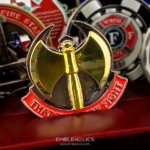
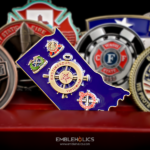
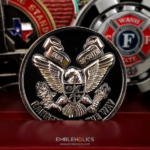
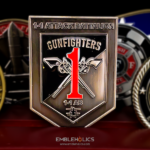
A garrison coin marks a place rather than a unit, and for the US Army in Germany that place is usually a Kaserne. This one was ordered by the 300th Military Police Company for Wilkins Kaserne. The brief was simple and elegant: the unit insignia and some lettering, nothing else. The execution puts the insignia in full color on one face and the same insignia in black and white on the other, with a machined wavy pattern running around the edge.
Check the installation’s name before anything is struck
This is the specific trap with German garrison coins and it catches people repeatedly. A Kaserne, which simply means barracks, has often been through several names: an original German name, a name given during US occupation and use, and sometimes a later Bundeswehr name after the site was returned. Installations with similar names sit in different cities, and histories get attached to the wrong one easily.
What that means in practice:
- Take the name from the unit, not from a search. Whatever the garrison is officially called today, in the form your own command uses, is what belongs on the coin.
- Do not put a founding date on a garrison coin without confirming it. Dates attached to German barracks are frequently the dates of a predecessor installation or of a different site with a similar name.
- Be careful with inherited heraldry. Some Kasernen have pre-war German origins, and symbols associated with those periods should not be imported into a modern US unit’s coin.
- Spell it the way the Army spells it. Umlauts, hyphenation and the Kaserne suffix all vary, and an error in a place name is the first thing a reader notices.
When in doubt, make it about the unit. A coin carrying the unit’s insignia and the garrison’s current name is safe, accurate and reorderable. A coin carrying a potted history is a coin with something on it that may be wrong.
The same insignia twice, in two treatments
Putting one insignia on both faces, in color on the front and black and white on the back, is an unusual and economical idea. It gives the coin two visibly different sides without requiring two pieces of artwork, and it reads as deliberate rather than as a design that ran out of material.
It also demonstrates something useful about enamel. The same relief, struck identically, looks like a different object depending on whether the recesses carry color. The colored face is bright and immediate; the uncolored face is all shadow and line, closer to a medal. Showing both on one coin makes the point better than any description.
And it halves the color cost. Enamel is charged by area on every coin, so a one-sided color treatment costs meaningfully less across a run than two colored faces. For a company-sized unit funding its own coins, that is a real saving that costs nothing in quality.
A wavy machined edge
Edge treatment is the most overlooked part of a coin and one of the cheapest ways to make a plain design feel finished. A plain cut edge is the default. A reeded edge, with vertical grooves, is the familiar coin texture. A wavy or scalloped machined edge is less common and immediately changes how the coin feels in the hand.
It costs die work rather than per-coin consumables, which puts it in the same category as relief and field texture: paid for once, reproduced across the entire run for nothing. For a unit choosing between an edge treatment and an extra enamel color, the edge is usually better value.
One caution. A pronounced wavy edge slightly reduces the diameter available for a rim inscription, so if text is running around the edge, settle the edge treatment before the layout rather than after.
Coins for units stationed overseas
A US Army unit in Germany faces the same practical issues as any forward-stationed command. Shipping goes through the military postal system and takes longer than domestic delivery, so order against your timeline with real margin. Our guide to APO and FPO shipping covers the address formatting, which is the part most often got wrong.
Count the whole garrison population if the coin is for the installation. Overseas posts include local national employees and Department of the Army civilians alongside the soldiers, and they are regularly left out of coin counts despite often being the longest-serving people there.
Ordering a garrison or unit coin
Send the unit insignia and the installation name exactly as your command writes it. If you want the garrison’s history on the coin, send us what your own command holds rather than asking us to research it, because installation histories in Germany are easy to attach to the wrong site. Tell us your timeline early so shipping can be built into the schedule. You can see more Army challenge coins we have produced, or send your artwork through the free quote form.
Frequently Asked Questions
What is a Kaserne?
Kaserne is the German word for barracks, and it is how US Army installations in Germany are generally named. A garrison coin for one marks the place rather than a single unit, though in practice most are ordered by a unit stationed there and carry that unit’s insignia alongside the installation name.
Why is the name on a German garrison coin worth double-checking?
Because most Kasernen have had several names: an original German one, one given during US occupation and use, and sometimes a later Bundeswehr name after the site was handed back. Installations with similar names also sit in different cities, so histories and dates get attached to the wrong one easily. Take the name from your own command rather than from a search.
Should a garrison coin carry the installation’s founding date?
Only if your command can confirm it. Dates attached to German barracks are frequently those of a predecessor installation or of a different site with a similar name, and a wrong date struck into a die cannot be corrected. A coin carrying the unit insignia and the garrison’s current name is the safe version.
Can the same insignia go on both sides of a coin?
Yes, and treating it differently on each face works well. Full color on one side and black and white on the other gives the coin two visibly different faces from a single piece of artwork, demonstrates how much enamel changes the same relief, and costs less than coloring both sides, since enamel is charged by area on every coin.
What does an edge treatment add to a coin?
A surprising amount for very little. A plain cut edge is the default, a reeded edge gives the familiar coin texture, and a wavy or scalloped machined edge immediately changes how the coin feels in the hand. Because it lives in the die it is paid for once and reproduced across the whole run, which usually makes it better value than an extra enamel color.
Does an edge pattern affect the design?
Slightly. A pronounced wavy edge reduces the diameter available for any inscription running around the rim, so if text is going there, settle the edge treatment before the layout is finalized rather than trying to fit the text around it afterwards.
How should an overseas unit plan a coin order?
Allow more time than a domestic order, because delivery goes through the military postal system and takes longer and less predictably. Format the address as a military rather than a foreign address. And if the coin is for the installation rather than a single unit, count the local national employees and Department of the Army civilians, who are often the longest-serving people on the post and are routinely missed.
More Army Projects