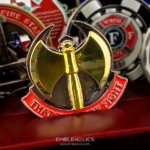
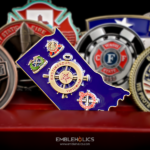
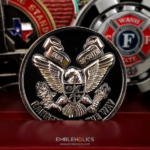
Gold plating across the whole piece, with the Army and Airborne emblems etched and engraved into the base metal and the insignia elements painted in their original colors. The rims are thin and the edge is smooth. The page describes the concept as unconventional and the result as elegant. This army airborne challenge coin was commissioned for a command sergeant major of the 82nd Airborne Division on his departure.
Coins for a Departure
A coin marking the end of someone’s time in a unit is a different object from a standard unit coin, and the differences are worth naming.
It is about a person. A unit coin represents an organization and goes to many people. A departure coin represents one career and the unit’s regard for it, which justifies spending more per piece on a smaller run.
A senior enlisted departure is a significant event. A command sergeant major is the senior enlisted leader of a formation, the person who ran its standards and development, often across years. Marking that with something ordinary would read as an undervaluation.
The recipient already has coins. Someone at that point in a career has a collection. A departure piece has to be distinct enough to stand out among coins they have been given across decades.
And it gets distributed, not kept. A departing leader typically hands these out as well as receiving them, so the quantity should cover the people they want to acknowledge on the way out.
See also military challenge coins.
Airborne Identity
Airborne is one of the strongest identities in the Army, and a coin drawing on it has material most organizations do not.
The 82nd Airborne Division is based at Fort Liberty, North Carolina, and is the Army’s strategic response formation. Airborne qualification is a shared experience: everyone who holds it went through the same school and the same jumps, which creates a bond that cuts across units, ranks and generations.
For a coin, that means two layers are available. The division’s own identity, specific to the formation, and the broader Airborne identity, shared with every paratrooper who ever served. Using both, as this coin does by carrying Army and Airborne emblems together, reaches further than either alone.
It also means the symbols are established rather than invented. Airborne insignia are precisely defined and deeply familiar to the people receiving them, which raises the standard for accuracy and removes any need for creative reinterpretation.
Thin Rims and a Smooth Edge
Two small decisions here produce most of the coin’s character, and they work together.
A thin rim gives the artwork more room. The raised border around a coin face protects the design and eats into it. Narrowing it moves the usable area outward, which makes a coin feel larger than its diameter.
A smooth edge keeps the piece quiet. No rope, no milling, no diamond cut. On a coin already carrying gold plating and painted insignia, a patterned edge would be one decorative element too many.
The trade-off on thin rims is protection. The rim is what takes the impact when a coin is dropped and what the coin rests on when it sits flat, so a narrow one offers the face a little less shelter. On a presentation piece that will live in a case or a drawer rather than a pocket, that is an easy trade.
The combination is what produces the elegant register. Elegance on a coin usually comes from what has been left off rather than from what has been added, and these are both subtractions.
Gold Plating With Insignia in Original Colors
Plating the whole coin gold and painting only the insignia in their correct colors is a specific and defensible structure.
Gold sets the register. It is the finish most associated with achievement and ceremony, which is correct for a career milestone and would be wrong for a working unit coin.
Painting the insignia in their own colors is the accuracy decision. Army and Airborne devices have specified colors, and rendering them correctly matters to the recipient far more than any design preference. A gold coin with monochrome insignia would look cleaner and would be less right.
The one thing to watch is contrast. Painted colors over gold have less separation than the same colors over a dark field, because gold is itself a mid tone warm color. Insignia with warm colors in them particularly need either a thin metal outline or a slightly deeper engraving to hold their edges against the plating.
See whether a gold challenge coin is real gold.
Order a Retirement or Airborne Coin
Professional artwork is free with unlimited revisions, and nothing goes into production until you approve a digital proof. The challenge coin minimum is 50 pieces, standard production runs about 45 to 50 days after final artwork approval, rush production is available on many projects, and shipping within the continental United States is included. Embleholics is veteran-owned, SDVOSB and registered in SAM.gov.
Two suggestions for a departure coin. Order enough for the departing person to hand out as well as receive, since they will want to acknowledge people on the way out. And start early, because production runs about 45 to 50 days and a change of command or retirement date does not move to suit a coin order. Request a free quote to begin.
Finished Coin (Front)

Finished Coin (Back)

Frequently Asked Questions
What is a departure or retirement challenge coin?
A coin marking the end of someone’s time with a unit. It represents one person’s career rather than the organization, which justifies a smaller run and a better finish per piece.
How is it different from a unit coin?
A unit coin goes to many people and represents the organization. A departure coin is about an individual, and the recipient usually already owns many coins, so it has to be distinct.
How many should be ordered?
Enough for the departing person to give out as well as receive. People in that position typically want to acknowledge colleagues on the way out.
Why does Airborne work well on a coin?
Because the qualification is shared across units, ranks and generations. Everyone who holds it went through the same school, so the identity reaches far beyond one formation.
What does a thin rim do?
It moves the usable area outward, which makes a coin feel larger than its diameter. The trade-off is slightly less protection for the face, which suits a presentation piece.
Should a presentation coin have a patterned edge?
Often not. On a coin already carrying plating and painted insignia, a rope or milled edge is one decorative element too many, and elegance usually comes from subtraction.
Why paint insignia in original colors on a gold coin?
Because the colors are specified and accuracy matters more to the recipient than visual preference. A monochrome version would look cleaner and would be less correct.
What is the challenge of painting over gold?
Contrast. Gold is a mid tone warm color, so warm painted colors have less separation against it and need a thin metal outline or deeper engraving to hold their edges.
More Army Projects