A unit coin does not have to carry the unit crest. The strongest challenge coin design ideas come from something the team already identifies with, an object, a nickname or a running joke, because the people receiving the coin are the only audience that has to understand it.
Where Do Challenge Coin Design Ideas Come From?
The most common way a coin project starts is somebody being handed the job and immediately reaching for the unit crest, because a crest is what coins have. It is a safe answer and it is usually the weakest one available, because every unit already has a crest on its patches, its signage, its letterhead and its coffee mugs. Putting it on a coin adds nothing the team did not already have.
Five things produce better ideas.
The unit is the audience. This is the one that unlocks everything else. A unit coin is not marketing. It is not going to be seen by a customer, a recruiter or the public, and it does not need to explain the organisation to anyone. A design that outsiders do not understand is working correctly. That freedom is the whole point of a unit coin, and most teams throw it away by designing something presentable.
Listen to what the team says to each other. The best material is already in the room. The running joke. The nickname nobody remembers the origin of. The thing everyone complains about. The piece of equipment that has become shorthand for the whole job. If a phrase gets said fifty times a week in that building, it belongs on the coin.
Objects beat emblems. An emblem is a drawing of an idea. An object is a thing, and things are more memorable in metal because the coin can become the shape of them. A kettlebell, a wrench, a coffee cup, a dog, a boat, a pair of boots.
Use the name if it gives you something. Unit designations, acronyms and call signs frequently contain an image already. If the acronym spells a word, that word is usually the design, and it is the easiest win available.
Know when not to. Covered below, because it matters.
Coins That Only Make Sense Inside the Unit
The gallery is full of designs that would not survive a marketing review and are much better for it.
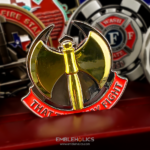
A Navy training unit section ordered a buckle shaped like a hotdog, drawn in 1960s cartoon style and inscribed with the section number. No insignia at all.
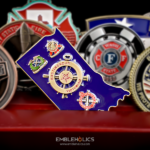
A federal resident agency in the Middle East chose a camel instead of an agency seal.
A multi-agency narcotics group whose initials spell FANG built their design around a unit whose acronym became its mascot, which is the acronym doing the work with no further invention required.
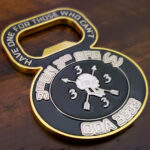
And this page’s coin is a kettlebell, because that is what the team’s culture is built around.
None of these explains anything to an outsider. That is the feature. A coin that makes a stranger ask “why that?” has done exactly what a unit coin is for, because the answer to that question is a story that only the people who were there can tell. A crest answers no questions and prompts none.
The practical test is simple. If you showed the design to somebody from another unit and they understood it immediately, it is probably too generic. If the people in your own team laughed, it is right.
When Not to Use an In-Joke
There are coins where this advice does not apply, and being straight about that matters more than being clever.
Change of command coins. These are handed to visiting officers, to guests from other organisations and to the outgoing commander’s family. The audience is deliberately wider than the unit, and a design that excludes them reads badly.
Retirement and presentation coins. A coin marking twenty or thirty years is likely to end up in a shadow box on a wall, seen by people who never served with the person. Formality holds up over that timescale in a way an inside reference does not.
Memorial coins. Never. A memorial coin goes to a family first, and humour in that context lands as carelessness even when everyone involved knows the person would have laughed.
Anything an outside organisation will hold. Coins presented at conferences, to partner agencies or to civic groups are representing the unit rather than belonging to it.
The distinction is who the coin is for. If it belongs to the team, design it for the team. If it represents the team to someone else, design it for the someone else. Plenty of units order both, and that is usually the right answer.
About This Kettlebell Coin
ODA 3333 is an Operational Detachment Alpha within 3rd Battalion, 3rd Special Forces Group (Airborne), a United States Army Special Forces unit.
The coin is shaped like a kettlebell. Their insignia and emblem are engraved on both faces, with the unit motto inscribed around them, and the piece works as a bottle opener.
The neat part is that the shape solved the engineering by accident. A bottle opener needs a gap with a lip on one side, and that gap has to be designed into the outline rather than cut into a finished coin. A kettlebell already has one: the handle. The team chose the shape because it meant something to them, and the function it needed turned out to be built into it.
That order of operations is worth copying. Pick the shape for what it means, then look at what the shape can already do. Trying it the other way around, deciding the coin should open bottles and then hunting for a shape with a suitable hole in it, tends to produce something that looks like a bottle opener with a logo on it. For the mechanics of the feature itself, see our page on how bottle opener coins work, and for more on cutting a coin to an outline, see custom shaped challenge coins.
Can We Use Our Unit Insignia on a Coin?
Most units can, but the authorisation has to come from the unit, not from us. Unit insignia, distinctive unit insignia, crests and service marks are controlled by the organisations that own them, and the rules differ between branches and between commands.
The practical version is straightforward. Clear the artwork through your own chain of command before you order, and send us artwork your organisation is authorised to supply. We produce from what the customer provides and we do not grant permission on anyone’s behalf. If you are unsure who signs off, your command’s public affairs office is usually the right place to ask.
Bring Us Your Idea
A rough idea is enough. You do not need artwork, a drawing or a finished concept. Describe the joke, name the object, send a photograph of the thing on the wall of your team room, and a designer will turn it into a coin at no cost with unlimited revisions. Nothing goes into production until you approve a digital proof.
Standard production runs about 45 to 50 days after final artwork approval, rush production is available on many projects, and shipping within the continental United States is included. Embleholics is veteran-owned, SDVOSB and registered in SAM.gov. Request a free quote and tell us the idea, however half-formed it is.
Frequently Asked Questions
What should we put on our unit’s challenge coin?
Put something the unit already identifies with, such as an object associated with the job, a nickname, a mascot or a running joke. The unit is the only audience that has to understand the design, so a coin that means nothing to outsiders is working as intended rather than failing.
Does a challenge coin have to use the unit crest?
No. A unit crest is optional, and many of the strongest coins leave it off entirely or reduce it to a small element on the reverse. The crest already appears on patches, signage and paperwork, so a coin is usually the one chance a team gets to use something else.
Can a coin be shaped like an object?
Yes. Coins can be cut to almost any outline, and object shapes such as tools, vehicles, animals and equipment are among the most common custom shapes. A shape is worth the extra cost when the outline itself carries meaning, rather than when it is decorative.
Can a coin design be funny?
Yes, and for a coin belonging to a team rather than representing it, humour usually produces a better object. In-jokes, cartoon artwork and unexpected shapes all work well on unit coins. The exceptions are change of command, retirement, presentation and memorial coins, which are seen by people outside the unit.
When should a coin design be formal instead?
Use a formal design when the coin will be held by people outside the unit. Change of command coins, retirement and presentation pieces, memorial coins and anything given to partner organisations or visiting officers all fall into this category, because the audience extends to guests and families.
Can a coin be a bottle opener as well?
Yes. A bottle opener is built into the coin’s outline as a gap with a lip, so it has to be part of the shape from the design stage rather than added later. Shapes that already contain a suitable opening, such as a kettlebell handle, work particularly well.
What is an ODA?
ODA stands for Operational Detachment Alpha, the designation for a United States Army Special Forces team. Each detachment carries a number identifying the group and battalion it belongs to.
Do we need artwork to start?
No. A written description, a rough sketch, a photograph or a verbal idea is enough to begin. Professional artwork is developed at no cost with unlimited revisions, and nothing goes into production until you have approved a digital proof of the final design.
More Army Projects