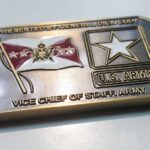
A dog tag challenge coin is a flat rectangular coin with rounded ends, shaped like a military identification tag. The format gives more room for lines of text than a round coin of similar size, which makes it the natural choice when a name, a date or a number has to go on the piece.
What Is a Dog Tag Challenge Coin?
The military identification tag has been essentially the same object for over a century: a small flat plate, rounded at both ends, stamped with a few lines of text and worn on a chain. Everyone recognizes the silhouette instantly, which is half of why it works as a coin shape.
The other half is what the shape offers as a surface.
Two flat parallel faces. A rectangle has no curved edge eating into the usable area, so more of the face is available for content than on a circle of comparable size.
A layout that reads as stacked lines. A round coin pushes text into a ring around the rim, because that is the shape that fits. A dog tag reads top to bottom in lines, the way the original does, which suits anything that is fundamentally a list.
Rounded ends and a familiar proportion. The shape is doing recognition work before anything is written on it. A viewer knows what they are holding is military before they read a word.
A natural place for a hole. The original has one, so a dog tag coin with one looks correct rather than modified.
Why Dog Tag Coins Get Personalized
Here is the thing that makes this shape different from every other coin format.
A dog tag is the one piece of military kit that carries an individual’s name. Everything else a service member wears identifies something collective: the unit patch, the rank, the branch tape, the qualification badge. All of it says what you belong to and what you have done. The tag says who you are.
So a coin in that shape arrives carrying an expectation. People look at a dog tag coin and think about putting a name on it, in a way that simply does not happen with a round coin. The shape asks for it.
What tends to go on:
- A name, which is the whole reason most people choose the shape
- Dates, of service, of a deployment, of a graduation or a retirement
- A unit, a rank or a service number
- A short line of the kind that would fit on a real tag
There is a practical dimension worth raising early. A set where every piece carries different text is a different kind of order from a set where all pieces are identical. It affects how the pieces are produced, how the proofing works, and how long it takes, because there is a list to check rather than one design to approve. None of that is a problem, but it should be part of the first conversation rather than discovered halfway through. Tell us at the quote stage whether the pieces are all the same or all different, and how many lines of text each one carries.
For a related approach on a different scale, see our page on numbered and serialised coins.
What Else Can a Dog Tag Coin Do?
Plating. Gold, silver, nickel, copper and black nickel are all available, along with antique gold, antique silver, antique brass and antique copper, and polished, matte and two-tone finishes. Antique finishes suit the shape particularly well, because a worn-looking tag reads as authentic rather than as new.
Engraving and relief. Text can be engraved into the surface or raised off it. Engraved lettering is closer to how a real tag is made, since the originals are embossed or stamped rather than sculpted, so it tends to look more correct on this shape than heavy relief does.
Cutouts. Sections of the piece can be cut through, which works well on a rectangle because the shape has clean straight edges to cut against.
A chain hole. Worth deciding deliberately. A hole means the piece can be worn, hung from a bag or added to a keyring, which turns it from something kept in a drawer into something carried. A piece without one is purely a coin.
A bottle opener version. A dog tag body is one of the better shapes for an opener, because the length gives leverage and the straight edges suit the geometry. How that is built is covered on our page about bottle opener coins.
When a Dog Tag Shape Is the Wrong Choice
Not every design belongs on a rectangle, and it is worth saying so.
A round emblem fights a rectangular frame. Most unit crests, agency seals and command insignia are circular, because that is what seals have always been. Drop a circle into a rectangle and you get dead space in all four corners, and the design ends up looking like a logo placed on a background rather than a coin. Either the emblem has to be cropped, which usually looks like an error, or the piece has to be sized around the circle, which wastes the shape’s main advantage.
A busy crest reads better in a circle. Dense heraldry with a ring of text around it is designed to be round. Forcing it into a tag squeezes the text into a narrower width and makes it smaller than it would have been on a disc.
The shape should mean something. A dog tag coin works when there is a reason for it: a name, an individual recipient, a service theme. Chosen only for novelty, it just produces a rectangle.
The general rule is straightforward. If the design is a list, use a tag. If the design is a seal, use a circle. Coins made to resemble other items of insignia have the same consideration, covered on our page about coins made to look like patches.
About These Dog Tag Coins
This was a set of military dog tag challenge coins produced from artwork the customer supplied, with a brief that asked for something simple and professional and for the original artwork to be reproduced accurately.
That is a narrower job than it sounds and a harder one than inventing something. When a customer supplies finished artwork and asks for it reproduced, the work is entirely in the accuracy: matching line weights so that nothing thickens or drops out at final size, holding proportions so the design is not subtly stretched by the change of shape, and setting the depth so that fine detail survives the strike without going soft.
A restrained design for a senior recipient is also the correct answer rather than a missed opportunity. The temptation on a prestigious order is to add something, and the discipline is not to. What was asked for here was a clean reproduction on a well-made piece, and that is what the project is.
See more custom Army challenge coins and plating and finish options.
Can We Use Our Unit Insignia on a Coin?
Most units can, but the authorization has to come from the unit, not from us. Unit insignia, distinctive unit insignia, crests and service marks are controlled by the organizations that own them, and the rules differ between branches and between commands.
The practical version is straightforward. Clear the artwork through your own chain of command before you order, and send us artwork your organization is authorized to supply. We produce from what the customer provides and we do not grant permission on anyone’s behalf. If you are unsure who signs off, your command’s public affairs office is usually the right place to ask.
Design a Dog Tag Coin
Professional artwork is free with unlimited revisions, and nothing goes into production until you approve a digital proof. If the pieces are to carry individual names or numbers, say so at the quote stage along with how many lines of text each one needs.
The minimum order is 50 coins. Standard production runs about 45 to 50 days after final artwork approval, rush production is available on many projects, and shipping within the continental United States is included. Embleholics is veteran-owned, SDVOSB and registered in SAM.gov. Request a free quote to get started.
Frequently Asked Questions
What is a dog tag challenge coin?
A dog tag challenge coin is a flat rectangular coin with rounded ends, shaped like a military identification tag. The format offers more usable text area than a round coin of similar size and reads as stacked lines rather than text curved around a rim.
Can individual names be engraved on dog tag coins?
Individual names, dates and numbers are a common request on this shape, and a set where every piece is different is produced differently from a set of identical pieces. Raise it at the quote stage, along with how many lines of text each piece needs, so the approach and timeline can be set.
Can dog tag coins be individually numbered?
Individual numbering is one of the personalization options to ask about when requesting a quote. Because it means each piece differs, it affects production and proofing, so it should be discussed before artwork is finalized rather than added afterward.
Does a dog tag coin have a hole for a chain?
A hole is optional and worth deciding deliberately. With one, the piece can be worn, hung from a bag or added to a keyring, which changes it from something kept in a drawer into something carried. Without one, it functions purely as a coin.
Can a dog tag coin work as a bottle opener?
Yes. A dog tag body suits an opener well, because the length gives leverage and the straight edges fit the required geometry. The opener profile is built into the design from the start rather than cut into a finished coin.
What plating options are available?
Available platings include gold, silver, nickel, copper and black nickel, plus antique gold, antique silver, antique brass and antique copper, and polished, matte and two-tone finishes. Antique finishes suit the dog tag shape particularly well, since a worn appearance reads as authentic on this format.
Is a dog tag shape better than a round coin?
Neither is better; they suit different designs. A dog tag is the right choice when the content is a list, such as a name, dates and a unit. A round coin is the right choice when the design is built around a circular crest or seal, which would leave dead corners in a rectangle.
What is the minimum order for dog tag coins?
The minimum order for custom challenge coins is 50 pieces. Larger quantities reduce the cost per piece. If the set includes individual names or numbers, mention that when requesting a quote, since it affects how the order is produced.
More Army Projects