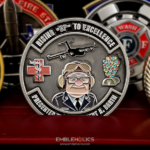
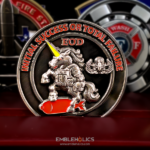
The base metal sits between brass and copper, warmer than one and softer than the other. The rims are etched with a wavy curved pattern rather than left plain or reeded. Both faces carry an insignia that is sculpted, machined and painted. It was made for the Fire and Emergency Services unit at Maxwell Air Force Base, which asked for something classy and elegant that would not look out of date.
Copper and Brass as Base Tones
Most coins default to gold, silver or nickel. A copper or bronze tone is the third option and it does something neither of the others can.
It reads as older. A warm reddish metal carries the association of age, which is why antique bronze is the standard finish on commemoratives. For an organization wanting to look established rather than new, that is the right instinct.
It is softer against color. Bright gold competes with enamel, pulling the eye to the metal. A copper tone sits further back, so painted areas read as the brightest thing on the coin rather than fighting the plating for attention.
It hides handling better than gold or silver. A warm matte metal absorbs fingerprints and small marks, and the patina it picks up in the recesses is generally considered an improvement rather than wear.
And the shade between brass and copper is the useful middle. Pure copper can read as pink in some lights and as dull in others. Pulling it toward brass keeps the warmth without the risk, which is why that intermediate tone is a common specification rather than a compromise.
The one thing to know is that it suits engraved and sculpted work better than it suits large flat painted areas. A copper tone is a textured, warm surface and it wants detail to catch on. See plating and finish options and antique vs polished finishes.
A Wavy Rim Instead of a Pattern
The edge of this coin is etched with a wavy curved pattern, which is worth separating from the usual edge options.
Most edge treatments are repeating and mechanical: reeding is straight vertical lines, a diamond cut is cross-hatching, a rope edge is twisted cable. Those read as traditional, because they come from currency.
A wavy etched rim is different. It is a continuous curved line rather than a repeating unit, which reads as contemporary and deliberate rather than conventional. The page describes it as contemporary compared to a common coin, and that is exactly the effect.
Three things to know if you want one. It has to be shallow, because the rim is the thinnest part of the coin and deep cutting there weakens it. It works better on a matte or warm metal than on a mirror finish, since it reads by shadow and a polish throws light into it. And it should be the only unusual element on the piece, because a contemporary edge on an otherwise traditional coin reads as a considered choice, while a contemporary edge plus a custom shape plus unusual color reads as unresolved.
For other edge options, see a diamond cut edge challenge coin.
Sculpted, Machined and Painted on Both Faces
Both sides of this coin carry an insignia that has been sculpted, machined and then painted, which is the full treatment and the most expensive of the options.
The sequence matters. Sculpting establishes the three dimensional form. Machining cuts the detail into it. Painting then fills the recesses. Each step depends on the previous one being right, which is why the order is not interchangeable and why a flaw early shows in the finished piece.
Doing it on both faces rather than one is a deliberate choice with a real cost, since a three dimensional model and a deeper die are needed for each side. What you get is a coin with consistent weight and depth whichever way it sits, which reads as a medal rather than a token. The planning note is that a coin has a finite thickness, so deep relief on both faces at the same point leaves little metal between them, and the two sides have to be designed together rather than in sequence.
Painting over sculpted relief is also the technique that gives color its best showing. Paint sitting in relief follows the form rather than filling a flat cell, so the color describes shape. See 2D vs 3D challenge coins.
A Coin That Will Not Date
The brief included not looking out of date, which is a request worth taking seriously because it rules things out.
No year, no event. Anything time-specific dates by definition.
No current equipment. A coin featuring today’s apparatus or aircraft looks dated when the fleet changes. The insignia does not.
No design trend. Whatever is fashionable in graphics now will read as a period piece in fifteen years. A conventional format with careful execution ages better than a stylish one.
And no command team. Naming the current leadership fixes the coin to a tour.
What is left is the insignia, the organization’s name and the quality of the object, which is precisely what this coin carries.
About the Base
Maxwell Air Force Base, officially Maxwell-Gunter Air Force Base, is a United States Air Force installation under Air Education and Training Command. It supports Air University, the 908th Airlift Wing, the Business and Enterprise Systems Directorate and more than 30 tenant units, with over 12,500 active duty, reserve, civilian and contractor personnel.
Its aviation history runs back to 1910, when the Wright Brothers built a flying school on the site, and the base describes itself as home to a proud tradition of aviators and airpower advocates.
A base fire department is a good coin client for a reason worth noting: it serves an installation rather than a city, which means its people work alongside both military and civilian emergency services and have an identity distinct from either. See more firefighter challenge coins and Air Force challenge coins.
Order a Copper Toned Coin
Professional artwork is free with unlimited revisions, and nothing goes into production until you approve a digital proof. The challenge coin minimum is 50 pieces, standard production runs about 45 to 50 days after final artwork approval, rush production is available on many projects, and shipping within the continental United States is included. Embleholics is veteran-owned, SDVOSB and registered in SAM.gov.
Two suggestions. If you want a warm metal, ask for the tone between brass and copper rather than pure copper, since it keeps the warmth without reading pink in some lights. And if the brief is that the coin should not date, say so explicitly, because it rules out years, current equipment, command names and anything stylistically of the moment, which is a useful constraint to apply from the first sketch. Request a free quote to begin.
Finished Coin (Front)

Finished Coin (Back)

Frequently Asked Questions
What is a copper challenge coin?
It is a coin with a copper or bronze toned base rather than gold, silver or nickel. The warm reddish metal reads as older and more established, which is why it is the standard choice on commemorative pieces.
Why choose copper over gold?
Because it sits further back visually. Bright gold competes with enamel and pulls the eye to the metal, where a copper tone lets the painted areas be the brightest thing on the coin. It also hides handling marks better.
Is pure copper a good choice?
Usually a tone between brass and copper is better. Pure copper can read as pink in some lights and dull in others, while pulling it toward brass keeps the warmth without that risk.
What does a wavy etched rim look like?
A continuous curved line around the edge rather than a repeating mechanical unit. Reeding, diamond cuts and rope edges read as traditional because they come from currency; a flowing etched line reads as contemporary.
How deep can an edge pattern be cut?
Shallow. The rim is the thinnest part of the coin, so deep cutting there weakens it. An etched rim also reads by shadow, so it works better on a matte or warm metal than on a mirror finish.
Can both faces of a coin be sculpted and painted?
Yes, and it gives the piece consistent weight and depth whichever way it sits. It costs more, since a three dimensional model and a deeper die are needed for each face, and the two sides have to be designed together because a coin has finite thickness.
Why paint over sculpted relief rather than flat areas?
Because paint sitting in relief follows the form rather than filling a flat cell, so the color describes shape. It also lasts longer, since color protected within a recess wears far more slowly than color on a raised surface.
How do you make a coin that will not look dated?
Leave off the year, any current equipment, the names of the current command team, and anything stylistically of the moment. What remains is the insignia, the organization’s name and the quality of the object.
More Air Force Projects