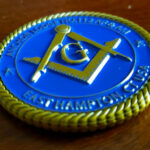
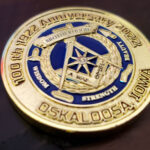
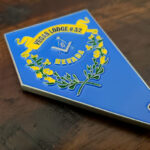
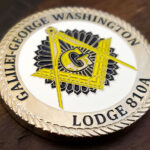
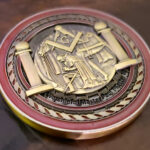
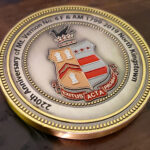
This coin was made for the 220th anniversary of the Mount Vernon lodge, to be presented by a Master Mason. It follows the style of older vintage coins, with the original Masonic symbols and insignia etched on both faces and gold and maroon applied to parts of the design.
A Coin Presented by a Master Mason
A Master Mason is a Freemason who has reached the third degree, and a coin presented at that level is a specific kind of object.
It is given personally, not issued. Which makes it a presentation piece rather than a membership token, and that points the design toward craft and restraint rather than toward color and novelty.
The symbols are the content. Masonic practice is built on emblems with established meanings, which means a lodge arrives with meaningful artwork rather than needing something invented. It also means the symbols should not be restyled for visual effect, because the forms carry the meaning.
And the recipient already knows what everything means. So the coin does not need to explain itself, which frees it from lettering and lets the devices stand alone. That is why these designs tend to be cleaner than most organizational coins.
See also a lodge coin cut to a state outline, a masonic lodge anniversary coin and more masonic challenge coins.
Marking 220 Years
A lodge chartered in the early 1800s has more history than a coin can hold, and the discipline is in what gets left out.
Two dates, not a timeline. The founding year and the current one say two centuries in eight digits. A list of milestones will not fit at a readable size and turns the face into a document.
The symbols are already historical. Which is the advantage a Masonic coin has over most anniversary pieces. The emblems have been in use for the whole of the lodge’s existence, so they date the organization without any device having to be added for the purpose.
And the style can do the work. Following the look of older coins, as this one does, communicates age through the design register rather than through content. That is a more economical way to say two hundred years than any inscription.
For another approach to a long anniversary, see a fire department anniversary coin and a 100 year challenge coin.
Etching on Both Faces
Both sides are etched rather than sculpted, which suits Masonic symbols particularly well.
The square and compasses, the letter G, the trowel, the level and the plumb are all drawn forms: line work, geometry and defined edges. Etching produces exactly that, because recessed line work reads as a drawing. Sculpting the same symbols in relief tends to make them look like castings rather than emblems, and it loses the precision that geometric devices depend on.
Etching also handles the density. Masonic designs frequently carry several symbols on one face, and recessed line work holds them all at a single depth, which keeps the face organized. A dozen sculpted devices would produce competing high points with nothing separating them.
The practical note on etched work is contrast. Bare engraving relies on shadow alone, which is subtle, so a fill in the recesses is what makes the line work read at arm’s length. See engraving and finish options.
Gold and Maroon
Two colors on an otherwise metal coin, and the pairing is doing specific work.
Gold is plating rather than paint. Where the design calls for gold, the metal itself is left exposed and plated, so those areas are the coin rather than something applied on top of it. They cannot chip or fade, and they catch light in a way painted gold does not reproduce.
Maroon is an unusual and well judged choice. A deep red reads as traditional and formal where a bright red would read as modern. It is also dark enough to act as the forgiving background color every coin benefits from, hiding small variations in fill the way black does, while being warmer than black against a gold plating.
And restricting it to parts of the design keeps the metal visible. A fully colored coin loses the plating that gives a Masonic piece its register. Applying color to some elements and leaving others bare is what makes the gold read as gold.
Lodge Emblems and Permissions
One practical point for any lodge ordering a coin.
Grand Lodge emblems and jurisdictional devices are generally governed by the Grand Lodge rather than the local lodge, and a lodge’s own seal may have its own rules. Clear the use through your officers and your Grand Lodge before ordering, particularly if the coins will be sold rather than given, since restrictions on selling branded items are frequently stricter.
We produce from the artwork a customer is authorized to supply and we do not grant permission on any organization’s behalf.
Freemasonry is a fraternal order that keeps some of its rituals and activities private, and one common misconception is that a person has to be invited to join.
Order a Coin for Your Lodge
Professional artwork is free with unlimited revisions, and nothing goes into production until you approve a digital proof. The challenge coin minimum is 50 pieces, standard production runs about 45 to 50 days after final artwork approval, rush production is available on many projects, and shipping within the continental United States is included. Embleholics is veteran-owned, SDVOSB and registered in SAM.gov.
Two suggestions. If the coin marks an anniversary, work backward from the date, allowing about 45 to 50 days of production after final artwork approval plus artwork and proof rounds. And if you want a coin that reads as traditional, say so explicitly, because it points the design toward etched line work, plated metal and a restrained palette from the first sketch rather than being a styling choice applied later. Request a free quote to begin.
Finished Coin (Front)
Finished Coin (Back)
Frequently Asked Questions
What is a Master Mason challenge coin?
It is a coin associated with the third degree of Freemasonry, often presented personally by a Master Mason rather than issued to all members. That makes it a presentation piece, which points the design toward craft and restraint.
Should Masonic symbols be etched or sculpted?
Etched. The square and compasses, the letter G, the trowel and the level are drawn forms built from line work and geometry, and recessed line work reads as a drawing. Sculpting them makes them look like castings and loses their precision.
Can several symbols go on one face?
Yes, and etching is what makes it possible. Recessed line work holds every device at a single depth, which keeps a dense face organized, where a dozen sculpted devices would produce competing high points with nothing separating them.
How do you mark a 200 year anniversary on a coin?
With two dates rather than a timeline, and by letting the design style carry the age. A traditional register communicates two centuries more economically than any inscription, and Masonic symbols are already historical.
Is gold on a coin plated or painted?
It can be either, and plating is better. Plated gold is the coin’s own exposed metal, so it cannot chip or fade and it catches light in a way painted gold does not. Most people asking for gold mean plating.
Why use maroon rather than red?
Because a deep red reads as traditional where a bright red reads as modern. Maroon is also dark enough to act as a forgiving background color, hiding small fill variations, while being warmer than black against gold plating.
Should the whole coin be colored?
Not on a traditional piece. A fully colored coin loses the plating that gives it its register, so applying color to some elements and leaving others as bare metal is what makes the gold read as gold.
Do we need permission for lodge and Grand Lodge emblems?
Generally yes. Grand Lodge emblems and jurisdictional devices are governed centrally rather than locally, with stricter rules on selling branded items than on giving them away. Clear it through your officers and Grand Lodge before ordering.
More Masons & Masonic Lodges Projects