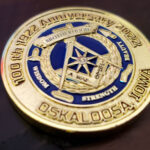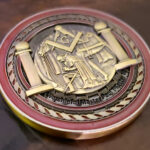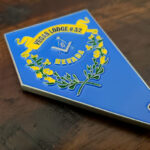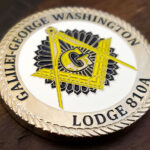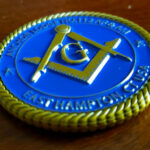
A lodge coin has three things to carry that a unit coin does not: a fraternity’s shared symbols, an individual lodge’s own name and number, and a sense of the lodge’s own character. This one was made for Anchor Lodge No. 112, AF & AM, in East Hampton, Connecticut. The design is deliberately classic, with rope-pattern edging, engraved symbols on both faces, and a base metal chosen to look substantial without being costly.
The number is not a detail
Within Freemasonry, a lodge is identified by its number as much as by its name, and the two always travel together. Anchor Lodge No. 112 is how the lodge is referred to in full, and a coin that drops the number reads as incomplete to any Mason who picks it up.
The letters after it matter too. AF & AM stands for Ancient Free and Accepted Masons; other jurisdictions use F & AM, Free and Accepted Masons. Which one a lodge uses depends on its Grand Lodge, not on preference, and getting it wrong is the kind of error that is obvious to the recipients and invisible to everyone else. Take the wording from the lodge’s own charter or letterhead rather than from memory.
Give the name and number room. On a coin with engraved symbols and a border, the lodge identification is the one piece of text that must be legible, so it should sit in the clearest space available rather than being fitted in around the artwork.
Shared symbols and the lodge’s own
The fraternity’s symbols are common to every lodge, which is exactly why they cannot carry a lodge coin on their own. The square and compasses identify the coin as Masonic to anyone, and that is useful, but a coin showing only the square and compasses could belong to any of thousands of lodges.
The lodge’s own name is usually the answer. Masonic lodges are named, and the name almost always suggests an image. An Anchor Lodge has an anchor, which is a gift to a designer: it is a simple, strong silhouette, it engraves cleanly, and it carries its own meaning within the fraternity as an emblem of hope and steadfastness. Using the lodge’s namesake image on one face and the shared symbols on the other gives both their proper weight.
Where a lodge’s name does not suggest an image, the usual alternatives are the founding year, the Grand Lodge’s jurisdiction, or a local landmark. Any of those distinguishes the coin from the generic.
Why a classic treatment suits a lodge
Freemasonry is an old institution with a strong attachment to continuity, and its coins generally look the part. Rope-pattern edging, engraved rather than printed symbols, antique or burnished finishes and restrained color all read as traditional, which is what most lodges want. A bright, heavily enameled, contemporary coin can look wrong on a lodge table even if it is well made.
Engraving over enamel is the key choice. Masonic symbolism is line work: the square and compasses, the letter G, the all-seeing eye, pillars, the trowel. These are drawings rather than color blocks, and they read far better cut into metal than filled with enamel. A lodge coin with little or no color is usually the better coin, and it also costs less, which matters for a group funding it from dues.
Choosing a base metal that looks expensive without being expensive is a legitimate goal, and it is mostly a finish question rather than a materials one. An antique brass or bronze finish over a standard base reads as older and more substantial than a bright plating, at no extra cost.
Who the coin is for, and how many
A lodge is a countable group, which makes quantities easy and makes it worth thinking about who else gets one. Beyond the current membership, lodges commonly want coins for visiting brethren from other lodges, for Grand Lodge officers on an official visit, and for presentation when a candidate is raised.
That last use argues for a reorderable design. If the coin marks a milestone in a member’s progress, it is needed continuously rather than once, so keep the year off the die. A lodge marking an anniversary is the exception, and that is a separate, finite piece.
Discretion is worth a word. Lodges differ in how publicly they treat their own materials, and a coin given to members is not necessarily a coin for sale. Worth agreeing within the lodge before ordering whether these are for members only.
Ordering a lodge coin
Send the lodge’s full name and number exactly as it appears on the charter, and tell us whether the lodge has its own emblem. If it does not, the name itself usually suggests one. Tell us the membership and whether you want coins for visitors and presentations, since that typically doubles the number. We have made a number of these, including the Mahaska Lodge 664 coin and the Master Mason coin, and you can see the full range of Masonic lodge coins or send your details through the free quote form.
Frequently Asked Questions
What should go on a Masonic lodge challenge coin?
The fraternity’s shared symbols, the lodge’s full name and number, and something specific to that lodge. The square and compasses identify a coin as Masonic but could belong to any lodge, so the lodge’s own name, emblem, founding year or jurisdiction is what makes the coin theirs. Most lodge names suggest an image that can carry one face.
Does the lodge number need to be on the coin?
Yes. Within Freemasonry a lodge is identified by name and number together, and a coin that omits the number reads as incomplete. Give it a clear position rather than fitting it around the artwork, since it is the one piece of text that has to be legible.
What is the difference between AF & AM and F & AM?
Ancient Free and Accepted Masons versus Free and Accepted Masons. Which a lodge uses is determined by its Grand Lodge rather than by preference, so it is not interchangeable. Take the exact wording from the lodge’s charter or letterhead, because an error here is obvious to every recipient.
Should a lodge coin use enamel or engraving?
Engraving, in most cases. Masonic symbolism is line work rather than color blocks, and the square and compasses, the letter G, pillars and the all-seeing eye all read far better cut into metal than filled with enamel. A restrained engraved coin usually looks more appropriate on a lodge table, and it costs less, which matters for a group funding it from dues.
How do you make a coin look expensive without the cost?
Through finish rather than materials. An antique brass or bronze finish over a standard base reads as older and more substantial than a bright plating, at no additional cost. Engraved relief adds to that impression, because it lives in the die and is reproduced across the run for nothing.
How many coins should a lodge order?
More than the membership. Lodges routinely want coins for visiting brethren from other lodges, for Grand Lodge officers on official visits, and for presentation when a candidate is raised. That last use is continuous, so keep the year off the die and the same design can be reordered indefinitely.
Should a lodge coin be sold or given only to members?
That is a decision for the lodge rather than a production question, and it is worth settling before ordering. Lodges differ in how publicly they treat their own materials, and a coin intended for members and visiting brethren is specified differently from one meant for general sale.
More Masons & Masonic Lodges Projects