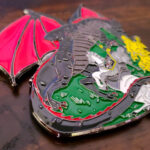
A defense attaché challenge coin belongs to the officers and civilians who represent the United States military inside its embassies abroad. This one was made for the Joint Military Attaché School, which prepares personnel from the five uniformed services and Department of Defense civilians for duty in the Defense Intelligence Agency’s Defense Attaché Service. The coin is one of the most unusual we have produced: a full-color machined scene of a knight in armor fighting a dragon, rather than the crest and scroll a school coin would normally carry.
Allegory instead of insignia
Most unit coins answer the question “who are we?” with a crest. This one answers it with a story. An eagle, a globe, a shield and a banner would have identified the school correctly and said nothing about the work. A knight facing a dragon says something a crest cannot: that the job involves going somewhere alone and dealing with what is there.
Allegory works on a coin when three conditions hold.
- The image is universally legible. A knight and a dragon need no explanation in any country, which matters for a coin whose recipients will be handing it to foreign counterparts. An inside joke or a local reference would not travel.
- The organization is comfortable being represented obliquely. Some commands want the crest and nothing else, and that is a legitimate position. Allegory suits organizations with a strong internal culture and a clear sense of what they do.
- There is enough coin to carry it. A scene needs more room than an emblem. Figures, action and depth do not compress the way a crest does, so an allegorical design usually wants a larger coin than you first planned.
The safe structure is allegory on one face and identity on the other. That is what this coin does: the scene carries the front, and the school’s name and lettering carry the back. Anyone receiving it gets the image first and the attribution second, which is the right order.
Machining a scene rather than an emblem
A figurative scene is a different production problem from a crest. An emblem is flat shapes with clean boundaries, which is what enamel is built for. A knight and a dragon have overlapping forms, implied motion, and depth that has to read as depth rather than as a jumble of outlines.
Three things make it work:
- Build the scene in distinct planes. Foreground figure, middle action, background. Each needs its own relief height so the eye can separate them. A scene cut at uniform depth becomes unreadable at coin size no matter how good the drawing was.
- Let color follow the relief, not fight it. On a full-color scene it is tempting to color every element separately. Limiting the palette and letting sculpted shadow do the separating keeps the image coherent.
- Protect the silhouette. The outermost edges of the figures are what the eye reads first. Those need the cleanest cutting and the most clearance from lettering and rim.
What a defense attaché coin is actually for
This is a coin that spends its life being given to foreigners, and that changes the brief. Defense Attaché Offices operate from United States embassies in more than a hundred locations, and attachés exchange coins with host-nation militaries, allied attachés and official visitors as a matter of routine. The coin is a diplomatic object as much as a unit one.
Practical consequences:
- Design for someone who does not read English. The image carries the meaning; the text is attribution. A coin whose entire content is a motto in English does little in a room where English is the third language.
- Presentation matters more than usual. A coin handed over in an official setting benefits from a capsule or a case in a way a pocket coin does not. This is one of the few cases where packaging earns its cost.
- Order generously. Exchange is reciprocal and unpredictable. Attachés run out, and a resupply across a diplomatic pouch is slower than a domestic reorder.
- Keep it releasable. Nothing on a coin that will circulate internationally should be anything other than openly published information about the organization.
Ordering a school or attaché coin
Tell us whether you want the crest or the idea. That single question decides almost everything else about the design, and it is worth settling internally before you come to us rather than discovering mid-revision that half the office expected a shield. If you want an allegorical design, bring the concept in words and let our artists draw it, because a scene described well translates better than a scene sketched roughly. You can see more military challenge coins we have produced, or send your brief through the free quote form.
Frequently Asked Questions
What is a defense attaché challenge coin?
It is a coin belonging to the military officers and Department of Defense civilians who serve in United States embassies abroad as part of the Defense Attaché Service. Because attachés exchange coins with host-nation militaries, allied attachés and official visitors as a routine part of the job, these coins function as diplomatic objects as much as unit ones.
What is JMAS?
JMAS is the Joint Military Attaché School, which trains personnel from the five uniformed services and Department of Defense civilians for duty in the Defense Intelligence Agency’s Defense Attaché Service. Its courses are attended by those ordered to the Defense Attaché Service and their spouses, and its instruction combines classroom work with practical exercises.
Can a challenge coin use a scene instead of a unit crest?
Yes, and it can be far more memorable, but it asks more of the design. The image needs to be legible to anyone, the organization needs to be comfortable being represented indirectly, and the coin usually needs to be larger, because a scene does not compress the way an emblem does. The safest structure is the scene on one face and the unit’s name and crest on the other.
How do you machine a figurative scene onto a coin?
By building it in distinct planes rather than at a uniform depth. Foreground, action and background each need their own relief height so the eye can separate them, which is what keeps a complex image readable at coin size. Color should follow the relief rather than outline every element, and the outer silhouette of the figures needs clearance from the lettering and rim.
Should an international coin carry a motto in English?
It can, but it should not be doing the work. A coin handed to foreign counterparts needs to communicate through its imagery, with text acting as attribution. A design whose entire meaning sits in an English motto will land flat in a room where English is nobody’s first language.
How many coins should an attaché office order?
More than you would for a domestic unit. Coin exchange abroad is reciprocal and hard to forecast, and resupplying an overseas post is slower than reordering at home. Running out mid-tour is the common failure, so build in a generous margin at the outset.
Is packaging worth it for a presentation coin?
For coins handed over in official settings, yes. Packaging is usually the first cost we suggest cutting, because most coins go straight into a pocket, but a coin presented formally to a foreign counterpart is the exception. A capsule or case is worth the per-unit cost on the portion of the order that will be used that way.
More Army Projects