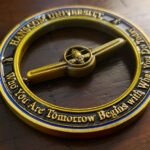
Challenge coins started as a military custom, and the civilian workforce that keeps military installations running is usually an afterthought in them. This one is not. It was made for Hanscom University, the professional development program established in 2022 at Hanscom Air Force Base in Massachusetts, which trains military and civilian personnel alike in individual development, communication, leadership and followership. The coin is round, with most of the field cut away so that the metal left behind forms an aircraft.
The people who get missed
Every military installation runs on a workforce that is substantially civilian, and coin orders are routinely sized to the uniformed population alone. We see it constantly: a command gives us a manning figure, the coins arrive, and the Department of Defense civilians, contractors and local national staff who have often been there longer than anyone in uniform are short.
Why it happens is structural rather than deliberate. The number most easily to hand is the military strength, the budget line is frequently a unit one, and the custom itself is understood as a military tradition. None of that is a reason to leave people out, and the fix is simply to ask for the right number before ordering.
For an organization that serves both populations, the design should reflect it too. A coin built entirely on rank structure, warfare devices or uniformed imagery quietly tells civilian recipients it is not really theirs. Installation identity, the organization’s own mark, the mission and the place all belong to everyone on the base.
Recognition coins for civilians are a growing part of what we make. Civilian employees have fewer formal recognition routes than service members do, with no ribbons and no devices, which makes a coin one of the few tangible things a command can actually hand them.
Negative space as the design
This coin is built the other way round from most. Instead of adding an aircraft to a field, the field is removed and the aircraft is what remains. The subject is made of the metal that was not cut away.
It is a striking effect and a demanding one. Three things have to hold:
- The shape has to read as itself with nothing inside it. Negative space work only succeeds with subjects that are recognizable in silhouette alone. An aircraft works. A detailed crest would not.
- Everything has to stay connected. Every part of the remaining metal needs a path back to the rim, or it falls out. On an aircraft that means the wings, tail and fuselage all have to meet the frame somewhere, which usually requires adjusting the drawing.
- It has to survive being thrown in a bag. A coin that is mostly hole has lost most of its rigidity, so the remaining structure needs enough width and thickness to stay flat. This coin was specifically built so the aircraft would stay intact and attached under ordinary rough handling, which is the right thing to engineer for.
Cutouts sit between an ordinary coin and a spinner on cost. There is no assembly, so the expense is die work rather than per-coin labor, which makes this one of the better value ways to produce something people will stop and look at. We compare the approaches on our shaped coin versus cutout coin page.
A coin for a school rather than a unit
A development organization coins differently from a squadron, and closer to a school. Participants cycle through continuously, so the coin is a standing supply rather than a single run, and it should carry no dates, no cohort numbers and no named officials on the die.
Think about what the coin marks. A school can issue a coin on completion of a course, on reaching a milestone in an awards program, or as general recognition by the director. Those are different volumes and arguably different coins, and deciding which one this is governs how many to order.
Order against annual throughput. As with any training organization, the per-unit price improves considerably at volume and the die cost is paid once regardless, so a year’s requirement ordered together beats quarterly top-ups.
Ordering a coin for a base school
Give us the full population the coin serves, civilians included, and say whether it marks completion, an award or general recognition. Those two answers set the quantity and the register. If you want a cutout, send the subject and we will tell you honestly whether it reads in silhouette and show you where the connecting points need to go. You can see more Air Force challenge coins we have produced, including the 65th Air Base Group award coin, or send your artwork through the free quote form.
Frequently Asked Questions
Can Department of Defense civilians receive challenge coins?
Yes, and they frequently should be. Military installations run on a workforce that is substantially civilian, and civilian employees have fewer formal recognition routes than service members, with no ribbons or devices, which makes a coin one of the few tangible things a command can give them. The usual problem is that orders get sized to the uniformed strength and the civilians come up short.
Should a coin for a mixed workforce look different?
In its imagery, yes. A design built on rank structure, warfare devices and uniformed imagery quietly signals to civilian recipients that it is not really theirs. Installation identity, the organization’s own mark, the mission and the place all belong to everyone on the base and work for both populations.
What is a negative space coin?
One where the design is formed by the metal left behind rather than by metal added to a field. On this coin most of the field is cut away and the remaining material forms an aircraft. It only works with subjects recognizable in silhouette alone, so simple strong shapes succeed where a detailed crest would not.
Will a coin that is mostly cut away stay strong?
Only if it is engineered for it. Removing most of the field removes most of the rigidity, so the remaining structure needs enough width and thickness to stay flat under ordinary handling. Every part of the design also needs a connecting path back to the rim, or it simply falls out, which usually means adjusting the original drawing.
Is a cutout cheaper than a spinner?
Considerably. A cutout involves no assembly, so the cost sits in die work and is paid once rather than per coin, where a spinner is assembled by hand one piece at a time. For a design that needs to stop people and make them look, a cutout is usually the better value of the two.
How should a training organization size its coin order?
Against annual throughput rather than the current cohort. Participants cycle through continuously, the die cost is paid once regardless of quantity, and the per-unit price improves at volume, so ordering a year’s requirement together beats quarterly top-ups. Keep dates, cohort numbers and named officials off the die so the same design serves indefinitely.
What is Hanscom University?
Hanscom University is a professional development organization established in 2022 at Hanscom Air Force Base in Massachusetts. It offers personal and professional development to the base workforce, covering individual development, communication, leadership and followership, and it is open to both military and civilian personnel assigned at Hanscom and at geographically separated units.
More Air Force Projects