A challenge coin can be built around an idea rather than an emblem. An image that stands for something the group went through, such as light through a prism for training, works provided the design is one clear symbol and the other face carries the insignia that says who the coin belongs to.
When Should a Coin Use a Symbol Instead of an Emblem?
Most coins answer the question “who are we.” A symbolic coin answers a harder one: “what did we go through.” That is a different job, and there are four situations where it is the right one.
Training and transformation. Anything that changes the people who complete it. A course, a selection process, a qualification, a pipeline. The emblem of the schoolhouse says where you were. A symbol can say what it did to you, which is what graduates actually want to carry.
A shared experience. A deployment, a response, a season nobody in the unit will forget. When the thing being marked is an experience rather than an organisation, an organisational crest is the wrong object.
A value the group holds. Vigilance, endurance, precision, whatever the unit genuinely organises itself around. This one is easy to do badly, because a value written as a word is a motto and a value rendered as an image is a design. If the idea only works with a caption explaining it, it is not ready.
Something everyone in the group did. A shared rite, a standard, a first. The test is whether everyone receiving the coin would nod at the image without being told.
And the cases where it is the wrong call. Presentation coins, because a recipient from outside the organisation has no context to decode a symbol with. Memorial coins, where clarity matters more than cleverness. Anything given to visitors, partners or families, for the same reason. If the coin is going outward rather than inward, use the emblem.
The related approach of building a coin around an object or an in-joke from a team’s own culture is covered on our page about coins built around objects and in-jokes, which is a different instinct aimed at a different audience.
How Abstract Ideas Work on a Coin
One image, not a collage. This is the rule that decides whether a symbolic coin works. A coin face is about the size of a large postage stamp, and an idea assembled from four elements reads as clutter rather than as meaning. Pick the single image and give it the whole face.
It has to be readable at coin size. An idea that needs fine detail to be legible will not survive the strike. The image has to work as a silhouette first and gain its detail second.
It has to be recognisable at a glance. Symbols people already know carry meaning for free. A few that work well and what they tend to stand for:
- A prism for transformation, or for revealing what was already present
- A compass for direction, judgement, finding a way
- A bridge for connection, or for getting others across
- A sunrise for a beginning, a watch change, a new command
- A chain for interdependence, or for a link being only as strong as the rest
- An anchor, a keystone, a lighthouse for holding, supporting, guiding
Pair it with an anchor face. This is the part most abstract designs get wrong. A coin with a symbol on both faces is a beautiful object that nobody can identify in five years, when the person holding it no longer remembers who gave it to them. This coin solves it the standard way: the insignia on the front says who, the symbol on the reverse says what. Abstraction on one face, identity on the other.
Why Minimal Designs Are Not Simple
The instinct is to assume a minimal coin is an easy coin. It is the opposite.
This design uses two flat background fields, green on one face and black on the other, with the raised elements carrying everything. There is no fine detail, no texture, no busy ring of text, nothing to occupy the eye between the edge and the central image.
That means there is nowhere for a fault to hide. On a detailed coin, a slightly shallow relief or an uneven spacing disappears into the surrounding activity. On a flat field, every edge is the only edge, so any softness in the strike, any variation in enamel depth, any element sitting a fraction off centre is immediately visible. A large flat colour field is also the hardest thing to fill evenly, because there is more area for the enamel to settle unevenly across and no detail to break it up.
So the restraint costs more attention in the die and at the fill stage, not less. The payoff is that a minimal coin with deep, clean fields and crisp raised elements looks more expensive than a crowded one, and it photographs better. For a contrasting approach where depth and layering do the work, see our page on relief depth and layering, and for another design carried by symbolism rather than insignia, see this symbolic coin design.
About This Fort Bragg Coin
Fort Bragg is a United States Army installation in North Carolina and one of the largest military installations in the world by population. Its name has changed more than once: it opened as Camp Bragg in 1918, became Fort Bragg in 1922, was renamed Fort Liberty in 2023, and returned to Fort Bragg in 2025 under a new namesake. The post is now named for Private First Class Roland L. Bragg, a World War II paratrooper with the 513th Parachute Infantry Regiment, 17th Airborne Division, who was awarded the Silver Star and the Purple Heart for his actions at the Battle of the Bulge. He had served at the post himself before deploying to Europe, which makes the name unusually fitting for the home of the airborne.
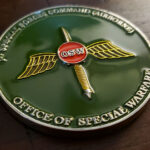
The coin was made for a special warfare organisation based at the post, and the brief was a minimal design that still had presence.
The front carries the unit insignia embossed on a solid green field. The reverse sets light passing through a prism against solid black, standing for the training that personnel go through.
That prism is the best single idea in this gallery, and it repays a second look. A prism does not add anything to light and it does not change what light is. It separates what was already there into something you can finally see. For an organisation whose job is training, that is a far more accurate and more generous image than a torch, a sword or an open book would have been. Training as revelation rather than manufacture. The unit that asked for it understood exactly what it was asking for.
For more work with the same service, see our Army unit coins and the wider set of custom Army challenge coins.
Can We Use Our Unit Insignia on a Coin?
Most units can, but the authorisation has to come from the unit, not from us. Unit insignia, distinctive unit insignia, installation emblems and service marks are controlled by the organisations that own them, and the rules differ between branches and between commands.
The practical version is straightforward. Clear the artwork through your own chain of command before you order, and send us artwork your organisation is authorised to supply. We produce from what the customer provides and we do not grant permission on anyone’s behalf. If you are unsure who signs off, your command’s public affairs office is usually the right place to ask.
Design a Coin Around Your Idea
Most people arrive with a concept rather than a picture. “Something about the pipeline.” “Something that means we all came through the same thing.” That is enough to start, and turning a concept into an image is exactly what the free artwork is for.
Professional design comes with unlimited revisions, and nothing goes into production until you approve a digital proof. The minimum order is 50 coins. Standard production runs about 45 to 50 days after final artwork approval, rush production is available on many projects, and shipping within the continental United States is included. Embleholics is veteran-owned, SDVOSB and registered in SAM.gov. Request a free quote and describe the idea in your own words.
Frequently Asked Questions
Can a challenge coin use a symbol instead of a logo?
Yes. A symbolic challenge coin design replaces the emblem with an image standing for an idea, such as training, endurance or a shared experience. It works best when the symbol occupies one face and the unit insignia occupies the other, so the coin still identifies who it came from.
What makes a good symbolic coin design?
A good symbolic design uses one clear image rather than several combined, reads as a silhouette before any detail is added, and is recognisable without explanation. Prisms, compasses, bridges, anchors and sunrises all work because viewers already associate them with a meaning.
Should both sides of a coin be abstract?
Usually not. A coin with symbols on both faces can become unidentifiable once the person holding it no longer remembers who gave it to them. Pairing an abstract face with an insignia face keeps the meaning and the identity together on one object.
Is a minimal coin design cheaper?
Not necessarily. A minimal coin has large flat fields and few elements, which means any unevenness in the strike or the enamel is fully exposed with no surrounding detail to disguise it. Cost is driven mainly by quantity, size, plating and features rather than by how much is on the face.
Why was Fort Liberty renamed Fort Bragg?
Fort Liberty was redesignated Fort Bragg in 2025 following a memorandum from the Secretary of Defense, with a formal redesignation ceremony held on 7 March 2025. The restored name honours a different individual from the one the post was originally named for.
Who is Fort Bragg named after?
Fort Bragg is named after Private First Class Roland L. Bragg, a World War II paratrooper who served with the 513th Parachute Infantry Regiment, 17th Airborne Division, and received the Silver Star and Purple Heart for his actions at the Battle of the Bulge. The post was originally named for Confederate General Braxton Bragg.
Can we use our unit insignia on a coin?
Unit insignia and installation emblems are controlled by the organisations that own them, so permission has to come from your unit rather than from a manufacturer. Clear the artwork through your chain of command and send us artwork your organisation is authorised to supply.
What is the minimum order for unit coins?
The minimum order for custom challenge coins is 50 coins. That figure suits a single unit, course or section rather than a whole command, and larger quantities reduce the cost per coin.
More Army Projects