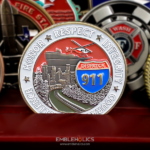
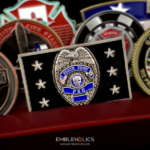
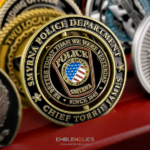
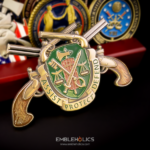
A customized version of the standard challenge coin format. One side carries the department’s insignia and the other Saint Michael, the patron saint of police officers. Both images are rendered with fine detail and texture, the lettering is crisp, and the palette runs to four colors: gold, silver, blue and red. This Brook Park police challenge coin was made for the department serving Brook Park, Ohio.
Saint Michael on Police Coins
Saint Michael is the most widely used figure in American law enforcement design after the badge itself, and the reasons are specific.
He is the recognized patron of police officers. That designation is long established, which means the figure is familiar across departments regardless of whether an individual officer is religious.
The imagery is protective rather than aggressive. Michael is depicted as a defender, which fits how police organizations describe their own role better than any weapon or predator would.
The iconography is fixed and well known. Wings, armor, sword, and the figure standing over a defeated adversary. A designer is working with an established composition rather than inventing one, and every viewer already knows what they are looking at.
And it carries meaning for families. Saint Michael medals are commonly given to officers by relatives, so the figure already appears in the personal lives of the people receiving the coin.
One judgment worth naming: this is religious imagery on an item that may be issued by a public agency. Many departments use it without difficulty and some prefer to keep official items secular, which makes it a question for the department rather than for whoever is organizing the order.
See also police challenge coins.
Rendering a Figure With Fine Detail
A human figure in armor is one of the harder subjects on a coin, and three things determine whether it works.
The face is the whole thing. A figure whose face is soft reads as a mannequin regardless of how good the rest is. The head needs disproportionate space relative to true anatomy, and it is the first element to check on a proof.
Armor is a texture problem. Plate, scale and feather detail are all fine repeating patterns, which hit the same limit every repeating texture does. Fewer and larger elements read as more detailed at coin size than a faithful reproduction would.
And the pose has to read in silhouette. A standing figure with a raised sword and spread wings has a distinctive outline. If the composition only makes sense once the interior detail is visible, it will fail at a glance.
Texture is what separates a good figure from a flat one. Varying the surface treatment between armor, skin, wing and background gives the eye boundaries that pure outline cannot, and on a coin this is often more effective than adding depth.
Four Colors Including Two Metals
Gold, silver, blue and red is a four color scheme where two of the four are metals, and that is a different proposition from four paints.
Gold and silver on one coin is dual plating rather than painting. Those areas are the metal of the coin itself, which means they cannot chip or fade, they catch light in a way painted metallic colors never reproduce, and they do the work of two colors without using any paint.
That leaves blue and red as the only applied colors, which is a restrained palette rather than a busy one despite the count of four. It is a useful way to think about any coin: count the paints, not the colors, because plating is free of the durability and registration problems that paint brings.
Blue and red are also the conventional law enforcement pairing, and they are opposite enough in temperature that neither disappears against the other. Against gold or silver, both hold their edges well, which is not true of warmer colors over gold.
See antique vs polished finishes and plating and enamel options.
Coins for Municipal Departments
Brook Park is a city in Cuyahoga County, Ohio, and a municipal department of that size has a coin profile worth naming.
The whole department fits one order. A small city force is comfortably inside a single run, which means everyone can have the same coin rather than it being reserved for a subset.
It is handed to the public. Municipal officers meet residents constantly, at community events, in schools and after incidents. A meaningful share of any run leaves the department.
The design should hold up outside the profession. Because of that, imagery that reads only to other officers is doing less work than imagery a resident understands, which is another point in favor of a recognizable figure.
And one coin usually serves for years. A small department reorders the same design rather than producing a new one annually, which argues for leaving dates and individual names off.
Order a Police Department Coin
Professional artwork is free with unlimited revisions, and nothing goes into production until you approve a digital proof. The challenge coin minimum is 50 pieces, standard production runs about 45 to 50 days after final artwork approval, rush production is available on many projects, and shipping within the continental United States is included. Embleholics is veteran-owned, SDVOSB and registered in SAM.gov.
Two suggestions. If the design includes religious imagery on an item a public agency will issue, confirm the department’s position before artwork rather than at the proof. And count the paints rather than the colors when setting a palette, since gold and silver can be plating instead of paint and carry none of the durability or registration problems that applied color does. Request a free quote to begin.
Frequently Asked Questions
Why does Saint Michael appear on police coins?
He is the recognized patron of police officers, the imagery is protective rather than aggressive, and the composition is well established, so every viewer knows what they are looking at.
Is religious imagery a problem on a department coin?
It depends on the department. Many use it without difficulty and some prefer official items to stay secular, so it is a question to settle with the agency before artwork begins.
What is hardest about putting a figure on a coin?
The face. A soft face makes the whole figure read as a mannequin, so the head needs more space than true anatomy would give it and it is the first thing to check on a proof.
How should armor and wings be rendered?
With fewer and larger elements than a faithful drawing would use. Plate, scale and feathers are fine repeating textures, and below a certain spacing they merge into a smooth surface.
Does a figure need to read in silhouette?
Yes. A pose that only makes sense once the interior detail is visible will fail at a glance, where a distinctive outline is recognized before anything is examined.
Is a four color coin busy?
Not necessarily. Count the paints rather than the colors. If two of the four are gold and silver plating, only two colors are actually applied, which is a restrained palette.
Why is plating better than metallic paint?
Because the plated areas are the coin’s own metal. They cannot chip or fade, and they catch light in a way painted metallic colors do not reproduce.
Should a small department’s coin carry a date?
Usually not. A small force typically reorders the same design for years rather than producing a new one annually, and an undated coin can be reissued from one die indefinitely.
More Police Projects