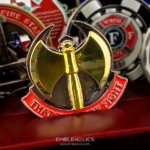
The coin is round, which is ordinary, and its center is hollowed out into the shape of an arrowhead, which is not. It was made to honor the winner of the USASOC Combined Logistics Excellence Award, presented by the 7th Special Forces Group.
What an Award Coin Has to Do Differently
A coin given to the winner of a named award is a different object from a unit coin, and three things change.
It is given to one recipient at a time. Which means it has to feel like a prize rather than a handout. That generally argues for something unusual in the construction, as here, rather than for more color or more detail.
It represents the award, not the unit. An award runs year after year with different winners, so the coin should carry the award’s identity rather than the current winner’s name or year. That keeps it reorderable and means the same design can be issued indefinitely.
And the presenting organization has a stake in it. An award coin is the presenting body’s object as much as the recipient’s, so its device belongs on the coin. Here that device is the Special Forces arrowhead.
The practical consequence is quantity. An award issued a few times a year still needs a 50 piece minimum, which means one order covers a decade of presentations. That is an argument for a design with nothing on it that will date.
See also a Ranger excellence challenge coin, a Military Police Corps coin of excellence and commander’s coins and coins of excellence.
Hollowing Out the Center
Taking the middle out of a coin is the most striking thing you can do to one, and the most consequential structurally.
The center is where a coin is strongest. Remove it and the piece becomes a ring, and a ring flexes in a way a disc does not. The remaining band has to be wide enough to stay rigid, which constrains how large the opening can be.
The cut edges need finishing. An internal opening has edges that were not part of the original surface, and they have to be smooth rather than sharp. That is a machining consideration rather than a design one, and it is worth confirming is included.
The shape of the opening is the design. This is the part people miss. When you cut out the middle, the hole becomes the most visible element on the coin, more visible than anything printed on the remaining metal. So the opening has to be a shape worth looking at, and the arrowhead here is a good example: a recognized device, strong silhouette, no narrow points.
And the negative space has to read. A cutout works because what you see through it is the background, the table, a hand, a shirt. That means the shape has to be identifiable as an outline alone, with no internal detail at all. Devices built from a single closed silhouette work; anything with internal elements does not.
For the trade-offs against cutting an outline instead, see custom shaped coin vs cutout coin and whether cutouts make a coin weaker.
Keeping the Round Outline
The decision to keep a conventional round outline and put the unusual element inside it is the smartest thing about this coin.
A shaped coin with a cutout in it is two unusual decisions competing. The eye has to resolve the outline and the opening at the same time, and neither gets full attention. A round coin with a shaped opening has one surprise, placed where the eye goes first.
It is also practical. A round coin fits standard capsules and display cases, where a shaped one does not, and for an award piece that may be presented in a case or mounted that matters more than it would on a pocket coin.
About the Award and the Group
The Combined Logistics Excellence Awards program recognizes logistics operations across supply, maintenance and transportation. The USASOC award is presented by the 7th Special Forces Group (Airborne).
The 7th Special Forces Group was activated on 20 May 1960 and spends much of its time on foreign internal defense, counter-drug and training missions alongside friendly governments’ armed forces in South, Central and North America and the Caribbean. Its mission is to organize, equip, train, validate and prepare forces for worldwide special operations in support of regional combatant commanders, American ambassadors and other agencies. Its motto is Lo Que Sea, Cuando Sea, Donde Sea: anything, anytime, anywhere.
Logistics is a good illustration of why award coins exist. It is measured by the absence of problems, which produces very little to put in a citation and even less to photograph. A coin is one of the few forms the recognition can take.
See also a 1st Special Forces Group coin and a Special Forces ODA coin.
Order an Award Coin
Professional artwork is free with unlimited revisions, and nothing goes into production until you approve a digital proof. The challenge coin minimum is 50 pieces, standard production runs about 45 to 50 days after final artwork approval, rush production is available on many projects, and shipping within the continental United States is included. Embleholics is veteran-owned, SDVOSB and registered in SAM.gov.
Two suggestions. Leave the winner’s name and the year off, since an award runs for years and a 50 piece order will cover many presentations; engraving an individual name afterward is a separate service and keeps the base design reusable. And if you want a cutout, choose a device that works as a pure silhouette, because the opening will be the most visible thing on the coin and anything with internal detail will not survive as negative space. Request a free quote to begin.
Frequently Asked Questions
What is an award challenge coin?
It is a coin presented to the winner of a named award rather than issued to a unit. It should carry the award’s identity and the presenting organization’s device rather than the recipient’s name, so the same design can be issued year after year.
Should an award coin have the year or winner’s name on it?
No, if you want it reusable. An award runs for years and a 50 piece minimum will cover many presentations, so a dated or named coin forces a new die. Engraving an individual name afterward is a separate service.
Can the center of a coin be cut out?
Yes, but the remaining band has to be wide enough to stay rigid. The center is where a coin is strongest, so removing it turns the piece into a ring, and a ring flexes where a disc does not.
What shapes work as a cutout?
Single closed silhouettes with no internal detail, such as an arrowhead, a star or an animal profile. A cutout works because you see the background through it, so anything with internal elements will not survive as negative space.
Does the cutout become the main element?
Yes, and this is the part people miss. Once the middle is removed, the hole is more visible than anything printed on the remaining metal, so the opening has to be a shape worth looking at.
Are cut edges inside a coin sharp?
They should not be. An internal opening has edges that were not part of the original surface and need machining smooth. It is worth confirming that finishing is included rather than assuming it.
Should a cutout coin also have a custom outline?
Usually not. A shaped outline and a shaped opening compete for attention, and neither gets it. A round coin with a shaped opening has one surprise, and it also fits standard capsules and display cases.
Why do logistics organizations order award coins?
Because the work is measured by the absence of problems, which produces little to put in a citation and nothing to photograph. A coin is one of the few available forms the recognition can take.
More Army Projects