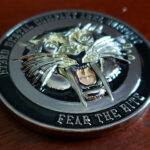
Military dentistry is a deployable capability, not a clinic you visit between postings, and its units carry the same identity and traditions as any other. This coin was made for the 673rd Dental Company (Area Support) at Joint Base Lewis-McChord, Washington, for its participation in an America’s Premier DCAS event run by the Association of Army Dentistry. It is a grey coin with a semi-matte finish, the unit’s cougar mascot sculpted in gold and cream, and the name and motto lettered in black around the insignia. For an association event coin built this way, see our 673rd Dental Company Area Support Coin.
Area support means it moves
The designation matters and it is widely misread. A Dental Company (Area Support) is a deployable unit that provides dental care across an area of operations rather than from a fixed installation clinic. It goes where the force goes, which puts it closer to a field medical unit than to a dental surgery.
That changes the imagery a coin should use. Clinical symbols, a tooth, a mirror and probe, read as a dental practice. A deployable company is better served by its own insignia, its mascot and its campaign history, which is what this coin does. The 673rd’s lineage runs back to its activation in 1945 with campaign credits across the conflicts since, and a unit with that record has more to draw on than a clinical motif.
It also sets the audience. A coin for a deployable company goes to soldiers who happen to be dental professionals, not to a civilian dental practice, and the register should match the rest of the Army rather than a healthcare brand.
Coins for a professional association event
This coin was made for an event rather than purely for the unit, and that is a distinct and underused category. Professional associations within the services, from the Association of Army Dentistry to any number of branch and corps bodies, run conferences, competitions and recognition events, and coins are a natural fit for all three.
What makes an event coin different from a unit coin:
- The audience is cross-unit. Recipients come from many commands, so the coin travels further than a unit coin and should be legible to people who do not know your unit.
- It often marks participation rather than membership. That is a weaker claim than belonging to a unit, which argues for the event and the association sharing billing with the unit.
- Quantities are harder to forecast. Attendance at an association event is an estimate until it is not, and a coin that runs out at the event is worse than one with a modest surplus.
- Timing is fixed and public. The date is known months ahead, so there is no good reason to be ordering late.
If a unit attends the same event annually, keep the year off the die and the same coin serves every year, or engrave the year after striking if marking it matters.
Grey metal and a semi-matte finish
This is a quietly sophisticated specification and worth understanding. Most coins reach for bright gold or antique silver. A grey base with a semi-matte finish does something neither of those does: it recedes, which lets the sculpted elements in gold and cream come forward without competing.
Semi-matte is the useful middle ground. A full matte finish can look flat and absorb too much light. A polish shows every fingerprint and reflects attention away from the relief. Semi-matte holds a little light without scattering it, which is why it works well on a coin where sculpted detail is the point.
Limiting the color to the sculpture is the other half of it. Gold and cream on the mascot and black on the lettering is three colors in total, applied where they carry meaning. The grey field is left alone, and because it is left alone the mascot reads immediately.
A mascot for a medical unit
A cougar on a dental company’s coin tells you something about how the unit sees itself. Medical and dental units in the Army often adopt mascots with no clinical connection at all, precisely because their soldiers want to be recognized as soldiers first.
It also solves a design problem. Medical heraldry is constrained and somewhat uniform across units, so a mascot is frequently the only element that is genuinely the unit’s own. Sculpting it with real relief, as here, gives the coin a focal point that no crest could.
We make a lot of coins for this base. Joint Base Lewis-McChord is a short drive from our shop in Port Orchard, Washington, and its medical commands are regular customers, including Madigan Army Medical Center and the Veterinary Readiness Activity.
Ordering a medical or dental unit coin
Tell us whether the unit is deployable and whether the coin is for the unit or for an event. Those two answers settle both the imagery and the quantity. If the unit has a mascot, send it, because it will almost certainly make a better coin than clinical symbols. You can see more Army challenge coins we have produced, or send your artwork through the free quote form.
Frequently Asked Questions
What is a dental challenge coin?
It is a coin for a military dental unit or for the Army Dental Corps community. Because Army dentistry includes deployable units that provide care across an area of operations rather than only fixed clinics, these coins usually look more like other Army unit coins than like anything from a civilian dental practice.
What does Dental Company (Area Support) mean?
It is a deployable dental unit that supports an area of operations rather than working from a fixed installation clinic. It moves with the force, which puts it closer to a field medical unit than to a dental surgery, and that is worth reflecting in how its coin is designed.
Should a dental unit coin use clinical symbols?
Usually not as the main subject. A tooth or a mirror and probe reads as a dental practice, where a deployable Army unit is better served by its own insignia, mascot and campaign history. The recipients are soldiers who happen to be dental professionals, and the register should match the rest of the Army.
How is an event coin different from a unit coin?
Its audience is cross-unit, so it travels further and needs to be legible to people outside your command. It often marks participation rather than membership, which argues for the event and association sharing billing with the unit. Quantities are also harder to forecast, so a modest surplus beats running out at the event itself.
Can we reuse an event coin design next year?
Yes, if the year stays off the die. A coin carrying the unit, the association and the event can be reordered every year from the same tooling. If marking the specific year matters, engrave it after striking rather than cutting it into the die.
Why choose a grey base with a semi-matte finish?
Because it recedes and lets the sculpted elements come forward. Bright gold and antique silver both compete for attention, while a grey semi-matte field holds a little light without scattering it, which suits a coin where sculpted relief is the focal point. Keeping color to the sculpture and the lettering completes the effect.
Why do medical units use mascots with no clinical connection?
Partly because their soldiers want to be recognized as soldiers first, and partly because medical heraldry is constrained and fairly uniform across units, so a mascot is often the only element that is genuinely the unit’s own. Sculpted properly, it gives the coin a focal point that a standard crest cannot.
More Army Projects