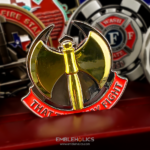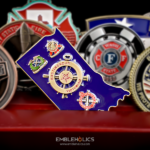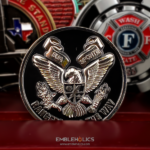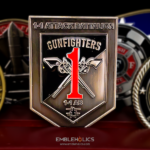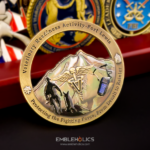
Most cutouts on a coin are decorative, removing metal to frame whatever is in the middle. This one is different: the openings are cut to the outline of Mount Rainier, so the hole itself is a recognizable shape. The front shows a soldier and a military working dog against the mountain, the reverse carries Alaska and Washington with base stars, and the same mountain silhouette appears on both faces because a cutout has no choice but to.
A Cutout Shaped Like Something
There are two reasons to cut metal out of a coin, and they produce different designs.
The usual one is to focus attention. Remove the field around a central device and the device reads bolder, because there is nothing else at that level for the eye to rest on and the subject is outlined against whatever is behind the coin rather than against metal. That is the structural approach, covered on the Air National Guard commander’s coin.
The other reason, which is much less used, is that the absence can be the picture. If the opening has a deliberate outline, the viewer reads the hole as a shape rather than as a gap, and you get a subject made entirely of nothing. On this coin that subject is a mountain, which is a particularly good fit, because a mountain in real life is a silhouette against sky, and a cutout is a silhouette against whatever is behind it. The device matches what it depicts.
If you are deciding between a cutout and a custom outline, the difference is explained in custom shaped coin versus cutout coin.
Only Shapes That Survive Mirroring Work as Cutouts
This is the constraint nobody mentions until it is too late, and it is the single most useful thing on this page.
A cutout goes all the way through the coin, so the same opening appears on both faces. It cannot be oriented correctly on one side and differently on the other, because it is one hole. Which means that whatever shape you cut, one face will see it mirrored.
For a mountain that does not matter. A ridgeline reversed is still a ridgeline, and nobody holding the coin will think anything is wrong. For a lot of other shapes it matters enormously.
- Shapes that work: mountains, trees, waves, stars, crosses, shields, geometric forms, anything symmetrical or close to it.
- Shapes that do not: aircraft, vehicles, animals in profile, running figures, letters, numbers, dates, anything with a front and a back or a reading direction. On one face they will be backwards.
So the test before committing to a cutout is simple: flip the shape horizontally and look at it. If it still reads correctly, it can be a hole. If it does not, it has to be relief or engraving instead, on one face only.
The Same Mountain, Positive and Negative
Because the opening is fixed on both sides, the design has to give it a job on each face, and this coin does that cleverly.
On the front, the mountain outline sits behind a soldier and a working dog, so it functions as a backdrop and the figures are the subject. On the reverse, the same outline becomes the frame around maps of Alaska and Washington with the installations marked. One face uses the shape as scenery and the other uses it as a border, so neither side has an opening sitting there unexplained.
That is the discipline with a shaped cutout. Design both faces around it from the start rather than designing one and discovering a hole in the other. It is the one element on a coin that cannot be adjusted independently per side.
A Working Dog and a Caduceus
The figures on the front are the clearest statement of what this unit actually does, and they are a better choice than an emblem would have been.
Army veterinary units care for military working dogs, among much else, and this activity supports around a hundred of them alongside its food protection and preventive medicine work. A soldier and a dog is immediately legible to anyone, including the families who encounter the unit through its clinics, and it is specific in a way a medical device alone is not.
The caduceus at the center is correct here, and it is worth noting because the two medical staffs get confused constantly. A caduceus has two snakes and wings and is the Army Medical Department’s device. A Rod of Asclepius has one snake and no wings and is what sits at the center of the EMS Star of Life. Both are legitimate and they are not interchangeable. The EMS version is covered on the White Pine County coin.
For working dog designs see a military police K9 coin.
From Denali to Rainier
The two mountains in the design are doing geography, and it is an elegant solution to a hard problem.
The unit’s area runs from Alaska to the Pacific Northwest, which is an enormous and awkward thing to put on a coin. Naming it takes too many words. Mapping it accurately takes too much space. Two mountains, one at each end, says it in two shapes: Denali for Alaska, Rainier for Washington.
That is a device worth borrowing for any unit with a wide or oddly shaped area of responsibility. Pick the two best-known landmarks at the extremes and let them stand for everything between.
The unit is based at Joint Base Lewis-McChord in Washington State, providing veterinary health, food protection and preventive medicine support across the Pacific Northwest and Alaska. Its official designation appears both as Veterinary Readiness Activity Fort Lewis and as Public Health Activity Fort Lewis, so both names are current enough to be in use on official pages, which is worth confirming with the unit before a coin goes to print.
Embleholics is in Port Orchard, across Puget Sound from JBLM. See also a Madigan Army Medical Center coin from the same base and more challenge coins in Washington State.
Order a Cutout Coin
Send your unit insignia and tell us what shape you want cut through the coin, and we will check it mirrors correctly before anything is tooled. Design both faces together, because the opening is shared between them.
Professional artwork is free with unlimited revisions, the minimum order is 50 coins, and nothing goes into production until you approve a digital proof. Standard production runs about 45 to 50 days after final artwork approval, rush production is available on many projects, and shipping within the continental United States is included. Embleholics is veteran-owned, SDVOSB and registered in SAM.gov. See more Army challenge coins.
Frequently Asked Questions
What is a cutout challenge coin?
A cutout challenge coin keeps a conventional outline but has areas removed from inside the design, so you can see through parts of it. That is different from a custom shaped coin, which has a non-standard outer outline. Cutouts are used either to focus attention on a central device or, less commonly, to make the opening itself a recognizable shape.
Can a cutout be shaped like a mountain or a landscape?
Yes, and a landscape is one of the best subjects for it. A mountain in real life is a silhouette against the sky and a cutout is a silhouette against whatever is behind the coin, so the technique matches what it depicts. The viewer reads the opening as a shape rather than as a gap.
Does a cutout look the same on both sides of a coin?
It is the same opening on both sides, so yes, except that one face sees it mirrored. A cutout cannot be oriented one way on the front and another on the back, because there is only one hole.
Which shapes work as a cutout and which do not?
Symmetrical or near-symmetrical shapes work: mountains, trees, waves, stars, crosses, shields and geometric forms. Shapes with a direction do not, including aircraft, vehicles, animals in profile, running figures, letters, numbers and dates, because they will appear backwards on one face. The test is to flip the shape horizontally and see whether it still reads correctly.
How do you design both faces around a shared cutout?
Give the opening a job on each side. On this coin it works as a backdrop behind the figures on the front and as a frame around the maps on the reverse, so neither face has an unexplained hole in it. Design the two faces together from the start, since the cutout is the one element that cannot be adjusted independently per side.
Is the symbol on Army medical insignia a caduceus?
Yes. A caduceus has two snakes and a pair of wings and is the Army Medical Department’s device. It is distinct from the Rod of Asclepius, which has a single staff with one snake and no wings and sits at the center of the EMS Star of Life. Both are legitimate medical symbols and they are not interchangeable.
How do you show a large area of responsibility on a coin?
Pick the best-known landmarks at the extremes and let them stand for everything between. This coin uses Denali for Alaska and Mount Rainier for Washington, which covers a vast region in two recognizable shapes where naming it would take too many words and mapping it accurately would take too much space.
What does Veterinary Readiness Activity Fort Lewis do?
It is an Army veterinary and public health unit at Joint Base Lewis-McChord in Washington State, providing veterinary health, food protection and preventive medicine support across the Pacific Northwest and Alaska. Its work includes care for military working dogs, animal medicine, food protection and zoonotic disease consultation.
More Army Projects