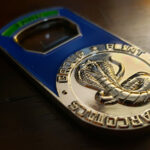
A custom bottle opener coin is built around a proven opener profile: a lip that catches the cap edge, a fulcrum behind it, and enough metal around both to take the force. The artwork is fitted to that geometry rather than the geometry being bent to fit the artwork.
How Is a Bottle Opener Coin Made?
The order of decisions is the thing most people get backwards. A bottle opener coin is not a coin with a notch cut into it afterwards. It is an opener that has been given a coin’s artwork.
The opener profile comes first. An opener has to do three things mechanically. A lip catches under the edge of the cap. A fulcrum behind that lip gives the lever something to pivot against. And there has to be enough solid metal around both to take the force without flexing or breaking. Those requirements set the shape of that part of the piece, and they are not negotiable, because a design that compromises any of the three produces something that looks like an opener and does not work as one.
Standard profiles exist, so nothing has to be invented. This is the part customers do not expect and are relieved to hear. There is a set of established opener geometries that are known to work, and a design can be applied to any of them. You are not being asked to solve an engineering problem. You are choosing a proven base and putting your artwork on it.
Strength is a material decision. A normal challenge coin lives in a pocket and is never stressed. A bottle opener is levered against, repeatedly, by people who are not being gentle. That makes the base metal, the thickness of the piece and the coating genuinely consequential rather than a matter of appearance, and it is why an opener is specified differently from a coin from the start.
Everything else stays open. The artwork, the relief, the finish, the plating and which face carries what are all decided the same way they would be on any coin. The constraint is narrower than it sounds: it applies to one region of one edge, and the rest of the piece is yours.
For the product range, see our custom bottle openers.
What Shapes Work as Bottle Openers?
Rounded and coin-like. The closest thing to a conventional challenge coin, with the opener worked into one edge. This is the default and the easiest to design for, because the artwork area behaves like a normal coin face.
Rectangular and dog-tag. A longer body gives more leverage and more room for the hand, which makes for a more comfortable opener. It also gives a landscape artwork area, which suits wordmarks and horizontal logos better than a circle does.
Outlines with the opener at one edge. A shaped piece, such as a badge or a shield, with the working part built into the bottom or side. This keeps a distinctive outline while staying on a proven geometry.
There is a harder route, which is hiding the opener inside a figurative shape so the object reads as something else entirely and the opening function is almost concealed. That needs a shape that happens to contain a suitable gap, so it only works with certain subjects, and it is covered on our pages about an opener hidden inside a figurative shape and a bottle opener built into an object shape.
Will It Actually Open a Bottle?
Yes, and it is worth being straight about what that requires.
A working opener is thicker and heavier than a standard challenge coin. That is not a manufacturing compromise, it is the point. The mass is what makes it rigid enough to lever against a cap without deforming, and a piece thinned down to coin proportions to look more elegant would be a worse opener. Anyone choosing this product should expect an object with more presence in the hand than a coin, and most people consider that a feature.
The working edge is also the part that wears. It is metal against metal every time it is used, so over years of regular use the plating on that edge will show it before anywhere else on the piece does. A display piece used occasionally will not, and a bar opener used weekly will. Neither is a fault, and knowing which one you are ordering is worth saying at the quote stage, because it affects the sensible choice of coating.
Talk to us about intended use when you request a quote. A piece that will be used is specified differently from one that will mostly sit on a desk.
Can a Bottle Opener Coin Have Sculpted Relief?
This is the real design tension in the product, and it is worth naming plainly. Relief wants height. An opener wants a flat, strong edge. Those two things pull in opposite directions, and a design that ignores it produces either flat artwork or an opener that does not seat properly against a cap.
The answer is placement rather than compromise. The raised sculptural work sits away from the working region, and the area around the opener stays flat and solid. In practice that usually means the face carrying the opener is the quieter of the two, with the heavier relief given to the other side or to the opposite end of the same face.
This coin is a good worked example. The cobra on the front is genuinely sculpted, with real height and modelling, and it occupies the body of the piece rather than crowding toward the working edge. The reverse carries an engraved figure, which is a flat technique and therefore has no interaction with the mechanics at all. Between the two faces, the piece gets one properly three-dimensional element and one detailed flat one, and neither interferes with what the object has to do.
One Design, Two Products
The same task force ordered both a coin and a bottle opener, carrying the same cobra and the same reverse figure.
That is worth pointing out because a lot of customers think they have to choose. Once the artwork exists, it has been drawn, revised and approved, and it can be applied to more than one product without starting over. The same design can become a coin, a bottle opener, a belt buckle, a keychain or a lapel pin, with adjustments for the shape and scale of each.
It also solves a practical problem. A coin suits some recipients and an opener suits others, and a group with one set of artwork can cover both without running two design processes. See the coin we made for the same task force for the other half of this pair.
About This Flint Area Narcotics Group Bottle Opener
The Flint Area Narcotics Group, or FANG, is a multijurisdictional drug team operating in Genesee County, Michigan, established in 1985. Its participating members include law enforcement agencies and governmental entities from townships, villages and cities across the county.
They asked for a challenge coin that also worked as a bottle opener. The front carries their mascot, a cobra, sculpted in relief. The reverse carries an engraved reaper figure.
The cobra is the reason this piece works as well as it does. The acronym gave the task force an animal, the animal gave the designers a subject with a natural three-dimensional form, and a snake’s coiled body fills a rounded outline more comfortably than most subjects would. When a unit’s name hands you an image that directly, the design mostly follows.
For the task force audience itself, how these groups form and why members want coins, see the coin page linked above. For related work, see our custom law enforcement challenge coins.
Can We Use Our Agency Insignia on a Coin?
Most agencies can, but the authorization has to come from the agency, not from us. Agency insignia, badges, task force devices and department seals are controlled by the organizations that own them, and a multijurisdictional task force may need clearance from more than one member agency.
The practical version is straightforward. Clear the artwork through your own chain of command before you order, and send us artwork your agency is authorized to supply. We produce from what the customer provides and we do not grant permission on anyone’s behalf. If you are unsure who signs off, your agency’s administrative division is usually the right place to ask.
Design a Bottle Opener Coin
Professional artwork is free with unlimited revisions, and nothing goes into production until you approve a digital proof. Send a logo, a patch photograph or a description and a designer will build the artwork around a working opener profile.
Minimum quantities for bottle openers differ from those for coins, so ask when you request a quote. Standard production runs about 45 to 50 days after final artwork approval, rush production is available on many projects, and shipping within the continental United States is included. Embleholics is veteran-owned, SDVOSB and registered in SAM.gov.
Frequently Asked Questions
How is a bottle opener challenge coin made?
A bottle opener coin is built around a proven opener profile, which needs a lip to catch the cap edge, a fulcrum behind it, and enough solid metal around both to take the force. The artwork is then fitted to that geometry rather than the opener being cut into a finished coin design.
What shapes work as bottle opener coins?
Rounded coin-like shapes, rectangular and dog-tag forms, and shaped outlines with the opener built into one edge all work. Longer bodies give better leverage and a landscape artwork area. An opener can also be concealed inside a figurative shape, which is harder and depends on the subject.
Will a bottle opener coin actually open a bottle?
Yes. A working opener is made to be used, which is why it is thicker and heavier than a standard challenge coin. The extra mass is what keeps it rigid under leverage. Tell us at the quote stage whether the piece will be used regularly or mainly displayed.
Are bottle opener coins thicker than normal coins?
Yes, and deliberately so. The additional thickness is what allows the piece to be levered against a cap without flexing. A bottle opener thinned to normal coin proportions would look more like a coin and work less well as an opener.
Can a bottle opener coin have sculpted relief?
Yes, provided the raised work is placed away from the working edge. Relief needs height and an opener needs a flat, strong edge, so the usual solution is heavier sculpting on the body or the opposite face, keeping the area around the opener flat and solid.
Can the same design be used on both a coin and a bottle opener?
Yes. Once artwork has been drawn, revised and approved, it can be applied to a coin, a bottle opener, a belt buckle, a keychain or a lapel pin with adjustments for each product’s shape and scale. Many groups order two products from one design.
Can we use our agency insignia on a coin?
Agency insignia, badges and task force devices are controlled by the organizations that own them, so permission has to come from your agency rather than from a manufacturer. A multijurisdictional task force may need clearance from more than one member agency before the artwork is finalized.
What is the minimum order for bottle openers?
Minimum quantities for bottle openers differ from the 50-coin minimum that applies to challenge coins, so ask when you request a quote. Larger quantities lower the cost per piece, as they do across all our products.
More Law Enforcement Challenge Coins Projects