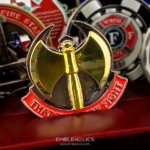
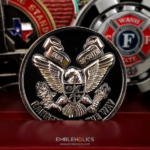
The coin is cut to the shape of a lion statue. The front carries the unit’s lion mascot sculpted in relief and the back carries small engravings of the insignia and the motto, with inscriptions worked in. The finish combines natural metal with painted color, and the whole piece was built to resemble an art sculpture rather than a disc. This Lion Troop challenge coin was made for the 2nd Squadron, 15th Cavalry Regiment.
A Coin Built as a Sculpture
Treating a coin as a small sculpture rather than as a struck disc changes what it is for, and there are trade-offs in both directions.
It is made to be looked at. A sculptural piece rewards close attention, with depth and form that a flat design does not have. That suits a presentation coin and a display piece.
It is less suited to a pocket. Deep relief and an irregular outline mean a piece that catches on fabric, sits awkwardly in a stack and shows wear on its high points sooner. A coin meant to be carried and challenged with wants a flatter design.
The outline does the first work. Cutting the coin to the subject means the piece is recognized before any detail is read, which is the entire argument for a shaped die.
And the sculpting is the cost. A figure built with real depth takes more die work than a flat emblem, so the budget goes into form rather than into color or extra elements.
The design that follows from this is correct: a sculpted figure on the front, and small engraved content on the back. Putting a second sculpted subject on the reverse would compete, where quiet engraving lets the front stay the piece.
See also custom shaped challenge coins and 2D vs 3D challenge coins.
Cavalry Troops and Their Names
The 2nd Squadron, 15th Cavalry Regiment is a United States Army cavalry unit, and the naming convention it uses is worth explaining because it is unlike the rest of the Army.
Cavalry keeps its historical terminology. What other branches call a battalion, cavalry calls a squadron, and what they call a company, cavalry calls a troop. Those terms come from the mounted era and have been retained deliberately, which is characteristic of a branch that puts more weight on lineage than most.
Troops within a squadron are lettered, and each tends to acquire a name of its own. A lettered troop that becomes the Lion Troop has built an identity beyond its designation, and that kind of name is exactly what produces a coin: it is specific to a small group, it is not in any official document, and a coin is the only place it gets recorded permanently.
That is also why the shape works here. A troop named for an animal can have a coin cut to that animal, which no unit identified only by a number can do.
See also military challenge coins.
Sculpting an Animal Figure
A lion is a demanding subject and the choices that make it work are specific.
A statue pose beats a live one. A seated or standing statue lion has a compact closed outline, where a lion in motion produces thin legs and a tail that will not survive a cutout. The statue reference solves the structural problem and the composition problem at once.
The mane is the test. It is the most recognizable feature and the hardest to render, being a mass of overlapping strands. It needs enough relief depth to read as volume rather than as scratches, and the strands need spacing or they merge in the strike.
The head needs disproportionate space. Detail concentrates in the face, so a head rendered small relative to the body is the first thing to lose definition. Sculptural coins often enlarge the head slightly against true proportion for this reason.
And the silhouette has to work alone. Filled in solid black with no interior detail, a lion statue should still be identifiable. If it is not, the shaped die is not earning its cost.
Natural Metal With Painted Color
Combining bare metal and paint on one piece is the finish decision that keeps this coin reading as a sculpture rather than as a figurine.
A fully painted figure reads as a toy. Paint covers the metal entirely, which removes the material quality that makes a struck piece feel substantial, and bright color on a sculpted animal tips the register toward novelty.
Leaving most of the metal bare keeps the material visible and lets the sculpting carry the form through shadow, which is how actual sculpture works. Applied color then becomes an accent that picks out specific elements rather than a surface treatment covering everything.
The practical point for a deeply sculpted piece is that paint on high points wears first. On a figure with real relief, the most exposed surfaces are exactly the ones a viewer looks at, so keeping color in the recesses and lower areas and leaving the high points as metal produces a piece that ages well rather than one that looks chipped within a year.
See antique vs polished finishes and paint and finish options.
Order a Cavalry or Sculpted Coin
Professional artwork is free with unlimited revisions, and nothing goes into production until you approve a digital proof. The challenge coin minimum is 50 pieces, standard production runs about 45 to 50 days after final artwork approval, rush production is available on many projects, and shipping within the continental United States is included. Embleholics is veteran-owned, SDVOSB and registered in SAM.gov.
Two suggestions for a sculptural piece. Decide first whether the coin is for display or for carrying, since deep relief and an irregular outline suit the first and work against the second. And keep paint off the highest surfaces of a sculpted figure, because those wear first and a chipped high point is the most visible kind of wear there is. Request a free quote to begin.
Frequently Asked Questions
Can a challenge coin be made as a sculpture?
Yes. Deep relief and a shaped outline produce a piece made to be looked at, which suits presentation and display, though it is less practical to carry than a flatter design.
What is the drawback of a sculptural coin?
It catches on fabric, sits awkwardly in a stack, and shows wear on its high points sooner. A coin meant to be carried and challenged with wants a flatter design.
What goes on the back of a sculpted coin?
Quiet content. Small engraved insignia and a motto let the sculpted front remain the piece, where a second sculpted subject would compete with it.
Why does cavalry use squadron and troop?
The terms come from the mounted era and have been kept deliberately. What other branches call a battalion, cavalry calls a squadron, and what they call a company, cavalry calls a troop.
Why do troop nicknames end up on coins?
Because they are specific to a small group and appear in no official document. A coin is often the only place a name like that gets recorded permanently.
What pose works for an animal shaped coin?
A statue pose. Seated or standing with limbs close to the body gives a compact closed outline, where an animal in motion produces thin legs that will not survive a cutout.
What is hardest about sculpting a lion?
The mane. It is the most recognizable feature and a mass of overlapping strands, so it needs enough depth to read as volume and enough spacing that the strands do not merge in the strike.
Should a sculpted figure be fully painted?
No. Full paint reads as a toy and hides the material. Leaving most of the metal bare lets shadow carry the form, and keeping color off the high points means the piece ages well.
More Army Projects