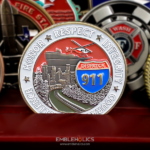
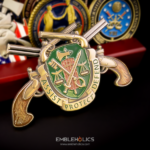
A police community outreach challenge coin is given to members of the public rather than to officers. Because most recipients have never held a challenge coin before, the design has to identify the department and the unit clearly on its own, without relying on anything the recipient already knows.
Who Receives a Community Relations Coin?
Children at community events. Parades, National Night Out, school visits, fairs, safety days. This is the largest single group by volume and the reason most outreach coins exist.
Citizen police academy graduates. Residents who complete a multi-week program learning how the department works. The coin marks the completion, and for these graduates it usually becomes a genuine keepsake.
Neighborhood watch and crime prevention volunteers. People giving their own time to a program the department runs.
Community leaders, faith groups and business owners. Partners in specific initiatives, often handed a coin at the end of a project rather than the start.
Members of the public being thanked. Someone who called something in, helped at a scene, or went out of their way for an officer.
Worth pausing on one thing. For almost everyone on that list, this is their first challenge coin, and very likely their only one. They have no frame of reference for the tradition, no drawer of others to compare it against, and no idea that what they are holding is part of a practice that runs through the whole of the military and public safety.
That is a real responsibility and it is also an opportunity. An internal unit coin is one of forty in a collection. An outreach coin is a singular object in someone’s house, and it will be on a shelf or in a drawer for years. Departments that understand this tend to spend a little more per coin than they otherwise would, because the coin is doing more work than its cost suggests.
What Changes When the Public Receives the Coin
The coin has to explain itself. An officer handed a unit coin already knows what the badge means, what the unit does and why the motto is funny. A member of the public knows none of that. The design has to carry its own labels, which is why an outreach coin usually names the department and the unit in full somewhere on the face.
No shorthand, no in-jokes, no dark humor. Internal police humor is a real and healthy thing and it has no place on a coin handed to a resident at a community event. This is the exact inverse of how a unit coin should be designed.
Quantities are larger and they recur. Every event is another handful, so an outreach coin is a standing supply rather than a one-off order. That argues for a design with nothing on it that dates, such as a specific year or a chief’s name, so the same artwork can be reordered for several years without a new setup.
It carries the department’s public face. An outreach coin is, in a small way, a piece of the department’s public identity. That is why these designs lean formal and patriotic rather than clever, and why the badge is almost always the center of the composition.
The same logic applies to school resource officers, fire department community programs, sheriff’s community services divisions, and any public-facing unit in a first responder organization. It is closely related to how presentation coins work in the military, covered on our page about coins given to people outside the organization.
About This Roswell Police Coin
This coin was made for the Community Relations Unit of the Roswell Police Department in Roswell, Georgia, just north of Atlanta. Most people hear Roswell and think New Mexico, so it is worth saying which one.
The Roswell Police badge sits prominently at the center, over an American flag background, with an outer border identifying the department and the unit. The metalwork is detailed and finished with enamel colors.
The layout is a good example of the order of information an outreach coin needs. The badge says who. The flag says whose. The border text says what. For a recipient who already knows the department, the badge alone would be enough and everything else is decoration. For a recipient who does not, the badge is just a shape, and the border is the part that turns the object into something they can explain to someone else later.
That is the practical test for any coin going to the public: if the person receiving it were asked a week later what it was, could they answer from the coin itself? On this one they could. On a great many unit coins they could not, and that is fine, because those coins are not for them.
Custom Challenge Coins for Police Departments
Police coins are made for units, departments, special events, retirements, awards and community programs. Designs can incorporate department badges, unit insignia, mottos, city imagery, names, dates and American flags.
Every part of a department orders differently. A patrol shift, a detective bureau, a K9 unit, a training division, a community relations unit and a chief’s office all want something of their own, and the 50-coin minimum is set so that a single unit can order without the whole department having to take part. See more custom police challenge coins, other municipal police department coins, and how handler groups approach it on our page about K9 unit coins.
If your department has a detailed badge, layered artwork or a lot of text around the border, our designers will adapt it into a coin that stays readable at final size.
Can We Use Our Department Badge on a Coin?
Most departments can, but the authorization has to come from the department, not from us. Badges, department seals, patch designs and unit insignia are controlled by the agencies that own them, and badge designs in particular are often protected under state law.
The practical version is straightforward. Clear the artwork through your own chain of command before you order, and send us artwork your agency is authorized to supply. We produce from what the customer provides and we do not grant permission on anyone’s behalf. If you are unsure who signs off, your department’s administrative division is usually the right place to ask.
Design a Coin for Your Unit or Program
Professional artwork is free with unlimited revisions, and nothing goes into production until you approve a digital proof. Send a photograph of your patch or badge and a description of the program, and a designer will draw it up.
One practical note for outreach programs: these coins are reordered rather than bought once, so it is worth designing something that will still be correct in three years. Leaving off dates, individual names and anything tied to a single event means the same artwork can be reordered without a new setup.
The minimum order is 50 coins, standard production runs about 45 to 50 days after final artwork approval, rush production is available on many projects, and shipping within the continental United States is included. Embleholics is veteran-owned, SDVOSB and registered in SAM.gov. Request a free quote to get started.
Frequently Asked Questions
What is a police community relations challenge coin?
A police community relations challenge coin is a custom coin a department gives to members of the public rather than to its own officers. It is handed out at community events, to citizen academy graduates and to volunteers, and it identifies the department and the unit clearly for recipients unfamiliar with coins.
Do police departments give challenge coins to the public?
Yes, and it is common. Community relations units, crime prevention programs and school resource officers all hand coins to residents, students, volunteers and community partners. For most recipients it is their first and only challenge coin, which is why outreach designs are more explanatory than internal unit coins.
Can officers hand challenge coins to children?
Yes, and it is one of the most common uses of an outreach coin. Officers give them at parades, school visits, safety days and community events, and for a lot of children it becomes a kept object rather than a giveaway. Coins are metal, so they suit older children rather than toddlers.
What should go on a coin given to civilians?
A coin for civilians should carry the department badge, the department and unit name written out in full, and usually a patriotic or city element. Avoid internal shorthand, unit humor and abbreviations, because the recipient has no context for them and the coin needs to explain itself.
Do school resource officers order their own coins?
Yes. School resource officers, DARE and crime prevention programs, and community services divisions frequently order their own designs separately from the department’s main coin, because their recipients and their purpose are different. The 50-coin minimum allows a single program to order independently.
How many should a department order for community events?
Order against annual event volume rather than for one event, since outreach coins are handed out continuously. A department attending a dozen community events a year will move through a few hundred, and larger quantities lower the cost per coin and avoid repeated setups.
Can we use our department badge on a coin?
Department badges, seals and unit insignia are controlled by the agencies that own them, and badge designs are often protected under state law, so permission has to come from your department rather than from a manufacturer. Clear the artwork through your chain of command and supply artwork your agency is authorized to provide.
What is the minimum order for police coins?
The minimum order for custom challenge coins is 50 coins. That figure is set so a single unit, shift or program can order without the whole department taking part, and larger quantities reduce the cost per coin.
More Police Projects