
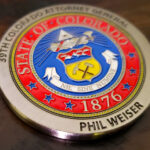
The brief here was contemporary: minimal use of classic patterns and elements, with a modern graphic on one face. The Seal of Colorado on the front is the only traditional element on the coin, and there is no sculpted rope or diamond work anywhere on it, which meant a great deal of very fine detail had to be machined into the graphics instead.
A Modern Coin for an Official Body
Most government coins default to a traditional register: a seal, a rope edge, a sculpted border, heavy serif lettering. There are good reasons for that, and also good reasons to depart from it.
A contemporary design signals how the organization sees itself. A state agency that works on consumer protection, civil rights or technology is not the same institution as a ceremonial office, and a coin built entirely from nineteenth century conventions says something the agency may not mean.
It also distinguishes the coin. Traditional government coins look alike, because the conventions they draw on are shared. A modern design is immediately recognizable as that agency’s rather than as a generic official piece.
The risk is looking corporate. There is a line between modern and commercial, and an official body generally wants to stay on the right side of it. Keeping one authoritative traditional element, as this coin does with the state seal, is the usual way of anchoring a contemporary design so it still reads as official.
That is the structural idea here and it is worth copying: one face traditional, one face modern. The seal supplies the authority, the modern graphic supplies the character, and neither has to compromise because they are not sharing a surface.
Why Removing the Ornament Adds Work
This coin has no sculpted rope border and no diamond cut, and that is not a simplification. It made the machining harder.
A sculpted border does two unglamorous jobs. It fills the outer band of the face, so less of the surface has to be designed, and it gives the eye something to look at that is not the main artwork. Remove it and the whole face is exposed.
What has to replace it is precision in the graphics themselves. Where a traditional coin can rely on a decorative frame to carry visual interest, a contemporary one has to earn that interest from the line work, which means a lot of small detail machined accurately. Detail that would have been hidden next to an ornate border is fully visible without one.
The same point applies to the lettering. Modern typefaces tend toward even stroke widths and open shapes, which look clean but have less of the thick and thin variation that helps type survive the strike. Weight usually has to be added during artwork. See manufacturing and finish options.
Putting a State Seal on a Coin
A state seal is a specific kind of artwork problem and it comes up on most government coins.
It cannot be altered. A logo can be simplified for metal; an official seal cannot. The only decisions available are its size, its position and what surrounds it.
It is dense. State seals are generally nineteenth century heraldry with mottoes, dates, landscapes and multiple devices packed into a circle. All of that was drawn to be seen at document size, and much of it is at the edge of what will reproduce at coin size.
So it needs room. The usual mistake is treating a seal as one element among several. Given a crowded face it becomes an illegible disc. Given its own face, as here, it works.
And it must come from the agency. A seal redrawn from a photograph or a web image will be subtly wrong in its proportions, and the people receiving the coin see that seal constantly. Approved artwork files are the only reliable source. More on this at state seals on challenge coins.
Coins in State Government
The Attorney General is the chief legal officer of the state, heading a department that handles litigation, criminal appeals, consumer protection and legal advice to state agencies. It is a large professional organization as well as an elected office.
State level bodies order coins for much the same reasons federal agencies do. There is a presentation culture already in place, the office changes hands periodically so a coin marks an administration, and the department has attorneys and staff whose work rarely produces anything to hand over. A coin is one of the few available ways to recognize a case closed or a long project finished.
See also a law enforcement association coin and more government challenge coins.
Order a Coin for Your Agency
Professional artwork is free with unlimited revisions, and nothing goes into production until you approve a digital proof. The challenge coin minimum is 50 pieces, standard production runs about 45 to 50 days after final artwork approval, rush production is available on many projects, and shipping within the continental United States is included. Embleholics is veteran-owned, SDVOSB and registered in SAM.gov.
Two things to settle early. Say at the start whether you want a traditional or a contemporary design, because it changes the approach from the first sketch rather than being a styling decision applied later. And send the approved artwork file for any official seal rather than an image from elsewhere, since a seal has to be exact. Request a free quote to begin.
Frequently Asked Questions
What is a state agency challenge coin?
It is a coin made for a department or office of state government, such as an attorney general’s office. State bodies use them much as federal agencies do: to recognize staff, mark an administration and present to visitors and counterparts.
Can a government coin have a modern design?
Yes, and it often suits the organization better. An agency working on consumer protection or technology is not a ceremonial office, and a coin built entirely from traditional conventions can say something the agency does not mean.
How do you keep a modern coin from looking corporate?
Anchor it with one authoritative traditional element, usually the official seal, and give that element its own face. The seal supplies the authority and the modern graphic supplies the character, with neither compromising the other.
Is a coin without ornament simpler to produce?
No, it is harder. A sculpted border fills the outer band and carries visual interest, so removing it exposes the whole face. The interest then has to come from accurately machined detail in the graphics themselves.
Do modern typefaces work on coins?
They need adjusting. Contemporary faces tend toward even stroke widths and open shapes, which look clean but lack the thick and thin variation that helps type survive the strike. Weight is usually added during the artwork stage.
Can a state seal be simplified for a coin?
No. An official seal is fixed and cannot be altered, restyled or simplified the way a logo can. The decisions available are its size, its position and what surrounds it, which is why layout is where all the work goes.
Does a state seal need its own face?
Usually, yes. State seals are dense nineteenth century heraldry with mottoes, dates and multiple devices drawn for document size. Crowded alongside other elements, a seal becomes an illegible disc; given its own face it works.
Where should the seal artwork come from?
The agency’s own approved files. A seal redrawn from a photograph or a web image will be subtly wrong in its proportions, and the people receiving the coin look at that seal constantly. We produce from what the customer supplies.