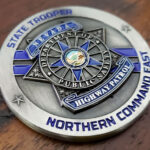
Flags are the most requested subject on a challenge coin and the hardest one to get right, because almost everything that makes a flag recognizable is too small to survive at coin size. This Nevada Highway Patrol coin handles it by layering: the Nevada state flag sits in front as the subject, the United States flag runs behind it as a background, and the whole reverse is executed in brushed raw metal rather than paint. The agency emblem takes the other side.
Two Flags on One Coin Face
Putting two flags on the same face is not a matter of fitting them in. Flags are rectangles of flat color with hard edges, which means two of them side by side read as two competing blocks and neither one wins.
The fix is hierarchy, and it has to be decided before the artwork starts.
- One flag is the subject. It gets the detail, the foreground position and whatever color the coin is going to use. Here that is the Nevada flag, which is correct for an agency coin, because the state is what the agency belongs to.
- The other flag is the ground. It gets simplified, pushed behind, and rendered in one tone or in metal texture rather than in full color. Here that is the United States flag.
- They must be at different depths. If both sit at the same relief height the eye reads them as one confused rectangle. The foreground flag needs to be visibly raised above the background one.
A useful test at proof stage: look at the artwork scaled down to the actual diameter of the coin, not at full size on a monitor. If you cannot tell within a second which flag is the subject, the hierarchy is not strong enough yet.
Why Flags Are the Hardest Subject to Shrink
The reason flags are difficult is that their meaning lives in repeated elements, and repetition is the first thing lost when you reduce an image.
The United States flag is the clearest case. Fifty stars in a grid and thirteen alternating stripes. At coin size the stars stop being stars and become a texture, and narrow stripes crowd close enough together that the eye merges them. Push the detail smaller and the canton reads as a grey patch.
There are three ways out, and they are all honest ways rather than compromises.
Render it as a waving flag rather than a flat one. A flag with folds reads as a flag from its silhouette and its shadow. The viewer identifies it before counting anything, which means the star and stripe count no longer has to be legible.
Reduce the repeated elements deliberately. A field with a smaller number of larger stars reads as the canton, where fifty tiny ones read as noise. This is a normal and widely accepted practice on coins, pins and insignia.
Use it as a background and let it be texture. That is the choice on this coin. Once the US flag is behind the state flag, its job is to be identifiable as the flag, not to be countable, and the stripes become a directional pattern that the brushed finish reinforces.
Nevada’s Flag Is Unusually Coin-Friendly
Nevada drew a better hand than most states for this purpose, which is part of why the design works.
The flag is a solid cobalt blue field with its entire design in the upper left quarter: two sprays of sagebrush crossed into a half wreath, a five-pointed silver star pointing upward at the center, the word Nevada in golden yellow in an arc below the star, and a golden yellow scroll above the wreath reading Battle Born in black. Battle Born refers to Nevada entering the Union during the American Civil War, and the silver star to the Silver State.
Every one of those is a discrete object rather than a repeating pattern. A star, a wreath, a scroll and a word. Discrete objects reduce well, because the eye recognizes each one on its own and nothing depends on counting. That is the opposite of stars and stripes, and it is why the state flag belongs in the foreground on this coin and the national flag behind it.
Two practical notes if you are using a state flag on a coin. Use the current version, since several states have revised their flags in recent years and an out of date flag is the first thing someone will point out. And check the lettering, because a flag with a word on it puts the smallest element on the coin inside the most detailed area of the design, which is where the proof review needs to concentrate.
Brushed Metal Instead of Paint
The finished coin is brushed raw metal rather than a painted flag, and that decision does more for the design than color would have.
A brushed finish has a directional grain. On a flag, that grain reads as woven fabric, so the flag looks like cloth instead of looking like a printed rectangle. Paint would have given the correct colors and a flat, plastic surface. Metal gives the wrong colors and the right material.
It also solves the layering problem for free. Two flags in full color on one face is four or five colors fighting in a small space. Two flags in the same metal, separated only by relief height and finish, have no color competition at all, so depth alone carries the hierarchy.
The trade-off is real and worth stating. A bare metal flag gives up the instant recognition that red, white and blue provides, so it relies entirely on the shapes being well drawn and the relief being deep enough to throw shadow. It is the more demanding option and the better-looking one. If you want to weigh finishes, see antique versus polished challenge coin finish.
The Agency on the Other Side
The front of the coin carries the Nevada Highway Patrol emblem, which is the right division of the two faces. The emblem identifies the agency, and the flags say what the agency serves.
The Nevada Highway Patrol traces back to the Nevada State Police of 1908, and the first Nevada state highway patrolman was hired on 23 June 1923 by the Nevada Highway Department, working under the Inspector of the Nevada State Police. By 1934 the force was three officers, based in Reno, Carson City and Las Vegas. The 1949 Legislature established the Nevada Highway Patrol as a division in its own right, it moved to the Department of Motor Vehicles in 1957, and since 2001 it has been a division of the Nevada Department of Public Safety. It is led by a Chief with the rank of Colonel, and its Deputy Chiefs each command a region.
This coin was ordered by troopers in one of those regional commands rather than by the agency centrally, which is the normal pattern for law enforcement coins and worth knowing if you are the one trying to get a coin made. See how police departments use challenge coins.
Design a Coin for Your Agency
Send your agency emblem or patch and tell us which flags you want and which one should lead. If you want flags rendered in bare metal rather than paint, say so early, because it changes how the relief is built.
Professional artwork is free with unlimited revisions, and nothing goes into production until you approve a digital proof. Standard production runs about 45 to 50 days after final artwork approval, rush production is available on many projects, and shipping within the continental United States is included. Embleholics is veteran-owned, SDVOSB and registered in SAM.gov. See more police challenge coins, a state trooper coin, or a state patrol communications coin.
Frequently Asked Questions
What is on the Nevada Highway Patrol challenge coin?
One side carries the Nevada Highway Patrol emblem and the other carries the Nevada state flag layered in front of the United States flag. The whole coin is finished in brushed raw metal rather than painted color, so the two flags are separated by relief height and surface texture instead of by color.
What does the Nevada state flag look like, and what does Battle Born mean?
The Nevada state flag is a solid cobalt blue field with its design in the upper left quarter: two crossed sprays of sagebrush forming a half wreath, a five-pointed silver star pointing upward, the word Nevada in golden yellow arcing below the star, and a golden yellow scroll above the wreath reading Battle Born in black. Battle Born refers to Nevada becoming a state during the American Civil War, and the silver star to Nevada as the Silver State.
Can the American flag be used on a challenge coin?
Yes, and it appears on a great many military, law enforcement and agency coins. The United States Flag Code discourages using the flag for advertising and printing it on items made to be used briefly and thrown away, but it is advisory rather than enforced, and a flag rendered as part of a design on a keepsake is widely accepted. We produce from the artwork a customer supplies and we do not give legal advice on flag use, so check your own agency or organization policy if you are unsure.
How do you put two flags on one coin?
By making one of them the subject and the other the background. The foreground flag gets the detail, the higher relief and any color being used, while the background flag is simplified and pushed behind it, often in plain metal. Two flags at the same relief height and the same level of detail read as one confused rectangle.
Why do stars and stripes not reproduce well at coin size?
Because their meaning depends on repetition, and repeated elements are the first thing lost when an image is reduced. Fifty small stars become a texture and narrow stripes merge into each other. The usual solutions are to show the flag waving so it is recognized by its silhouette, to use fewer and larger stars in the canton, or to use the flag as a background where it only needs to be identifiable rather than countable.
Is bare metal or painted color better for a flag on a coin?
Painted color gives instant recognition. Bare metal with a brushed finish gives the flag a woven, fabric-like surface and avoids several colors competing in a small space, which matters when more than one flag is on the same face. Metal is the more demanding option, because the design then depends entirely on well-drawn shapes and deep enough relief to cast shadow.
When was the Nevada Highway Patrol founded?
The agency traces back to the Nevada State Police of 1908, and the first Nevada state highway patrolman was hired on 23 June 1923 by the Nevada Highway Department under the Inspector of the Nevada State Police. The Nevada Highway Patrol was established as a division in its own right by the 1949 Legislature, and it has been a division of the Nevada Department of Public Safety since 2001.
Can a regional command or a group of troopers order their own coins?
Yes, and that is how most law enforcement coins are ordered. Coins are commonly commissioned by a command, a shift, a unit or a group of officers rather than by the agency centrally, which is why the minimum order quantity rather than a departmental budget is usually the deciding factor.
More Police Projects