
The Genesis Mission is a federally funded, multi-agency initiative designed to embed advanced artificial intelligence directly into the United States’ scientific, energy, defense, and national security infrastructure. Backed by federal appropriations and coordinated through the Department of Energy in partnership with other civilian and defense agencies, Genesis is structured to leverage national laboratories, high-performance computing resources, and approved private-sector partners to accelerate discovery at scale.
The intended effect is not limited to government research alone: by enabling continuous, AI-driven learning across domains like energy infrastructure, defense technology, space exploration, and advanced materials, Genesis aims to shorten the path from scientific insight to real-world deployment—reshaping how innovation moves across public institutions, the military, and industry alike.
Artificial intelligence has moved past the phase where it can be treated as a productivity tool or a software upgrade. For governments and militaries, AI is rapidly becoming strategic infrastructure—as consequential as energy systems, logistics networks, or communications platforms. The Genesis Mission makes that shift explicit.
This is not about deploying a single model or automating isolated tasks. It is about building systems that can learn continuously, adapt rapidly, and operate at national scale—while remaining accountable to human intent.
In that sense, Genesis is less a reaction to a problem and more an acknowledgment of reality: the race toward AI-enabled capability is already underway, and speed—paired with trust—now determines advantage.
Acceleration Is the Point—and the Mechanisms Matter
Genesis is not simply “AI helping researchers work faster.” It is built around specific mechanisms that represent the leading edge of applied AI research today.
At the center are scientific foundation models—large, general-purpose AI systems trained on massive scientific datasets that can be adapted across domains such as materials science, energy modeling, climate analysis, propulsion, and defense-related research. These models are paired with AI agents capable of autonomously designing experiments, running simulations, analyzing results, and refining hypotheses without waiting for human-in-the-loop at every step.
When integrated with autonomous laboratories and high-fidelity simulation environments, this creates a continuous learning loop: models propose, test, learn, and improve at a pace no traditional research pipeline can match. Genesis is designed to connect these capabilities across national laboratories, government agencies, and approved private-sector partners.
The result is not just faster research—it is adaptive capability, where insights propagate across institutions in near real time.
AI Changes the Pace of Power
When learning accelerates, power compounds. This is why AI is now central to national competition.
In defense and national security contexts, accelerated discovery translates directly into:
- Shorter development cycles for advanced systems
- Faster adaptation to emerging threats
- Improved modeling of complex, contested environments
- Reduced lag between scientific breakthroughs and operational use

The same dynamic applies to energy infrastructure, where AI-assisted modeling enables better prediction of cascading failures, faster response to cyber or physical threats, and more resilient grid design.
Genesis reflects an understanding that the decisive advantage is no longer static superiority, but learning speed—the ability to absorb new information, update models, and adjust behavior faster than competitors.
Continuous Learning Requires Guardrails, Not Blind Faith
Acceleration without control is not progress—it’s risk. One of the most important aspects of the Genesis Mission is its emphasis on trustworthy AI, not just powerful AI. And this all happens on the back of human control and human input.
In defense and public-sector practice, “human-aligned AI” does not mean abstract ethics statements. It means systems that are:
- Auditable: decisions and recommendations can be traced and reviewed
- Evaluated: performance is tested against real-world conditions, not just benchmarks
- Robust: models can withstand adversarial manipulation and degraded data
- Accountable: humans remain responsible for outcomes, even when AI assists
This reflects current Department of Defense doctrine, which treats AI as a decision-support system, not a decision-maker. AI can inform, recommend, and simulate—but responsibility does not get delegated to a model.
Genesis is built around that assumption: AI must accelerate human judgment, not replace it. This happens by using the AI to increase your processing power. AI can parse through mountains of data and decide what’s going to be most actionable, presenting that to the user faster.
The Reality of AI in Adversarial Environments
One thing serious defense practitioners understand is that AI does not operate in a neutral environment. Models can be attacked. Data can be poisoned. Systems can fail in unexpected ways under stress.
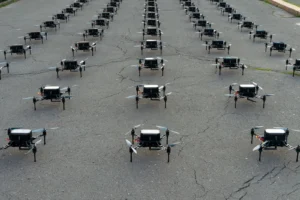
This is why modern defense AI research places heavy emphasis on robustness, red-teaming, and operational testing. Programs like DARPA’s efforts in AI security exist because battlefield and national-security AI systems will be probed, manipulated, and exploited if weaknesses exist.
Genesis operates in that same reality. Its value depends not just on intelligence, but on resilience under adversarial pressure. Trust in AI systems—especially those influencing national security or energy infrastructure—must be earned through rigorous testing, documentation, and validation.
And again, human input has a role here. AI systems are vulnerable to attack, whether thhat be cyberattack or facilites—so human oversight and input needs to be considered at all levels. An AI system will most likely not be as bold as human input, and as General Patton said, “War is an art and as such is not susceptible of explanation by fixed formula.”
There is no substitute for human boldness and ingenuity—the real benefit to AI is speed. Speed matters, but it’s only helpful if you’re speeding in the right direction.
From Research to Reality: AI Is Already Being Operationalized
Genesis does not exist in isolation. It feeds directly into a broader shift already underway across the U.S. military and defense ecosystem.
AI-assisted operational planning tools are moving from experimental pilots into real command workflows. Autonomous and semi-autonomous systems are being developed at scale, with human oversight baked into their design. Programs exploring collaborative human–machine teaming—such as uncrewed aircraft supporting crewed platforms—are transitioning from concept to capability.
What ties these efforts together is the same principle underlying Genesis: continuous learning paired with human control. Research acceleration at the national level enables faster iteration and deployment at the operational level.
Genesis is the upstream engine that makes downstream capability possible.
Leadership in a Compressed-Time Environment
AI-driven acceleration doesn’t just change technology—it changes leadership demands. When discovery cycles compress and feedback loops tighten, leaders can no longer rely on slow deliberation or rigid planning models. It will actually speed up the OODA loop, which is how we respond to input during times of stress. Observe, orient, decide, and then act. Observation and orientation may become much quicker.
Effective leadership in AI-enabled environments requires:
- Comfort making decisions under uncertainty
- Willingness to integrate AI insights without deferring responsibility
- Clear articulation of intent and boundaries
- Continuous reassessment as systems learn and evolve
Genesis implicitly acknowledges this shift. AI increases the tempo of decision-making, which makes clarity of purpose more important, not less.
AI Still Runs on Humans
For all its capability, AI does not define goals, values, or priorities. Humans do. Genesis is ultimately about how people work with intelligent systems, not about removing people from the loop.

Continuous learning systems magnify intent. If that intent is well-defined, aligned, and disciplined, AI becomes a force multiplier. If it isn’t, AI simply accelerates confusion.
Genesis places a stake in the ground: the future of national capability depends on human-guided intelligence, not autonomous ambition.
Marking the Moment
Major shifts in national capability tend to create moments that endure beyond the technology itself. Genesis represents one of those moments—a transition in how the United States approaches discovery, defense, and resilience in an AI-driven world.
For teams working inside government, the military, or advanced technology sectors, participation in initiatives like this carries meaning beyond the code, the models, or the research outputs.
That’s where something as simple—and intentional—as a challenge coin still has relevance. Not as nostalgia, and not as decoration, but as a way to mark contribution at pivotal moments—when capability, responsibility, and human judgment converge.
Embleholics helps teams commemorate meaningful work with purpose-built challenge coins and mission insignia—designed for moments that matter. If you’re part of an AI-driven mission in government, defense, or advanced technology, and want more information about creating a challenge coin for your mission, please contact us.
Because some milestones deserve more than a release note.
Recent Posts