The Legacy of Project Paperclip
In the ashes of World War II, as the dust settled over a battered Europe, another battle quietly began—one for technological dominance. This new frontier wasn’t defined by soldiers on the ground, but by scientists, engineers, and the innovations they would bring.
Project Paperclip was the United States’ covert initiative to recruit top German scientific minds before the Soviets could.
More than 1,600 former German scientists and technicians—many of whom worked on advanced weapons systems and rocketry—were quietly brought to the U.S. Their arrival wasn’t broadcast. Their backgrounds were often concealed. But their impact? That would roar through the next five decades.
From missile systems to aeronautics and early space exploration, these minds reshaped the direction of American defense. What began as a classified operation would become a foundation for the U.S. military’s cutting-edge capabilities—turning America into a strategic juggernaut during the Cold War.
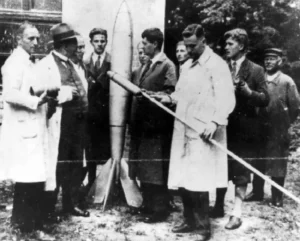
A group of German scientists and engineers involved in early rocket experimentation. Courtesy: NASA / MSFC.
Quiet Science, Loud Impact
Though Project Paperclip remained classified for years, its contributions echoed loudly through American military and technological infrastructure. The imported knowledge didn’t stay in laboratories—it reshaped battlefield capabilities, elevated research priorities, and drove long-term innovation across the armed forces.
Among the most notable figures was Wernher von Braun, a leading mind behind Germany’s V-2 rocket program. Under Paperclip, von Braun transitioned into a pivotal role within the U.S. Army Ballistic Missile Agency and, later, NASA. He helped design the Saturn V rocket, a breakthrough that enabled the U.S. to win the space race.
But von Braun was only one piece of a larger force.
Dozens of other Paperclip recruits contributed to the development of:
- Ballistic missile guidance systems
- Advanced jet propulsion
- Nuclear weapons and chemical defense
- Radar and electronic surveillance technologies
These weren’t academic projects—they were the bedrock of Cold War deterrence. With Soviet influence rising, the U.S. needed immediate technological superiority. Paperclip offered a shortcut, turning yesterday’s adversaries into tomorrow’s architects of defense.
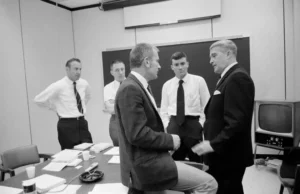
Dr. Wernher von Braun (right) speaks with Dr. Donald Slayton during an Apollo 13 postflight debrief. At the time, von Braun was NASA’s deputy for planning. Courtesy: NASA.
How Paperclip Fueled America’s Military Ascent
The strategic brilliance of Project Paperclip was not simply in acquiring foreign expertise—but in embedding it at the core of America’s military-industrial ecosystem. These scientists weren’t sidelined. They were empowered, placed into defense programs, and given the resources to build.
Their influence stretched across:
- Post-WWII operations modernization: Projects like the Redstone missile and the Atlas ICBM directly benefitted from Paperclip-era breakthroughs.
- Air Force innovation hubs: At places like Wright-Patterson Air Force Base, imported scientists helped build next-gen aircraft and navigation systems.
- Cold War readiness: Early-warning radar arrays, secure communication platforms, and surveillance technologies gained a massive leap forward.
Through these efforts, Paperclip didn’t just support military innovation—it accelerated it, giving the U.S. a crucial edge against the Soviet Union. With tensions high and the arms race in full swing, the contributions of Paperclip scientists often meant the difference between leading and lagging.
Strategic Success, Historical Silence
Despite its monumental contributions, Project Paperclip operated in the shadows for decades. Public awareness was minimal, and official acknowledgement didn’t surface until documents were declassified in the 1970s.
This was no accident. The secrecy was part of the strategy. By minimizing public scrutiny, the government could focus on integration and execution, rather than defending the program’s origins. And while ethical discussions would emerge much later, within military and strategic circles, the verdict was clear: Paperclip worked.
The program allowed the U.S. to:
- Leapfrog Soviet capabilities in missiles and space technology
- Build domestic expertise by pairing foreign scientists with American engineers
- Establish R&D pipelines that continue to serve national defense today
Without Project Paperclip, key moments—like the launch of Explorer 1, the development of ICBMs, or the Apollo 11 mission—might have been delayed or never realized.
The Ongoing Influence of Paperclip-Era Innovation
The effects of Project Paperclip didn’t end in the 1960s. Many of the foundational technologies developed by Paperclip scientists evolved into critical systems used throughout the 20th and 21st centuries. Their early work in rocketry, flight dynamics, and secure communications set the stage for:
- Precision-guided munitions
- Global positioning systems (GPS)
- Hypersonic research
- Cyber-defense architecture
In fact, many modern military innovations owe their roots to Paperclip-era developments. The infrastructure built during that time continues to support research programs today, including space defense, missile defense, and high-altitude intelligence gathering.
Military superiority isn’t static—it’s built layer by layer, generation after generation. And Project Paperclip represents a foundational layer in America’s ascent as a global power.
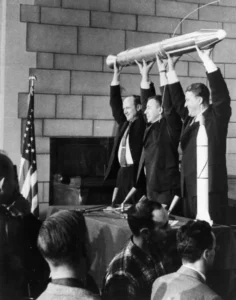
Dr. William H. Pickering, Dr. James A. van Allen, and Dr. Wernher von Braun hold up a model of the Explorer 1 satellite. Courtesy: NASA.
What Project Paperclip Teaches Us About Leadership and Vision
Strategically, Paperclip was more than an intelligence win—it was a masterclass in long-term vision. U.S. leaders understood that dominance wouldn’t come through manpower alone—it required unmatched scientific and technological superiority.
Paperclip demonstrates how calculated risks and bold decisions can shift the trajectory of history. It underscores the importance of investing in knowledge, empowering experts, and recognizing opportunity in unexpected places.
Today’s defense challenges may be digital and unmanned—but the blueprint for innovation under pressure was written decades ago by the quiet force behind Project Paperclip.
Every Coin Tells a Story—Even the Silent Ones
At Embleholics, we believe stories like these matter. They remind us that history isn’t just made on the battlefield—it’s forged in labs, decisions, and quiet breakthroughs that shape the world.
Project Paperclip may have flown under the radar, but its legacy is monumental. And for organizations that carry legacies of service, excellence, and transformation, we craft coins that speak volumes.
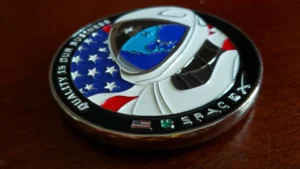
Want to honor your story with precision and pride?
Let’s build a coin that represents your mission—boldly, strategically, and with lasting impact.
Until Next Time.
Recent Posts