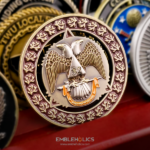
A council or grand body challenge coin represents a governing organisation that oversees subordinate lodges or bodies across a whole jurisdiction, rather than a single lodge. The design carries the jurisdiction’s emblems and authority, and the coin is usually tied to an annual session or to a presiding officer’s term.
What Is a Council of Deliberation?
A Council of Deliberation is a governing body within Scottish Rite Freemasonry that operates above the level of the individual subordinate bodies in its jurisdiction. Its role is administrative and coordinating: it convenes the bodies under its authority, holds an annual session, and supports the officers who lead those bodies.
It sits within a larger structure. Subordinate bodies answer to the council, and the council answers in turn to the supreme council of its jurisdiction. That chain is the reason a council coin looks and functions differently from a lodge coin, which is the subject of the rest of this page.
The same tier exists across almost every fraternal organisation under different names: grand lodges, state councils, grand chapters, national governing bodies, supreme councils. What follows applies to any of them.
How Governing Body Coins Differ From Lodge Coins
They represent a jurisdiction, not a building. A lodge coin can lean on a lodge name, a lodge number, a founding date and a building that members meet in every month. A council has none of that. Its identity is the territory it covers and the authority it holds, so the design has to do the work with emblems, heraldry and titles instead of with a number on a door.
They are usually tied to an annual session. Most governing bodies meet once a year, and the session is the occasion the coin is made for. That gives the coin a date on it, which turns it into a series. Members who attend every year end up with a run of them, and a coin that is part of a run gets kept rather than spent. It also means the order has a hard deadline, because a session coin that arrives after the session is worthless.
They are frequently associated with an officer’s term. A presiding officer who serves a fixed term often issues a coin for it, and the next officer issues their own. This is the same pattern as an elected sheriff or a commanding officer, and it produces the same result: a predictable reorder cycle, and a strong argument for putting the office and the jurisdiction on the coin rather than making it entirely about one person.
They travel further than a lodge coin. A lodge coin circulates inside one membership in one town. A council coin goes to officers of subordinate bodies spread across an entire state or region, and to visiting officers from other jurisdictions at the annual session. It gets seen by more people who are not members, and by more people who are qualified to judge whether it was done properly. That raises the standard, and it is why this tier tends toward formal designs rather than novelty ones.
Quantity works differently too. A lodge orders for its own members. A council is ordering for the officers of every body it oversees, plus visitors, plus a reserve for the year ahead, which usually puts the order comfortably above the 50-coin minimum.
For the level below this one, see how lodge challenge coins are handled, and for the wider set see our Masonic and fraternal challenge coins. The same governing-body pattern appears outside Freemasonry in coins for state lodges and associations.
What Goes on a Council or Grand Body Coin?
Jurisdiction emblems. The device that identifies the governing body itself, which is usually the single largest element and usually placed on the reverse.
Heraldic devices. Eagles, crowns, crosses, shields and stars appear throughout this tier of organisation, generally rendered in relief rather than filled with colour.
Banners and legends. A raised banner carrying a short line of text, set beneath or across the central device. The text is typically the body’s name, its motto or its jurisdiction.
Session years and terms. The year of the annual session, or the years of a presiding officer’s term, often set around the rim or beneath the main device.
Officer titles and the body’s full styling. Governing bodies generally use their complete formal name rather than an abbreviation, which means the design has to accommodate a long piece of text without crowding the centre.
Formal finishes. Antique gold, antique silver and two-tone metal dominate. Bright enamel is far less common at this tier than it is on lodge coins, and the restraint is a convention rather than a limitation.
One practical note on all of the above: this tier of design tends to be text-heavy, and text is what fails first when a coin is struck too small. A council coin carrying a full formal name, a jurisdiction, a session year and a motto usually needs 1.75 inches at minimum, and 2 inches is a safer choice.
About This Council of Deliberation Coin
The Russell L. Parks Council of Deliberation is a governing body within Prince Hall Scottish Rite Freemasonry, operating in Texas under the authority of the United Supreme Council, 33°, Ancient and Accepted Scottish Rite of Freemasonry, Prince Hall Affiliation, Southern Jurisdiction, USA.
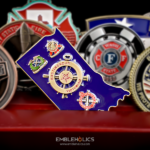
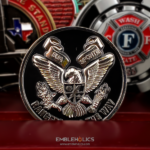
The coin is a formal design with no unusual shape, no cut-outs and no novelty features. The insignia are struck in relief, the legends carry graphical patterning, and the rim is left clean. An eagle sits in relief above a small banner carrying lettering, and a geometric jurisdiction emblem appears as a separate device.
The element worth looking at closely is that geometric emblem. It is built from thin lines, and every one of them had to be cut to the same width and the same depth. That sounds like a small thing and it is the hardest part of the piece. A geometric device with lines of uneven weight stops looking like an emblem and starts looking like a sketch, because the eye reads the variation as a wobble in the drawing rather than as an effect of the strike. Getting them uniform is what keeps the device authoritative at coin scale, and it is the difference between an emblem and a decoration. The same problem, solved the same way, appears on fine detail on a coin in a completely different industry.
The layout works for a reason that is easy to miss. Every element is given its own space, nothing overlaps, and the clean rim closes the composition without adding another pattern to compete with the emblem. On a coin carrying this much text and this much relief, space is the design decision.
Can We Use Our Organisation’s Emblem on a Coin?
Most organisations can, but the authorisation has to come from the organisation, not from us. Emblems, seals, degrees and jurisdictional devices are controlled by the bodies that own them, and in fraternal organisations the rules are usually set several tiers above the group placing the order.
The practical version is straightforward. Clear the artwork through your own governing body before you order, and send us artwork your organisation is authorised to supply. We produce from what the customer provides and we do not grant permission on anyone’s behalf. If you are unsure who signs off, your supreme or grand body is the right place to ask.
Design a Coin for Your Council or Lodge
Professional artwork is free, with unlimited revisions, and nothing goes into production until you approve a digital proof. You do not need finished artwork to start. A photograph of an existing coin, a scan of a certificate or a description of the emblem is enough to work from.
If the coin is for an annual session, say the date at the first contact. Standard production runs about 45 to 50 days after final artwork approval, rush production is available on many projects, and a session date is fixed in a way that most deadlines are not. The minimum order is 50 coins, shipping within the continental United States is included, and Embleholics is veteran-owned, SDVOSB and registered in SAM.gov. Request a free quote to get started.
Artwork
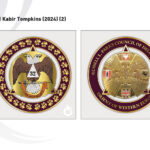
Russell L. Parks Council of Deliberation Artwork
Frequently Asked Questions
What is a Council of Deliberation?
A Council of Deliberation is a governing body within Scottish Rite Freemasonry that oversees the subordinate bodies in its jurisdiction. It convenes those bodies, holds an annual session and supports their officers, and it answers in turn to the supreme council of its jurisdiction.
What is the difference between a lodge coin and a council coin?
A lodge coin represents a single lodge and usually carries its name, number and founding date. A council coin represents a governing body that oversees many subordinate bodies across a jurisdiction, so it carries jurisdiction emblems, formal titles and often a session year instead of a lodge number.
Who orders challenge coins for a grand body?
Grand body coins are usually ordered by the presiding officer or the session committee, rather than by individual members. The order typically covers officers of every subordinate body in the jurisdiction, visiting officers from other jurisdictions, and a reserve for the year ahead.
What goes on a Scottish Rite challenge coin?
A Scottish Rite challenge coin usually carries the body’s jurisdiction emblem, a heraldic device such as an eagle, a banner with the organisation’s name or motto, and the year of the session or officer term. Antique gold, antique silver and two-tone metal are the most common finishes at this tier.
Can a coin be made for an annual session or convention?
Yes, and session coins are one of the most common fraternal orders. Standard production runs about 45 to 50 days after final artwork approval, so the session date should be raised at first contact. Rush production is available on many projects when the date is tight.
Can fine geometric emblems be reproduced on a coin?
Yes. Geometric emblems reproduce well provided every line is cut to the same width and depth, which is what stops the device looking hand-drawn once it is struck in metal. Fine geometric work generally needs a coin of at least 1.75 inches to hold its precision.
Can we use our organisation’s emblem on a coin?
Fraternal emblems and jurisdictional devices are controlled by the bodies that own them, so permission has to come from your organisation rather than from a manufacturer. Clear the artwork through your governing body and send us artwork your organisation is authorised to supply.
What is the minimum order for council coins?
The minimum order for custom challenge coins is 50 coins. Governing body orders usually sit well above that, because they cover the officers of every subordinate body in the jurisdiction plus visitors and a reserve, and larger quantities reduce the cost per coin.
More Army Projects